


I had heard two versions of Peekamoose Blue Hole. In one, it is a Catskills miracle: clear water in a smooth rock bowl, the kind of place that makes you forget your phone exists. In the other, it is a cautionary tale: people drive up from the city, get to Route 42, discover the lot is permit-only, and spend their Saturday doing a slow, humiliating U-turn while a Tow Away Zone sign does the scolding.
What’s Different Now: The Permit System That Decides Your Day
Peekamoose Blue Hole sits in the Sundown Wild Forest within the Catskill Forest Preserve, and the New York State Department of Environmental Conservation treats it like a fragile, high-demand day-use area. The headline rule is simple but unforgiving: in peak season, you need a paid, vehicle-linked permit to use the Peekamoose Valley Riparian Corridor, which includes the Blue Hole.
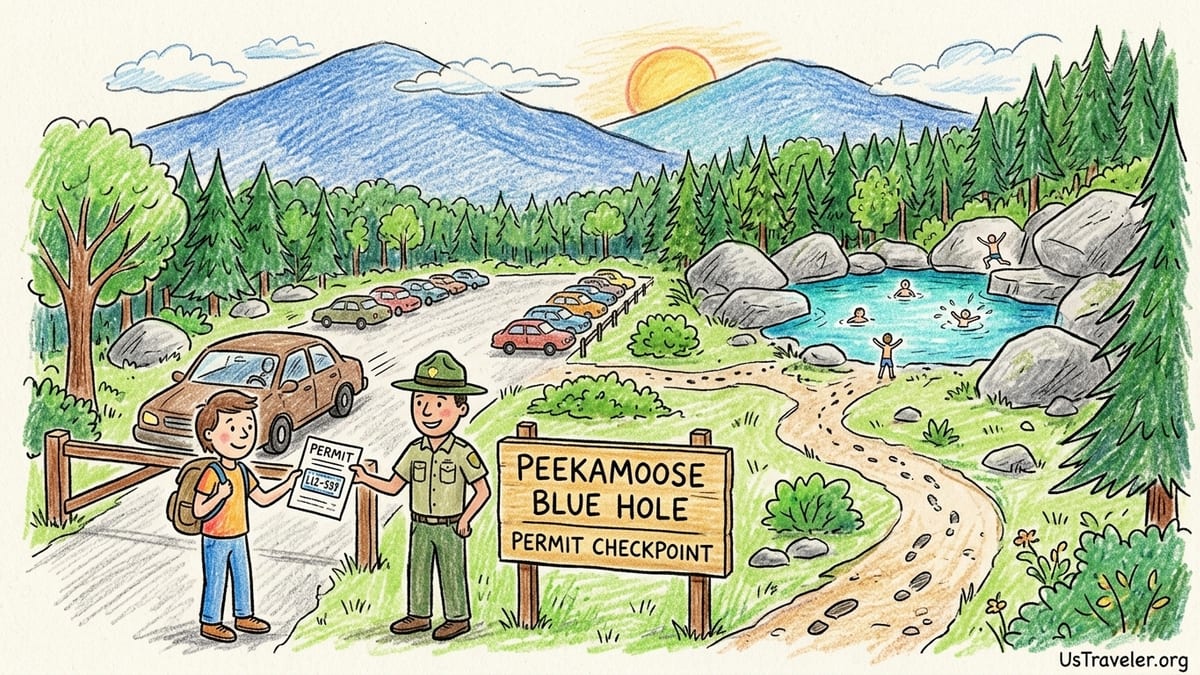
According to DEC’s current public guidance, the permit costs $10 and is required between May 15 and September 15. The permit is linked to one vehicle and capped at five people total, and children count toward that five-person maximum. The permit is checked at the entry to the designated lot, meaning the permit is not a nice-to-have, it is what allows your car to enter the only day-use parking area.
The other detail that shapes everything is the timing rule: permits are intended to be reserved in advance, and DEC’s published rules emphasize that you should not expect to show up and sort it out on-site. In practical terms, the trip begins at your keyboard, not at the trailhead.
How I Booked: Timing It So the Website Didn’t Beat Me
I planned my visit around the booking window, because the window is the trap that catches most first-timers. The system is designed so you cannot treat Peekamoose like a casual, last-minute swim stop. I picked a day, then backed into my timeline: I wanted the flexibility to adjust plans, but I also did not want to wake up to a sold-out calendar.
My approach was to choose a target visit date first, then set a reminder to reserve as soon as the booking rules allowed. I also made a decision early to consolidate into one vehicle. The permit is vehicle-linked and occupancy-limited, so splitting into two cars usually means buying two permits and gambling that two permits will even be available for the same day and time.
Before paying, I double-checked three details that matter at the gate: the date, the vehicle information, and the headcount. This permit is not like a general park admission where you can casually change the plan in the parking lot. If you show up with the wrong plate, the wrong day, or six people when the cap is five, you are relying on luck and leniency, and those are not part of the official system.
I also saved the permit in two places: a screenshot on my phone and a printed copy in the glovebox. Cell service in the Catskills can be uneven, and there is nothing worse than having paid $10 and then standing at a checkpoint trying to load an email that will not open.
Arrival Day: The Permit Check and the Parking Reality on Route 42
I arrived earlier than I normally would for a swimming hole, because the parking lot is the choke point. DEC’s own language makes it clear that parking is extremely limited and that roadside parking on the corridor is prohibited and enforced. In plain terms: the “I’ll just squeeze onto the shoulder” approach is exactly what the rules are designed to stop.
The day-use parking is concentrated into one designated lot, described by DEC as a 60-car lot that provides access to the Blue Hole and nearby trails. That lot is where your permit matters. If you do not have a valid permit, you cannot count on entering the lot, and there is no legal backup plan that involves leaving your car along the road.
At the lot entrance, I encountered what I expected: a permit check before being waved in. This is where being organized actually pays off. I had my permit ready and did not have to dig through email threads with sweaty hands while cars queued behind me.
Once inside, I followed posted directions and parked only in a marked space. DEC specifically instructs visitors to follow the one-way directional signs and use designated parking spots. It is not the place to invent your own “spot” at the edge of the lot, even if it looks harmless.
The Walk In: The 0.6-Mile Reality Check (And Why Footwear Matters)
From the lot, DEC directs visitors to follow a 0.6-mile trail to reach Peekamoose Blue Hole. On paper that sounds like a quick stroll. In practice, it is long enough that you should pack and dress like you are actually going somewhere, not like you are walking from a beach parking lot to a boardwalk.
I wore trail shoes rather than flip-flops, and I was glad I did. Even when the distance is short, the Catskills can make you pay attention. A half mile becomes a problem if you are carrying too much, wearing slick sandals, or trying to balance a bulky picnic setup that the rules may not even allow.
DEC also advises visitors to avoid walking on the road for safety. That matters because the corridor is narrow, the driving can be brisk, and the temptation to “shortcut” along Route 42 is real if you are trying to save a minute. The trail exists for a reason, and on a busy day, it feels like the only sane option.
I treated the walk like a filter: if someone in your group cannot comfortably do 0.6 miles in, plus 0.6 miles out, with whatever you carry, it is better to know that in advance than to find out after you have passed the permit checkpoint.
At the Water: Temperature, Crowd Level, And Whether It Felt Worth It
The water was exactly what people warn you about: cold, even on a warm day. Catskills swimming holes have a particular kind of shock, the kind that turns your first steps into a gasp-laugh and makes you question your decision-making for about 15 seconds. Then your body adjusts, and you remember why you came.
Crowd level is the biggest variable, and the permit system is clearly designed to keep the worst weekend chaos from overwhelming the place. Even with permits, I did not have the Blue Hole to myself, but it felt more controlled than the horror stories that circulate online. There was the usual mix: small friend groups, families trying to keep kids from slipping on wet rock, and a few confident jumpers scanning for the perfect entry point.
I did not try to treat the Blue Hole like an all-day beach. The setting rewards a simpler plan: arrive, cool off, eat a small snack, and leave before the day feels crowded or the rocks feel like a waiting room. In that sense, the permit process did not feel like a burden as much as an acknowledgment: this is a small place with a big reputation.
Did swimming justify the planning? For me, yes, but with an asterisk. The swim itself is short-lived joy, not an extended resort day. The planning is worth it if what you want is a cold-water dip in a beautiful Catskills corridor and you are willing to be flexible about timing. If what you want is a guaranteed private swimming session or a picnic-heavy day, the regulations and the popularity will make this the wrong target.
Facilities, What I Brought, And The Regulations That Surprised Me
Peekamoose is not a developed beach. DEC describes it as a carry in, carry out facility, and during summer months it typically provides portable toilets and a dumpster between Memorial Day and Labor Day. That is helpful, but it is not the same as having running water, changing rooms, or a staffed concession stand. I packed as if I would not be able to buy or borrow anything.
What I brought was intentionally minimal: a small daypack, a refillable water bottle, snacks that would not melt into a disaster, a lightweight microfiber towel, and a basic first-aid kit. I also packed a trash bag. Even when a dumpster is present, it is smart to assume you may have to carry your own waste back out if things are full or messy.
The most surprising regulations were the ones that effectively ban “beach day” behavior. DEC lists a series of prohibitions at the Blue Hole area, including alcohol and glass containers. It also prohibits radios and other audio devices, and it restricts cooler size, with coolers larger than 12 inches in any dimension prohibited. That last one is the rule that would catch a lot of casual visitors, because a typical hard-sided cooler for a group can exceed 12 inches without anyone thinking twice.
Another rule that changes how you plan is the ban on fires and cooking setups. DEC prohibits all fires and specifically includes charcoal fires, wood fires, gas grills, propane stoves, or other portable stoves in the prohibited list for the Blue Hole area, with limited use allowed only at a nearby designated camping area. If your day-out vision includes grilling or a stove-top lunch, this is not the right venue.
Finally, I planned my timing around the stated open hours: the corridor is open from a half hour before sunrise to a half hour after sunset, except for the nearby designated camping area. That matters because it sets a hard boundary, and it reinforces the general tone of the rules: this is a day-use natural area, not a party cove.
The Takeaway
The best way to think about Peekamoose Blue Hole is that the permit is the trip. The swim is the reward for respecting a system built around limited parking, fragile resources, and a location that got too famous for its own good. If you plan like a responsible visitor, the day is straightforward. If you plan like it is a random roadside pull-off, you are likely to be turned away or forced into an illegal parking decision that can end your day with a ticket or tow.
My practical advice is to treat the permit like you would treat a timed museum ticket in a major city: buy it correctly, save it offline, arrive early enough to handle small hiccups, and do not expect exceptions at the gate. Once you are past the checkpoint and walking the 0.6-mile trail, the stress drops away fast.
Would I do it again? Yes, but only with the same mindset. Pack light, follow the rules, keep the group to one vehicle, and aim for a calm, early visit. The Blue Hole is still beautiful, still bracingly cold, and still worth it, but only for travelers who accept that access is intentionally controlled.
FAQ
Q1. Do I need a permit to visit Peekamoose Blue Hole?
Yes. DEC requires a $10 permit for the Peekamoose Valley Riparian Corridor, including the Blue Hole, during the seasonal permit period.
Q2. When is the Peekamoose Blue Hole permit required?
DEC currently states the permit is required between May 15 and September 15.
Q3. How much does the permit cost, and what does it cover?
The permit costs $10 and is linked to one vehicle, with a maximum of five people per permit.
Q4. Do children count toward the five-person maximum?
Yes. ReserveAmerica’s facility details state that all children, regardless of age, count toward the five-person max.
Q5. Can I just show up and buy a permit on-site?
No. DEC’s system is designed for advance reservation, and the day-use lot requires a valid permit to enter.
Q6. Where do I park for Peekamoose Blue Hole?
Parking is limited to the designated day-use lot in the corridor. Roadside parking is prohibited and enforced as a tow-away zone.
Q7. How far is the walk from the parking lot to the Blue Hole?
DEC states it is a 0.6-mile walk from the lot to the Blue Hole.
Q8. Are there bathrooms at Peekamoose Blue Hole?
DEC states portable toilets and a dumpster are provided during summer months between Memorial Day and Labor Day, but the area is otherwise carry in, carry out.
Q9. What items are prohibited at the Blue Hole?
DEC lists prohibitions that include alcohol, glass containers, radios and other audio devices, and coolers larger than 12 inches in any dimension, among other restrictions.
Q10. Is Peekamoose Blue Hole open all day and night?
No. DEC states it is open from a half hour before sunrise to a half hour after sunset (with separate rules for the nearby designated camping area).