


The Catskills can feel like a geographic riddle from the driver’s seat: mountain ranges that block direct routes, creek valleys that pull you off course, and little towns that seem close on a map but take an hour of curving two-lanes to reach. The trip that finally made the region click for me wasn’t a single grand loop. It was three honest, drivable clusters I could tackle in chunks: (1) Woodstock to Phoenicia to Hunter and Tannersville, (2) Livingston Manor to Roscoe to Bethel, and (3) the Upper Delaware Scenic Byway on Route 97, where the road itself becomes the attraction. Combine two clusters for a long weekend, or stack all three for a multi-day drive where changing hotels actually reduces fatigue instead of creating pointless packing.
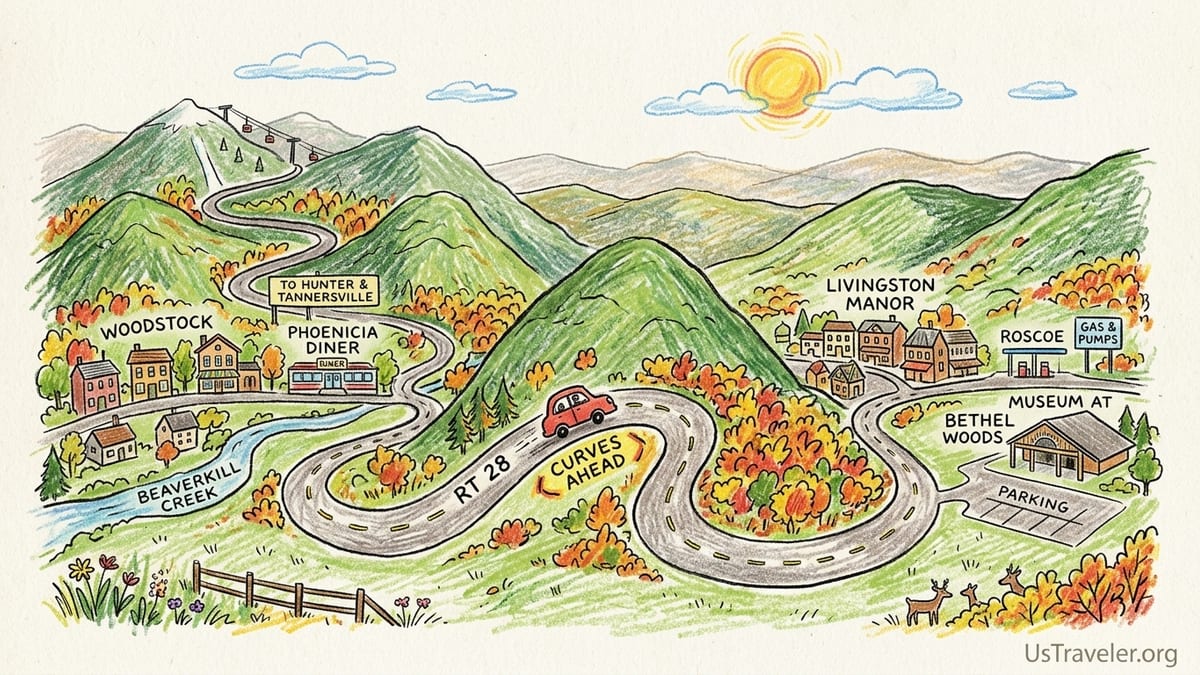
Start With A Base That Keeps You Off The Long Curves After Dark
If you try to “do the Catskills” from one hotel, you end up repeating the same mountain roads twice a day. That is the hidden tax here: not mileage, but curves, elevation changes, and the mental load of driving twisty roads after dinner when you are tired, it is raining, or your passenger’s phone has one bar. The fix is simple: pick a base that matches the cluster you are driving that day, then move your hotel only when it saves you a big backtrack.
On my first pass, staying too far east meant I kept crossing the same pinch points near the river and the same narrow stretches around popular trailheads. Once I treated the Catskills as connected valleys rather than a circle, the region made sense. Two nights near Woodstock or Phoenicia works for the Route 28 and Route 23A corridor. Two nights near Livingston Manor works for the Beaverkill and Willowemoc valleys, Roscoe, and Bethel. And if you want the Upper Delaware, it is its own overnight unless you enjoy two hours of night driving on a river road with spotty reception.
Practical note: driving fatigue in the Catskills tends to spike late afternoon, not late night. That is when day-trippers are leaving trailheads, the sun starts dropping behind ridgelines, and you are more likely to get stuck behind a slow RV on a no-passing stretch. Plan your “hard driving” segments for morning, then park the car for the afternoon and evening in whatever town you are sleeping in.
Cluster 1: Woodstock To Phoenicia To Hunter And Tannersville (Route 28 + Mountain Curves)
This is the Catskills’ most intuitive first cluster because it follows the grain of the land. Once you point the car up Route 28 toward Phoenicia, you are in a creek valley and the road behaves like one: it narrows, bends constantly, and keeps you honest with speed. In good weather it is relaxing. In rain or leaf season it can be tiring, because wet leaves on shaded curves are a real thing here.
Woodstock works well as a “start line” because you can arrive from the Hudson Valley and immediately be on foot for a bit. Then you drive north toward Phoenicia for food and a reset. The Phoenicia Diner is an easy anchor because it is straightforward for timing: it opens at 8 a.m., closes at 6 p.m., and operates first come, first served with no reservations. If you want one tangible reason to do this cluster early in the day, it is parking and traffic. The diner’s popularity and the general Route 28 flow mean the same five-mile segment can feel calm at 9 a.m. and strangely stressful by 1 p.m.
What to order when you are actually driving: something that won’t put you into a food coma before the curves. The diner’s current menu pricing makes that choice feel real. A soup can run about $7 to $10, while bigger mains like a breakfast skillet can land around $18 and a sandwich can be around $19. If you are trying to keep the day moving, split something, hydrate, and save the heavier meal for after you are parked for the night.
From Phoenicia, you have two classic Catskills decisions: stay in the valley (easy on the nerves) or climb toward the ski towns (harder driving, bigger views). Hunter and Tannersville are the logical next step, but the drive is what you are signing up for. Expect sharper curves, steeper grades, and pockets where your music drops because cell service can be inconsistent in the folds of the mountains. The payoff is that the landscape looks more “Catskills” with each switchback: tighter ravines, wider forested slopes, and sudden open vistas where you realize how much elevation you gained.
Road Reality On Route 28: Fuel, Shoulders, Parking, And The “Stop Now Or Regret It” Rule
Route 28 is not a remote expedition, but it is the kind of road where you should not treat fuel like an afterthought. Stations exist, but you do not want to be hunting for one with a low tank while stuck in weekend traffic. In the Shandaken area, local municipal listings include a Valero country store and gas station, a reminder that in the Catskills the most reliable stop is often a simple pump-and-store rather than a big brand complex.
Road surface changes are part of the story. You will move between smooth state-maintained pavement, patched segments, and occasional rougher sections near pull-offs or where winter has chewed the edge. The shoulder can be narrow, and not every “pretty spot” is safe to stop. When you see a proper pull-off with room for your car to be fully out of the lane, take it if you want a photo. If you assume there will be another in two minutes, you may end up driving ten miles of no-shoulder curves.
Parking is a trip-planning factor in the Catskills, not a footnote. When you are doing Woodstock and Phoenicia as a morning, then heading toward Hunter or Tannersville, you are effectively in the same flow as every day-tripper. That means you should decide ahead of time what you are parking for. A quick walk and coffee? Park once. A long sit-down lunch? Park once. If you keep hopping, you will waste your best daylight re-parking and re-merging into Route 28 traffic.
Cell service is not guaranteed in the mountain folds, so download maps before you leave Woodstock or Kingston. Also, do not rely on streaming for navigation voice prompts. A dropped signal at the wrong moment tends to happen exactly when the road forks, you are mid-curve, and there is a line of cars behind you.
Cluster 2: Livingston Manor To Roscoe To Bethel (Beaverkill And Willowemoc Valleys Without Overdriving)
This western Catskills cluster is where the region stops feeling like a weekend playground and starts feeling like a real place with working rivers, small businesses, and distances that add up. Livingston Manor is a great base because it is close to the Willowemoc Creek valley, and it lets you do Roscoe and Bethel without returning to the Route 28 corridor every night.
A grounding stop here is the Catskill Fly Fishing Center and Museum, which sits on a 53-acre campus. For planning, the practical details matter: the museum and gallery are open Friday through Monday from 10 a.m. to 4 p.m. (April through December), admission is $12 per person, and the grounds and trails are open daily from sunrise to sunset without admission. That means you can park, walk, decompress, and still keep your driving day reasonable even if you arrive outside building hours.
From Livingston Manor, Roscoe is the kind of place you use for logistics: fuel, ice, snacks, and a quick reset. The best road-trip detail I can give you is not a view, it is a verified pump. Sunoco currently lists two Roscoe locations with posted daily hours of 7 a.m. to 11 p.m., and Mobil lists a Roscoe station on Old Route 17 with hours that run 7 a.m. to 10 p.m. on Sundays and later on Fridays and Saturdays. That gives you a real window to top off before you push farther into the hills or commit to an evening drive.
Bethel is where this cluster becomes an experience rather than errands. The Museum at Bethel Woods is open daily April 1 through December 31 from 10 a.m. to 5 p.m., and adult admission is priced at $20 in advance (with a higher day-of price). It is a rare Catskills attraction where the road trip ends in a structured visit: you park, you walk, you learn, and your brain gets a break from scanning for deer at dusk. This is also a good place to remember that Bethel Woods is cashless, so you want a card or mobile payment ready before you get in line.
Hotel Strategy: Where Switching Bases Helps, And Where It Just Creates Packing
Changing hotels in the Catskills can be either brilliant or pointless. It is brilliant when it removes a repeated, high-effort driving segment. It is pointless when it saves you only 20 minutes but forces you to repack toiletries and recheck into a new place right when you could be walking around town. The key is to move only when you are switching valleys.
A practical split that consistently makes sense is two nights in the Route 28 corridor (Woodstock or Phoenicia) followed by two nights in the Livingston Manor corridor. That change lets you stop treating Roscoe and Bethel as “day trips” and instead makes them part of the natural flow of your drive. The first time I did this region from one base, I underestimated how draining it is to do mountain curves twice a day. Once I moved the hotel, the days got shorter even when the miles were similar.
Where moving is often not worth it: bouncing between Woodstock and Phoenicia. They are close enough that you can just pick one and commit. If your plan is morning coffee, mid-day driving, and evening dinner, you will gain more from unpacking once and learning one parking situation than you will from shaving a few minutes off a drive on a road that is already slow in peak periods.
If you add the Upper Delaware Scenic Byway, that is the moment a third base can make sense. The byway is a full day of attentive driving if you actually stop at overlooks and river towns. Doing it as an out-and-back from Livingston Manor or Woodstock can turn into the kind of late-day fatigue that makes you miss the point of being there.
Cluster 3: Upper Delaware Scenic Byway (Route 97), Hawk’s Nest Pull-Offs, And Poor Signal
The Upper Delaware Scenic Byway is one of the Catskills drives that feels like a destination in its own right, not just a route between towns. The National Park Service describes New York Scenic Route 97 as running parallel to the river and connecting Port Jervis and Hancock, effectively setting the frame for your day: you are driving a river corridor, not cutting across a mountain range.
The signature moment is Hawk’s Nest, a narrow, winding section of Route 97 high above the Delaware River valley. This is not a place to improvise. The National Park Service notes that parking at Hawk’s Nest is limited, with small narrow areas that generally fit only a few cars, and it specifically cautions drivers not to park on the shoulder. It also notes something that matters in real life: it is easier to park if you are driving southbound, because you can pull directly into the parallel spots rather than trying to cross a narrow lane of traffic on a curve.
Road texture here is different than the Catskills interior. Route 97 can feel like a ribbon pinned to cliffs, with repeated curves and fewer “reset” moments. If you are prone to motion sickness as a passenger, this is the stretch to sit up front and keep your eyes far ahead. It is also where you should not count on reliable cell service. Even county planning material in Sullivan County has explicitly flagged the Upper Delaware area as having cell coverage challenges, which matches the lived experience: you will have pockets of signal and pockets of nothing.
This is also where scenic pull-outs become part of your safety plan. If you feel yourself tensing up, take a legal pull-off, get out, and let your eyes rest. Hawk’s Nest is famous, but it is not the only place where a short stop improves your driving. A five-minute break can do more to prevent mistakes than another coffee.
The Takeaway
The Catskills finally make sense when you stop trying to “cover” them and start driving them like they are built: as valleys and corridors that reward focus. Do the Woodstock to Phoenicia to Hunter and Tannersville cluster when you want classic mountain roads and quick access to food and towns. Do the Livingston Manor to Roscoe to Bethel cluster when you want a western Catskills rhythm with real logistics, river culture, and a major museum day that breaks up driving fatigue. And save the Upper Delaware Scenic Byway for the day you want the road to be the main attraction, complete with narrow curves, limited parking at overlooks, and the kind of patchy signal that forces you to slow down and look out the window.
For fall travelers, the timing is not an afterthought. I LOVE NY’s current fall foliage reporting is issued weekly during the season and specifically calls out Catskills locations and road-trip drives, framing these routes as foliage-season experiences rather than just transportation. Build your trip around two clusters first, then add a third only if you have the stamina and daylight. In the Catskills, the best road trip is the one you finish without rushing the last hour.
FAQ
Q1. How many days do I need for a Catskills road trip that feels coherent?
Three days can work if you pick two clusters, but four to five days is ideal if you want to add the Upper Delaware Scenic Byway without rushing.
Q2. Should I try to drive one big loop to hit every Catskills town?
No. The Catskills reward cluster driving. A forced loop adds repetitive mountain curves and late-day fatigue without adding better experiences.
Q3. Where is a practical breakfast stop on the Woodstock to Phoenicia corridor?
Phoenicia Diner is a reliable anchor because it posts consistent hours, runs first come first served, and is directly on Route 28.
Q4. Are there real, late-hour fuel options near Roscoe?
Yes. Sunoco lists Roscoe locations with posted daily hours that run into the evening, which is helpful when you are returning from Bethel or driving after museum time.
Q5. What is the biggest driving challenge on Route 28?
It is not distance, it is sustained curves, narrow shoulders, and weekend traffic that can make short segments feel mentally tiring.
Q6. What makes the Upper Delaware Scenic Byway different from other Catskills drives?
Route 97 is a river corridor drive with cliffside curves and designated overlooks. The driving itself is the attraction, not just the stops.
Q7. Is Hawk’s Nest easy to stop at for photos?
It can be, but parking is limited and narrow. Plan to use the marked pull-offs and avoid shoulder parking, especially on busy foliage weekends.
Q8. Where does changing hotels actually help on this road trip?
Switching from a Route 28 base (Woodstock or Phoenicia) to a Livingston Manor base can reduce backtracking and shorten your most tiring driving days.
Q9. Where is changing hotels usually not worth it?
Moving between Woodstock and Phoenicia often creates more packing and check-in time than it saves in driving, since the towns are close enough to day-trip between.
Q10. What is a smart “break from driving” attraction in the western Catskills?
The Museum at Bethel Woods is a strong mid-trip reset because it is a structured visit with posted hours and ticketing, and it breaks up continuous road time.