


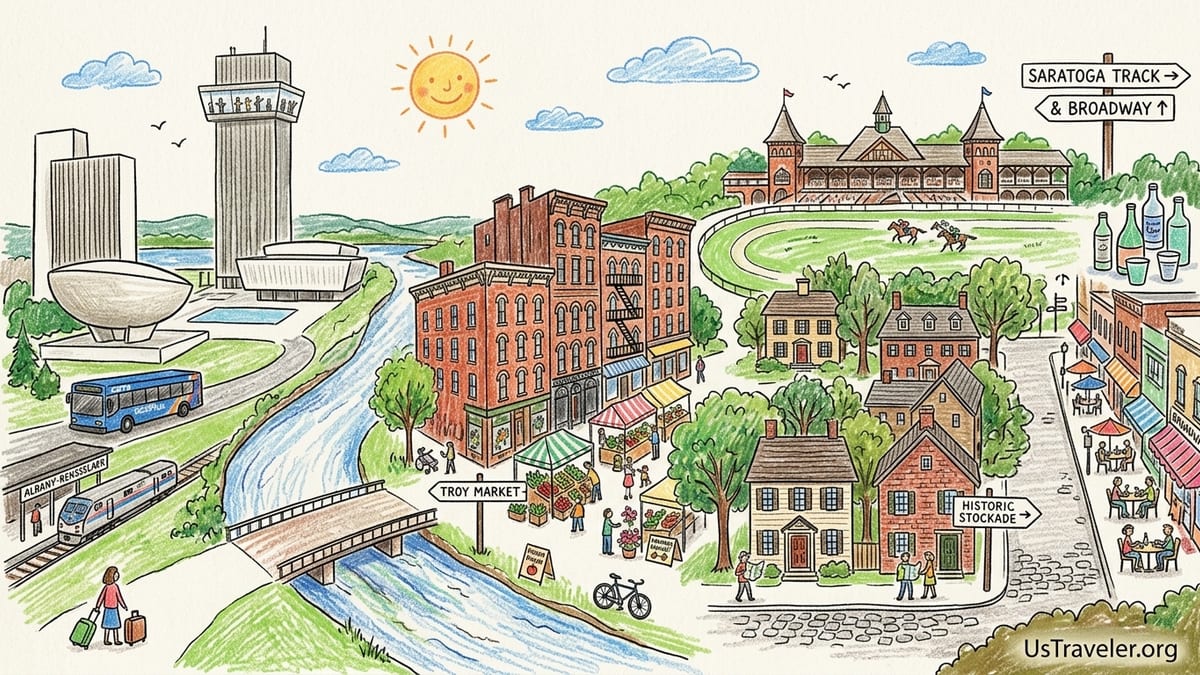
I expected the Capital-Saratoga region to behave like one small metro with a few scenic add-ons. Instead, it felt like four distinct cities laid down almost back-to-back, each with its own walking rhythm, architecture, and even its own idea of what a “night out” looks like. The biggest surprise was how quickly the vibe changed as I hopped between Albany, Troy, Schenectady, and Saratoga Springs, sometimes in under an hour door-to-door, and how easy it was to accidentally create unnecessary backtracking if I didn’t commit to smart bases and clean routes. What follows is the planning guide I wish I had before I arrived, built from what I actually did, what I’d do differently, and what I confirmed while I was on the ground about transportation, parking, hours, seasonal schedules, and the very real swing between government-modernist Albany, brick-and-iron Troy, colonial Schenectady, and resort-town Saratoga.
How I Got Around (And What I’d Do Differently Next Time)
I built this trip around two anchors: the Albany-Rensselaer train station and a rental car I picked up nearby. That combination ended up being the sweet spot for this region, because it let me do the cities on foot when I wanted to, then “stitch” them together quickly without treating every day like a logistics puzzle. The driving times really are as friendly as tourism officials claim, and the short hops between Albany, Troy, Schenectady, and Saratoga Springs make multi-base planning feel almost luxurious compared with other upstate corridors.
I used CDTA buses selectively when it made sense for one-way moves and avoided it when timing would have forced me into long waits. CDTA’s regular cash fare is $2.00, and their BusPlus corridors include a Blue Line along the Hudson River communities (useful for Albany to Troy) and a Red Line that runs Albany through Colonie toward Schenectady. In practice, I found the system most useful when I treated it as a convenience layer rather than the spine of my entire itinerary.
Amtrak was my other useful connector, especially for the idea of a “car-lite” trip. Albany-Rensselaer is the region’s major rail hub, and Saratoga Springs has its own station, which matters during summer racing season when driving and parking can shift from easy to aggravating quickly. I did not rely on a single static timetable screenshot; I verified schedules close to travel because Amtrak timing can change seasonally and with service updates.
What I would change next time is simple: I’d avoid bouncing bases. On my first pass, I wasted time returning to Albany at mid-day after Troy, only to drive right back north later. The distances make it tempting to “reset” at your hotel between cities, but that’s exactly how you create backtracking. If you’re doing Saratoga Springs plus the battlefield plus Troy, it’s often cleaner to go north in the morning and come back once, late.
Albany: Empire State Plaza Felt Like A Movie Set (In A Good Way)
Albany surprised me most at Empire State Plaza, which is where the city’s abstract reputation becomes physical. On foot, the place reads like a series of deliberate choices: broad hardscape, strong lines, huge skies, and buildings that feel as if they were designed to frame weather. I visited when the light was sharp enough that the plaza’s geometry looked extra crisp, and I remember how the wind made the open spaces feel even bigger than they are.
I parked in the Empire State Plaza visitor garage (entered off Madison Avenue) and appreciated how straightforward it was compared with curb-hunting downtown. The plaza itself is open around the clock, and the Corning Tower observation deck operates on weekday hours, which mattered for planning. I built the deck into a weekday morning rather than gambling on a weekend, then used the view to orient everything else: the river, the bridges to Troy, and the way the region fans out toward Saratoga.
What I noticed most walking around was how the plaza can be both grand and strangely quiet. The scale feels federal, but the atmosphere is local, and that contrast is part of the charm. A short walk takes you from monumental government spaces to more lived-in blocks where you start noticing everyday Albany details: corner delis, students, and office workers slipping out for coffee.
If you only do one “architecture hour” in Albany, I’d put it here, then commit to a second neighborhood elsewhere rather than trying to sample the entire city in a single day. My mistake was assuming I could tack on “just one more stop” after the plaza without accounting for how long I’d linger, especially once I started watching the light change on the buildings.
Troy: Brick, Iron, And A Downtown That Rewards Slow Walking
The drive from Albany to Troy is short enough that it barely registers, but the aesthetic shift does. Downtown Troy felt like a city that wears its industrial-era bones proudly: dense brick, heavy details, cast-iron hints, and streets that make you want to look up. I arrived on a Saturday morning specifically to catch the Troy Waterfront Farmers Market, which runs year-round every Saturday from 9:00 AM to 2:00 PM downtown.
The market changed the whole feel of the city for me. It pulled locals into the same blocks I was exploring as a visitor, and it forced me into a kind of happy, slow-moving navigation: stop, weave, pause, then drift toward another corner that smelled like coffee or baked goods. The best planning lesson I learned here was to arrive earlier than I thought I needed to, because the later I stayed, the more I felt the parking pressure and pedestrian density build.
I made an intentional choice to keep my Troy visit walk-heavy and meal-driven rather than museum-heavy. That paid off, because the city’s strongest moments for me were textural: the sound of footsteps on older sidewalks, the way storefront windows reflect brick facades, and the feeling that you’re in a place that has been a working downtown for a long time, not a newly assembled “district.”
The backtracking trap in Troy is subtle: it’s tempting to keep hopping between River Street, side streets, and the waterfront area for “one more photo,” then realize you’ve walked the same blocks repeatedly. Next time, I’d choose one deliberate loop and stick to it, especially if I’m using a time-limited parking session or trying to make a reservation elsewhere.
Schenectady: The Stockade District And A Completely Different Time Scale
Schenectady was my reminder that the region isn’t just a string of downtowns. It’s also a set of older neighborhoods that carry their own identities, and the Stockade District is the clearest example. The moment I started walking its streets, the pace changed. Instead of browsing storefronts, I was reading doorways, lintels, and the spacing between houses, the way you do in a place where history is baked into the everyday streetscape.
I used the Stockade as a walking-first afternoon. A self-guided tour approach works well here because the pleasure is in noticing: the way the neighborhood sits near the river, the way the street grid feels older and calmer than busier commercial areas, and the way trees and stoops shape the view. I also timed my visit around the annual Stockade Walkabout, which is scheduled for Saturday, September 26, 2026, from 11:00 AM to 5:00 PM, a rare chance to see inside some homes and understand the neighborhood beyond the sidewalk.
What surprised me in Schenectady is how quickly the “Capital Region” label dissolves into something intimate. I didn’t feel like I was in a satellite of Albany. I felt like I was in a place with its own story and its own community life. That’s why I think Schenectady works best as a half-day you treat seriously, not as a quick drive-by between Troy and Saratoga.
The mistake I made was trying to pair too much with the Stockade on the same day. The neighborhood wants unhurried time. If you rush it, you’ll still see pretty streets, but you won’t get the deeper payoff of noticing how the city’s colonial-era identity sits right alongside modern life.
Saratoga Springs: Broadway Energy, Mineral Water Rituals, And The Racing Atmosphere
Saratoga Springs felt like the region’s mood swing in the best possible way. After Albany’s civic grandeur, Troy’s grit, and Schenectady’s historical quiet, Saratoga arrived with a resort-town confidence. Broadway, in particular, carried the town’s social energy. I noticed it immediately in the way people dressed for dinner, how many groups were walking between bars and restaurants, and how the sidewalks felt like they had a steady pulse even on an ordinary night.
Parking is the first practical issue here, because the town is easy on foot once you’re parked, but you don’t want to waste your evening circling. The city uses a seasonal paid parking system in city-owned garages and lots, and there are also time-restricted areas like the lot at 500 Broadway that is restricted to permit holders between 9:00 AM and 6:00 PM. I planned my evenings around garages and longer-stay options so I could actually relax and enjoy Broadway instead of keeping one eye on a meter.
The mineral-spring experience is what made Saratoga feel unlike any other small city I’ve visited. The ritual is simple: bring your own bottle or cup, then sample. There are more than a handful of public springs around town, and the “taste map” is real. Some are crisp, some are aggressively mineral, and a few are so iron-forward they taste like licking a stone. I treated it like a low-stakes tasting tour: small sips, notes in my head, and a reset with regular water afterward.
Racing season is the amplifying factor. Saratoga Race Course’s 2026 summer meet is scheduled to open Friday, July 3, 2026 and run through Labor Day, and the town’s atmosphere tends to sharpen around those dates. Even if you never step inside the track, you feel the presence of it: conversations about post times, the little clusters of dressed-up groups moving with purpose, and the way the town’s dining reservations start feeling more competitive.
One Day In The Countryside: Saratoga National Historical Park (And Why It Reset My Brain)
I needed a break from downtown energy, and Saratoga National Historical Park delivered it in a way that felt restorative rather than merely educational. I went specifically to experience how the landscape holds the story. The park’s visitor center hours are updated by the National Park Service, and I checked them right before I went because conditions and operations can shift by season. On arrival, what struck me was how quickly the noise fell away. The battlefield spaces feel open, grassy, and contemplative.
I drove, parked easily, and then made myself slow down. This is not a place to “collect” stops. It’s a place to walk and let the terrain do the work. I paid attention to the ground underfoot, the long sightlines, and the way interpretive points connect across the fields. Even when you know the broad narrative, seeing the distances in person changes your sense of what “movement” meant historically.
Condition-wise, I approached the park like I would any outdoor site in upstate New York: I expected changing weather, damp patches after rain, and a need for shoes that can handle uneven ground. My best practical advice is to plan this as a morning or late-afternoon block rather than a squeezed-in hour, because the park’s impact comes from time spent walking without a stopwatch.
This was also where I realized how much the Capital-Saratoga region benefits from mixing city texture with countryside. If you do only downtowns, you’ll miss the way open landscapes sit so close to urban life here. The park gave me that contrast in the cleanest way possible.
Where I Based Myself (Hotels), What I Ate, And The Itinerary Mistakes I’d Avoid
I treated Albany as my most practical base because it split the distance between Troy, Schenectady, and Saratoga Springs. The tradeoff is that Saratoga nights can end late, and a drive back to Albany after a full Broadway evening is not the same as rolling into a hotel two blocks away. If I were traveling specifically for racing, SPAC shows, or a Saratoga-heavy weekend, I would base in Saratoga Springs for at least two nights and keep Albany for a separate city-focused block.
Meals were the glue of my itinerary. In Albany and Troy, I leaned into casual, walkable eating: cafés and quick dinners that didn’t require me to move my car again once I’d parked. In Saratoga Springs, I planned for longer dinners and people-watching because Broadway is part of the meal. My simplest rule was: if I’m in Saratoga at night, I stay on foot as long as I can; if I’m in Albany during the day, I cluster big sights like the plaza and any tours into one clean loop.
My most avoidable mistake was unnecessary backtracking caused by not committing to a northbound day. I did Troy, returned to Albany, then later drove north toward Saratoga, which effectively doubled a segment that could have been a single continuous day. A cleaner design would be Albany to Troy in the morning, then continue to Saratoga Springs for the afternoon and evening, then return once, late.
Another mistake was underestimating how time shifts between these cities. Albany can feel brisk and businesslike on weekdays. Troy can stretch time on a market morning because you stop constantly. Schenectady’s Stockade makes you slow down. Saratoga’s Broadway speeds you back up at night. I found the trip worked best when I accepted those rhythms instead of fighting them.
The Takeaway
What surprised me between Albany and Saratoga Springs wasn’t a single attraction. It was the speed of the identity changes. I drove a short distance and landed in places that felt architecturally and emotionally distinct: Albany’s big civic statements, Troy’s brick-and-market buzz, Schenectady’s quiet historical gravity, and Saratoga’s mineral-spring rituals and nightlife pulse.
The region rewards travelers who plan like locals: pick smart bases, avoid returning to your hotel between every stop, and treat parking and seasonal schedules as part of the itinerary, not an afterthought. Build one day for modern civic Albany, one morning for downtown Troy, one slow half-day for the Stockade, and one Saratoga day that includes mineral springs and an evening walk on Broadway. Then, if you want the trip to feel complete, give the battlefield its own breathing room.
If I had to describe Capital-Saratoga in one line, it would be this: it’s a set of four cities close enough to combine easily, but different enough that you should let each one be itself.
FAQ
Q1. What is the easiest home base for a first trip to the Capital-Saratoga region?
Albany is the most central base for splitting time between Troy, Schenectady, and Saratoga Springs, especially if you are arriving by train at Albany-Rensselaer.
Q2. Do I need a car to visit Albany, Troy, Schenectady, and Saratoga Springs?
You can do parts by train and CDTA buses, but a car makes multi-city days much smoother and helps with countryside stops like Saratoga National Historical Park.
Q3. What should I know about CDTA fares and routes before using the bus?
CDTA’s standard cash fare is $2.00, and their BusPlus Red and Blue lines are useful for high-frequency corridors like Albany to Schenectady and Albany to Troy.
Q4. When is Saratoga Race Course’s 2026 season?
The 2026 summer meet is scheduled to open on Friday, July 3, 2026 and run through Labor Day, and the town’s atmosphere typically intensifies around those dates.
Q5. Is the Belmont Stakes happening in Saratoga Springs in 2026?
Yes, the 2026 Belmont Stakes is scheduled for June 6, 2026 at Saratoga Race Course as part of a multi-day Belmont Stakes festival.
Q6. What are the most realistic “must-do” experiences if I only have a weekend?
I would prioritize Empire State Plaza in Albany, a Saturday morning in downtown Troy, a Stockade District walk in Schenectady, and an evening stroll on Saratoga’s Broadway with mineral spring tastings earlier in the day.
Q7. Are Saratoga’s mineral springs free and easy to access?
Many public mineral springs are free to sample, but you should bring your own cup or bottle and treat it like tasting rather than chugging because flavors can be intense.
Q8. What is the biggest itinerary mistake to avoid in this region?
Unnecessary backtracking. Because the cities are close, it is tempting to return to your hotel between each stop, but that can double your driving and waste prime walking time.
Q9. What should I plan around for the Empire State Plaza and Corning Tower?
The plaza itself is open daily, but the Corning Tower observation deck keeps weekday hours, so it is smartest to schedule it for a weekday daytime window.
Q10. What is a good way to add countryside without committing to a long drive?
Saratoga National Historical Park is an easy countryside-feeling reset near Saratoga Springs, and it works best if you give it at least a half-day rather than rushing it.