


I came to New York’s Capital Region expecting a “road trip,” then laughed the first time my GPS promised Albany to Troy in roughly 15 minutes. This corner of upstate is compact, and that’s the whole point: you can stitch together Albany, Troy, Schenectady, and Saratoga Springs with short drives, smart parking choices, and just enough rural breathing room to make the city hops feel intentional. What surprised me wasn’t distance but friction, specifically, where the car was a superpower (easy river crossings, quick hotel switches, side trips) and where it became dead weight (downtown blocks with one-way turns, event pricing, and curb rules that change by hour).
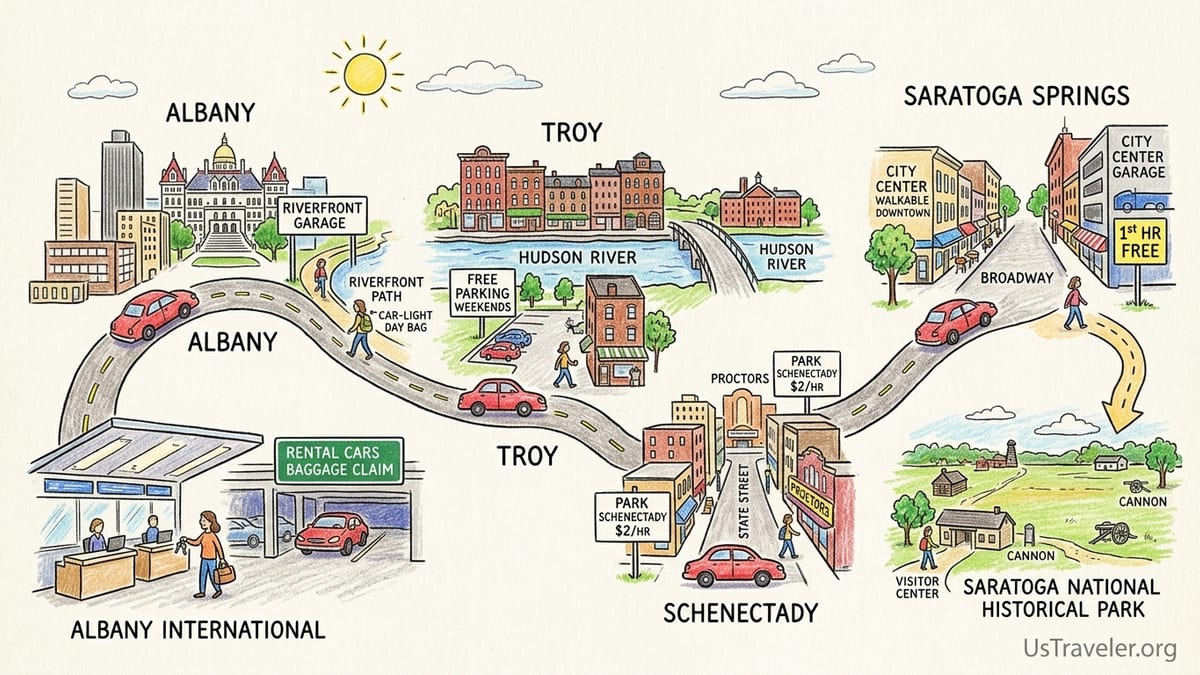
Picking Up My Rental Car at Albany International, Then Getting Out of the Way
I built my itinerary around Albany International Airport because it’s the simplest place to start if you want a car immediately, without treating this like an epic drive. At Albany International, the rental car counters are located in the terminal’s baggage claim area, and the rental fleets are kept inside the airport parking garage, which makes pickup feel unusually straightforward for a mid-size airport. I walked out of baggage claim, signed, and was in the garage within minutes, no shuttle bus, no off-site trek.
Before I even left the airport, I made one practical decision that influenced the rest of the trip: I treated the rental car like a tool I would put down frequently. Downtown Albany, Troy, and Saratoga Springs all reward you if you park once and walk, and downtown Schenectady is similar if you’re centered on State Street. So I packed my day bag to be “car-light” (water, charger, light jacket) and planned each city as a park-once block of time.
I also noticed immediately that parking costs are part of the real budget here. Albany International’s published daily rates list the garage at $18 per day, with other lots below that. That matters because if your flight arrives late or you’re doing a one-night in Albany before moving on, it can be cheaper to get off airport property quickly rather than letting the rental sit in airport parking while you explore on foot.
Day 1: Albany First, Because It’s the Easiest Downtown to “Learn the Region”
I started in Albany not because it’s the cutest of the four, but because it’s the most useful orientation point. Albany’s downtown has the region’s most obvious government-and-business gravity, plus a street grid that teaches you quickly where you’ll spend time driving and where you won’t. I aimed for a midday arrival so I could check into a hotel, drop the car, and do my first on-foot loop without fighting rush hour.
For parking, I leaned on ParkAlbany garages to keep it simple. Riverfront Garage and Quackenbush Garage are two of the main options in the downtown core, and Riverfront’s published max daily rate is $15. The “park once” feeling kicked in immediately: it was easy to stash the car, then walk to waterfront-adjacent blocks and downtown corridors without thinking about feeding a meter every hour.
What surprised me about Albany was how quickly the car became inconvenient once I was actually downtown. Short hops that look like two minutes on a map can turn into a one-way maze or a “wrong side of the street” problem that costs you ten minutes. I found it faster to park and walk for anything within the core, then use the car only when I was clearly leaving downtown.
Albany earned a night for me. It’s not that you need multiple days for a checklist of attractions; it’s that Albany works well as a base the first evening, when you’re learning the rhythm of the area, timing your crossings, and deciding how early you want to start the next morning. I also liked having access to structured garages at night, when I didn’t want to play curb-sign roulette after dinner.
Day 2 Morning: Albany to Troy in One Easy Hop, Then Park and Walk the Riverfront Blocks
The next morning I drove from Albany to Troy, and the drive time really did feel in the “blink and you’re there” category. This is where the road trip mindset shifts: instead of “how far,” the question becomes “what time should I arrive so parking is painless and the neighborhood feels alive?” I aimed to arrive while morning was turning into midday, early enough for easier parking but late enough that coffee shops and storefronts were fully awake.
Troy is where I felt the first real payoff of compact-city sequencing. The Hudson River is the star, and I treated the crossing as part of the narrative of the day: Albany’s broader downtown energy, then a quick transition into Troy’s historic blocks and riverfront angles. Once I arrived, I tried to keep the car out of the way and explore on foot.
One very practical Troy detail: the city’s published parking guidance notes that City-operated parking lots and garages are free Monday through Friday from 6 pm to 8 am, and all day on Saturday and Sunday (plus listed holidays). That can change the entire cost of your Troy stop depending on when you go. If you can plan your Troy time for a weekend day, the parking math is simply better, and it encourages you to linger.
Troy was a half-day city for me in this loop, not because it lacks depth, but because it’s best when you focus. I picked a tight slice of downtown, walked the blocks, and made it about river views, historic streets, and one strong meal or coffee stop rather than trying to cover every neighborhood by car.
Day 2 Afternoon: Troy to Schenectady, With the Mohawk as the Mental Reset
After Troy, I pointed the car toward Schenectady and treated the drive as a reset. The region’s geography is the quiet theme of this itinerary: the Hudson River and the Mohawk River are not just scenery, they’re the lines that shape how neighborhoods connect. In practice, that means you’ll feel the trip as a series of short crossings and quick highway merges rather than a long, continuous drive.
Downtown Schenectady made me happiest when I committed to one anchor zone, and for me that was the State Street corridor around Proctors. Proctors lists its location at 432 State Street, and its parking notes emphasize a pattern that repeats across the region: free on-street parking after 6 p.m. on weekdays and all weekend. If you’re timing Schenectady for dinner and a show, that kind of policy can make the difference between “I’ll drive in” and “maybe I’ll skip it.”
I also checked the city’s current parking guidance because curb rules are the kind of detail travel stories often gloss over. Park Schenectady’s published rates list on-street parking at $2 per hour on weekdays between 8 a.m. and 6 p.m. That’s a clean number to plan around if you’re doing a mid-afternoon walk, especially if you’d rather pay a couple hours at the curb than hunt for the perfect garage spot.
Schenectady was another half-day for me on this sequence. It works well as an afternoon into evening: arrive, park, walk State Street, build your plan around a meal and one main attraction, then leave without feeling like you shortchanged the city. If you only have one night total in the region, I’d still sleep in Albany or Saratoga Springs, but Schenectady earns a solid block of time.
Day 3: Schenectady to Saratoga Springs, Where the Car Starts Feeling Optional
Saratoga Springs is the city on this loop that made me most tempted to ditch the keys. It’s polished, walkable, and full of reasons to stay out late, which is exactly when you don’t want to be thinking about where you left the car. The driving distance from the Capital Region cities is still short enough that it feels like a quick reposition, not a “travel day,” and official drive estimates commonly peg Saratoga Springs at around 45 minutes from Albany, Troy, or Schenectady depending on routing and traffic.
Parking is also where Saratoga Springs becomes its own kind of puzzle, particularly in peak season. For a straightforward plan, I relied on garage parking rather than hunting for the perfect curb spot on Broadway. One widely cited option is the Saratoga Springs City Center garage, and current visitor guidance for 2026 describes a simple pay-per-park structure: the first hour free, then $2 per additional hour, up to a daily maximum of $15. That is exactly the kind of predictable pricing that lets you stop thinking about the car and start enjoying the city.
I also learned that Saratoga Springs has leaned into app-based convenience. The city promotes the ParkMe app for finding parking and managing time, which is useful if you’re trying to avoid circling blocks during busy hours. I used it more as a reassurance tool than a strict necessity, but in a downtown where demand spikes, anything that reduces “hunt time” is worth considering.
Saratoga Springs deserved my second night in this itinerary. The city stays lively into the evening, and it’s the one place where a single overnight felt like it unlocked the full experience: dinner without rushing, a relaxed morning coffee, and time for a side trip that didn’t feel squeezed between checkout times.
My Favorite Add-On: Saratoga National Historical Park as a Quiet, Open-Space Counterpoint
To keep the itinerary from becoming four downtowns back-to-back, I added a stop that felt genuinely different: Saratoga National Historical Park. It’s close enough to Saratoga Springs that it doesn’t become a detour story, and it’s a nice reminder that the region’s biggest landmarks are not all urban. It also resets your senses after a couple days of garages, one-way streets, and stop-and-go downtown driving.
Timing matters because hours change seasonally. The National Park Service lists the Saratoga National Historical Park Visitor Center as open daily with posted hours, including Sunday hours that differ from some weekdays. I built my visit around the Visitor Center being open rather than assuming I could just arrive at any time and get the full interpretive experience. When the Visitor Center is open, it’s the most efficient way to start, especially if you want maps, a quick orientation, and up-to-date guidance.
This was the part of the trip where the car became a true advantage again. Within Saratoga Springs, walking is the point. But to reach quieter park landscapes and move between overlooks or separate points of interest efficiently, the car saved time and turned the park into a flexible add-on rather than a full-day commitment.
If your schedule is tight, this is the add-on I’d keep because it changes the texture of the trip without adding much driving complexity. It’s also the stop that makes the “Capital-Saratoga Road Trip” feel like an actual road trip, even when the city-to-city legs are short.
The Takeaway
This loop works because it refuses to pretend distance is the headline. The headline is sequencing. Albany is your easiest starting point and a logical first night because it helps you learn how the region moves. Troy and Schenectady shine as half-day stops when you park once and walk, especially if you time Troy for free garage windows and Schenectady for evening energy around State Street. Saratoga Springs is the reward city: walkable, stay-late-friendly, and worth a night because you’ll actually use the evening hours instead of spending them driving.
The car is both hero and hassle, often within the same hour. It’s a hero for river crossings, quick hops between compact downtowns, and the Saratoga National Historical Park add-on. It’s a hassle when you try to “drive the downtown,” especially in Saratoga Springs and Albany, where it’s almost always smarter to garage the car and move on foot. If you treat this like a series of park-once mini trips instead of a continuous drive, the whole itinerary clicks.
Most importantly, this is a road trip you can scale without breaking it. If you have one full day, do Albany plus Troy or Albany plus Schenectady. If you have two days, add Saratoga Springs and sleep there. If you have three, add Saratoga National Historical Park and enjoy the fact that “more time” doesn’t mean “more miles,” it means fewer compromises.
FAQ
Q1. Is this really a road trip if the drives are so short?
Yes, but it’s a sequencing road trip, not a mileage challenge. The value is linking distinct downtowns efficiently and using the car strategically rather than constantly.
Q2. Where did you pick up your rental car for this itinerary?
I picked up at Albany International Airport, where rental car counters are in baggage claim and the vehicles are in the airport parking garage, so there’s no off-site shuttle step.
Q3. What parking option worked best for downtown Albany?
A ParkAlbany garage made the trip easiest. Riverfront Garage is a reliable downtown option with a published max daily rate of $15, which helped me stop thinking about meters.
Q4. When is parking in Troy easiest on the wallet?
Weekends. The City of Troy states that City-operated lots and garages are free all day Saturday and Sunday, which makes Troy a great “linger” stop.
Q5. What did on-street parking cost in downtown Schenectady when you went?
Park Schenectady lists on-street parking at $2 per hour on weekdays from 8 a.m. to 6 p.m., which is a straightforward mid-day planning number.
Q6. Where did the car become most inconvenient?
Downtown cores, especially when I tried to do short hops by car. In Albany and Saratoga Springs, it was almost always faster to park once in a garage and walk.
Q7. What’s the simplest parking plan for downtown Saratoga Springs?
The City Center garage is a clean default. Current visitor guidance for 2026 describes the first hour free, then $2 per hour, up to a $15 daily maximum.
Q8. Is there a parking app worth using on this route?
Saratoga Springs promotes the ParkMe app for finding parking and tracking time, which can reduce circling during busy periods.
Q9. Which city deserved a night on your loop?
Saratoga Springs was my top pick for a night because the walkable downtown and evening scene felt wasted as a rushed day trip. Albany also worked well as a first night base.
Q10. Are there any attractions with specific opening days and hours you checked?
Yes. I checked the National Park Service listing for Saratoga National Historical Park’s Visitor Center hours before going, because seasonal schedules and holiday closures can affect what’s open.