


I learned quickly that “Capital-Saratoga” is less a single destination than a tight cluster of small cities where your hotel choice quietly determines the kind of trip you end up having. I planned a long weekend with one goal: pick a home base that would let me do the Saratoga things I actually cared about (the track, a spa soak, Broadway dinners) without giving up the practical stuff (easy parking, quick highway access, and at least one night out that didn’t require a designated driver). With Albany, Saratoga Springs, Troy, and Schenectady all within an easy drive of each other, it is tempting to treat them as interchangeable. They are not. Here’s how I chose between them after real overnights, real dinner walks, and real “where did I leave the car” moments.
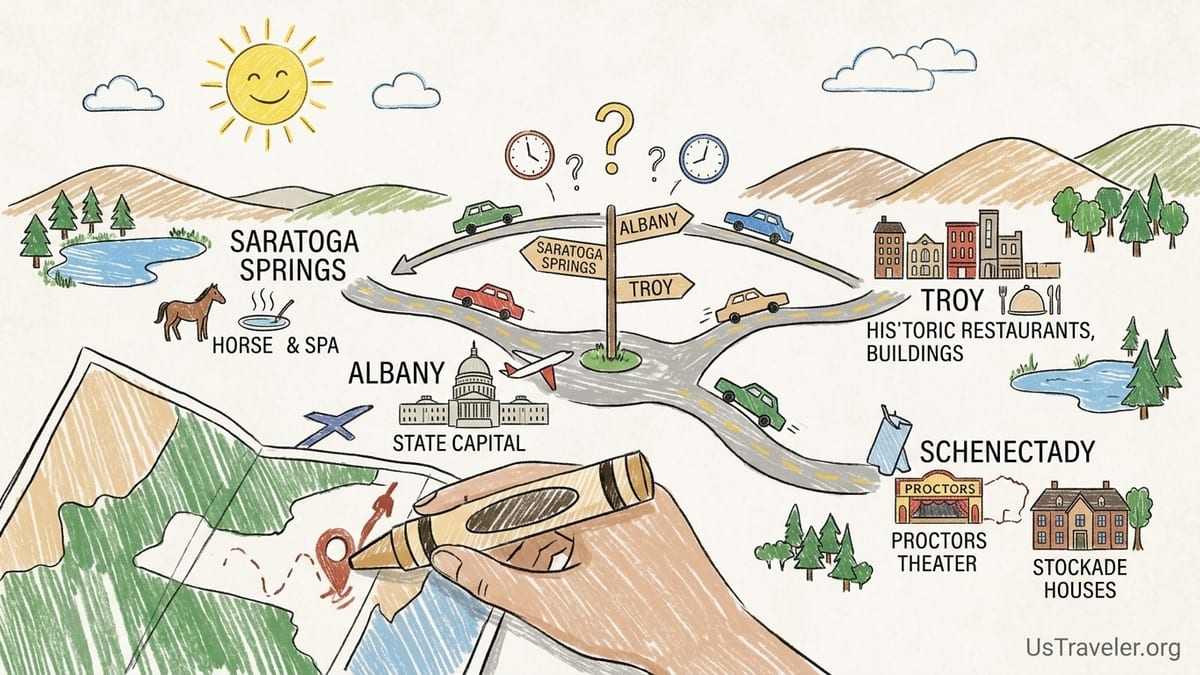
How I Framed The Decision: The Base Matters More Than The Map
When four cities sit roughly 15 to 45 minutes apart by car, the natural instinct is to book the cheapest room and promise yourself you will “just drive.” In practice, that promise breaks down the moment you add one or two non-negotiables: walking to dinner, grabbing a nightcap without moving the car, getting back from Saratoga Race Course without a stressful parking hunt, or reaching Albany International Airport at the hour your flight actually leaves.
I approached the choice like a base-selection problem, not a hotel search. I asked: What do I want to do after 9 p.m.? Will I be annoyed if I must drive for every meal? Do I want a place where I can park once and forget the keys, or am I okay with being in and out of the car all day? Those answers pushed me toward Saratoga Springs for certain weekends, Albany for others, and Troy when I wanted charm and good food without the Saratoga price pressure. Schenectady stayed in the mix as a “purpose-built” base: ideal when the trip revolved around Proctors or the Stockade.
The key insight from my overnights is that the cities serve different trip styles. Saratoga Springs is a walking-and-lingering town where the evening is the point. Albany is an efficient hub with airport convenience and state-capital attractions. Troy feels like a smaller city with serious architecture and a restaurant scene that rewards wandering. Schenectady is the most “event night” friendly when you’re doing a show and want to park once, eat nearby, and walk back afterward.
Saratoga Springs: Racing, Spas, Broadway Dinners, And The Luxury Of Not Driving
If your trip includes Saratoga Race Course, Saratoga Springs is the base that reduces friction the most, especially during the summer meet. The New York Racing Association’s 2026 Saratoga summer meet runs from Friday, July 3 through Labor Day, Monday, September 7, which creates an extended peak season where the town’s energy (and pricing) noticeably changes. During that stretch, staying in Saratoga Springs is less about saving drive time and more about buying yourself the ability to do the town the way it is meant to be done: on foot, at a relaxed pace, with the option to pop back to your room.
My most “Saratoga” night was the simplest: I parked once, walked to dinner on Broadway, wandered past busy patios afterward, and ended the evening without calculating who would drive. Broadway is the spine: it’s where you feel the density of restaurants, bars, and people-watching that makes Saratoga different from the other bases. If you are trying to replicate that feeling from Albany or Troy, you can, but you will drive in and out, and it changes the rhythm of your nights.
Parking is the part visitors stress about, and the part locals navigate almost automatically. In the city-owned garages and lots, Saratoga Springs has used seasonal paid parking; one common structure is a “first hour free, then hourly charge up to a daily maximum” setup (for example, $2 per additional hour after the first free hour, with a capped daily maximum that has been listed at $15 in seasonal guidance). Practically, that meant I could drive into town, park near downtown, and not panic if dinner took longer than expected. Street parking exists too, but it is the kind of “you must read every sign” situation that turns relaxing into a scavenger hunt during the busiest weekends.
Would you still need a car in Saratoga Springs? For the core Saratoga experience, not always. If you stay close enough to downtown, you can walk to meals and nightlife, and you can also make Saratoga Spa State Park part of the plan with a short drive or rideshare. But the moment you add day trips (Troy for architecture, Schenectady for a show, Albany for museums and the Capitol, or Lake George for a full-day escape), the car becomes your flexibility tool. My advice: in Saratoga, keep the car for daytime mobility, but pick a location that lets you put it away at night.
Albany: The Practical Hub For Airport Access And State-Capital Days
Albany is the base I chose when I wanted the trip to be easy, not precious. It is the most straightforward city in the cluster for logistics: major highways converge nearby, the region’s airport is close, and Albany works as a “wider radius” hub if you plan to bounce between multiple towns in the same weekend. If your itinerary includes an early flight out of Albany International Airport, Albany is the choice that reduces morning stress.
For travelers who like to anchor a trip around big, fixed attractions, Albany also delivers. I built one afternoon around the New York State Capitol and the Empire State Plaza area, the kind of sightseeing that feels best when you are not watching the clock for a drive back to Saratoga. The Capitol offers weekday walk-in tour times (commonly listed in the 10 a.m., 12 p.m., and 2 p.m. range on visitor listings), which makes Albany feel like a true destination rather than just a place you slept. Even if you only do one “capital” thing, it helps justify choosing Albany over the prettier alternatives.
Parking in Albany was the least mentally taxing of my overnights. It felt like the city where you are most likely to have a hotel lot, a predictable garage, or at least a more normal urban parking cadence. At the airport specifically, Albany International Airport publicly posts parking and transport information, including an hourly rate shown as $2. The airport has also communicated policy changes such as moving away from cash for parking transactions starting August 1, 2026, which is the kind of detail that matters when you land late and just want to get out.
Albany’s tradeoff is that it can be a drive-first experience depending on where you stay. There are areas where you can walk to dinner, but the “I’ll just stroll out and choose a restaurant” feeling is not as automatic as in downtown Saratoga Springs. Nightlife exists, but I found myself planning it more deliberately: pick a spot, drive or rideshare, and commit. If you want a trip that feels like a car-free village after dark, Albany is not the strongest match. If you want a hub that makes everything else easy, Albany is hard to beat.
Troy: Smaller-City Atmosphere, Architecture, And A Food Scene That Rewards Wandering
Troy surprised me as the base that felt most “discovered,” even though it is not obscure. The city has an immediate sense of place: older streetscapes, dense blocks, and the kind of architecture that makes you slow down. It is the base I liked when my goal was to eat well, walk a few blocks, and feel like I was in a real, lived-in small city rather than a resort town in high season.
What made Troy work for me as a base was the combination of walkability and comparatively forgiving parking. The City of Troy’s parking guidance highlights a mix of on-street and off-street options, and it explicitly notes that city-operated parking lots and garages are free during specific windows: weekdays after 6 p.m. through the morning, plus all day on Saturday and Sunday (and on listed holidays). That single detail changed my behavior: I felt comfortable parking near downtown and walking to dinner without a “meter countdown” anxiety. It also made Troy feel particularly easy for a weekend stay, when visitors tend to arrive Friday evening and move the car less.
Walking to dinner in Troy felt natural: you can pick a place, walk there, and then pivot to a second stop without turning the night into a driving plan. Nightlife is more low-key than Saratoga Springs in racing season, but that is part of the appeal. Troy’s evenings felt like a sequence of good meals and casual bars rather than a full-on scene. For some travelers, that is exactly right.
Did I still need a car while staying in Troy? For Troy itself, no, not for the evenings. But for the “Capital-Saratoga” concept, yes. Troy is a strong home base if you plan to drive to Saratoga Springs for a day, then return to a calmer city at night. It is also a smart compromise when Saratoga room rates spike: you can still reach the track, spas, and Broadway restaurants within a manageable drive, then retreat to Troy’s more grounded atmosphere.
Schenectady: When Proctors Or The Stockade Are The Point
Schenectady entered my decision tree whenever I had a specific evening plan: a show at Proctors, or a deeper history walk through the Stockade Historic District. If your trip is built around a performance night, staying in Schenectady is the most “park, eat, show, sleep” efficient option in the region. Proctors is in downtown Schenectady at 432 State Street, and their directions and parking guidance call out nearby garage options and show-night convenience.
The parking detail that made Schenectady feel easy is the way it treats show nights. Proctors notes that parking in the Schenectady Municipal Garage at 407 Hamilton Street is free on show days, weekdays after 5 p.m., and all weekend. That is a practical perk, not a minor one: it means you can arrive early, park once, go find dinner, walk to the theater, and not worry about extending a meter mid-act. If you are trying to do a similar theater night while staying in Albany or Troy, you can, but you will drive home after, and the night feels more structured.
The Stockade adds a different reason to stay. Discover Schenectady describes the Stockade as the city’s oldest neighborhood, continuously inhabited for more than 300 years. If your weekend is about historic streets and a slower pace, basing in Schenectady can make the Stockade feel like your backyard rather than a side quest. I found it especially appealing for a fall weekend: walkable history by day, performance by night, and an easy drive the next morning to Albany or Saratoga without feeling like you “moved hotels” in the middle of the trip.
Would I choose Schenectady as a general base for the whole region? Only if the trip is anchored there. As a hub, it is workable, but Albany is more straightforward for airport access and Saratoga Springs is more immersive for the Saratoga experience. Schenectady’s sweet spot is a purpose-driven itinerary: the show is the centerpiece, and the base supports it.
Distances, Drive Times, And The “Car Necessary” Reality Check
Because the four cities are close, it is easy to underestimate the cumulative cost of driving. Yes, you can go from Albany to Saratoga Springs, or Troy to Schenectady, and still be back in time for a late dinner. But the question is not “Can I?” It is “Will I want to?” Over multiple days, driving for every dinner and drink is the quickest way to make the region feel spread out rather than compact.
My rule after doing it the hard way: choose one place where you do not drive at night. For me, that was either Saratoga Springs (when I cared about Broadway, the spa vibe, and the post-track evening) or Troy (when I wanted a walkable food weekend with easy weekend parking). Albany was the base when the trip was built around daytime attractions and logistics, and I was comfortable with more driving after dark or using rideshares selectively.
Hotel-to-attraction distance matters less as a pure number and more as a mood. In Saratoga Springs, being close enough to walk to dinner changed everything about my evenings. In Albany, being “close” still often meant crossing broader streetscapes where you may choose to drive anyway. In Troy and Schenectady, compact downtown blocks made it easy to decide on foot. That is why I see this as a base-selection story: the cities are near each other, but their on-the-ground experience is not interchangeable.
If you are trying to go car-light, Saratoga Springs gives you the best chance during an ordinary weekend, and Troy can also work for evenings. But if your plan includes multiple towns plus any hiking, lake time, or off-hours airport movement, a car remains the most convenient way to make the region feel effortless. I kept the car for every version of the trip, but I deliberately chose bases where I could “park it for the night.”
Where I’d Stay: Racing Season Versus An Ordinary Weekend
During Saratoga racing season, I would stay in Saratoga Springs if the track is central to the trip. The NYRA meet (July 3 through September 7, 2026) is long enough that you can find quieter weekdays, but the overall pattern is the same: Saratoga becomes a magnet, and the easiest way to enjoy it is to sleep close enough to walk to dinner afterward. Racing days are not only about the races. They are about the transition from afternoon track time to evening Broadway time, with minimal friction in between.
If I could not justify Saratoga Springs pricing during peak weekends, my second choice in racing season would be Troy, not Albany. Troy gave me the best combination of weekend parking ease and a satisfying night scene that did not feel like a consolation prize. I would drive into Saratoga Springs earlier in the day, accept that parking may be part of the adventure, and then leave when I was ready to wind down.
On an ordinary weekend outside peak racing pressure, my decision flips depending on what I am doing. If I want spas, restaurant hopping, and a walkable “vacation town” feel, Saratoga Springs still wins. If I want museums, Capitol tours, and the convenience of quick airport access, I would stay in Albany and treat Saratoga as a day trip. If I want food-forward wandering and architectural texture, I would stay in Troy. And if a Proctors performance is the reason for the weekend, I would stay in Schenectady so the night runs smoothly from parking to curtain call.
The simplest way to pick is to decide what you want your default evening to look like. Racing season: Saratoga Springs by default. Ordinary weekend: Troy for charm, Albany for logistics, Schenectady for a show-centric plan, Saratoga Springs for that signature Broadway-and-spa vibe.
The Takeaway
I stopped thinking of Albany, Saratoga Springs, Troy, and Schenectady as four equal options and started treating them as four different “trip personalities.” Saratoga Springs is the base when you want the classic Saratoga experience and the freedom to walk to dinner and nightlife, especially during the July-to-Labor Day racing season. Albany is the base when airport proximity, highway convenience, and state-capital attractions matter, and you do not mind driving for evenings. Troy is the base when you want a smaller-city atmosphere with architectural character, a satisfying food scene, and weekend-friendly parking. Schenectady is the base when Proctors or the Stockade is the centerpiece and you want a simple, walkable show-night flow.
If you only remember one decision rule, make it this: pick the city where you can live the way you want to spend your nights. The drives between the four are short enough. The experience of getting out of the car is what actually changes your trip.
FAQ
Q1. Which city is best if I want to walk to dinner and bars without driving?
Saratoga Springs is the easiest for a car-free evening, especially near Broadway, with Troy as a strong second for a smaller, food-forward night out.
Q2. Where should I stay during the 2026 Saratoga racing season?
If the track is a main priority, stay in Saratoga Springs during the NYRA summer meet running July 3 through September 7, 2026; it makes post-race dinners and nightlife far simpler.
Q3. Is Albany a good base if I am flying in or out?
Yes. Albany is the most practical hub for airport access and highway connections, which helps if you have early departures or a multi-town itinerary.
Q4. What is the weekend parking situation like in downtown Troy?
The City of Troy notes that city-operated lots and garages are free all day Saturday and Sunday, which makes weekend stays notably easier for drivers.
Q5. If I’m seeing a show at Proctors, should I stay in Schenectady?
It is often the smoothest option. Proctors’ parking guidance points to nearby garage parking and notes the Schenectady Municipal Garage at 407 Hamilton Street is free on show days, after 5 p.m. weekdays, and all weekend.
Q6. Can I stay in Albany and just day-trip to Saratoga Springs?
Yes, especially outside peak race weekends. The tradeoff is that Saratoga’s best experiences are often at night, and you may end up driving back after dinner or drinks.
Q7. Do I need a car if I stay in Saratoga Springs?
You can reduce driving if you stay near downtown and focus on Saratoga Springs itself, but a car is still very helpful for day trips to Albany, Troy, Schenectady, and the wider region.
Q8. Which base feels most like a “small city” rather than a resort town?
Troy tends to feel the most like a lived-in small city with historic streets and a walkable downtown that rewards wandering.
Q9. What’s the most balanced base if I want to visit all four cities?
Albany is usually the most central-feeling for logistics and highway access, while Troy can be a good compromise if you prioritize walkable evenings and weekend parking.
Q10. If I only have one weekend, where should I stay for the most memorable nights?
For classic energy, Saratoga Springs is the pick, especially during racing season. For a quieter but still excellent food-and-walkability weekend, choose Troy.