


I’ve done plenty of modern spas where the experience is mostly about fluffy robes, eucalyptus steam, and a playlist that sounds like it was engineered in a lab. Roosevelt Baths & Spa in Saratoga Springs, New York, feels different. It’s historic in a way you can see and touch, yet the main event is simple: a private tub filled with naturally effervescent mineral water, warmed just enough to soak in without boiling off its personality.
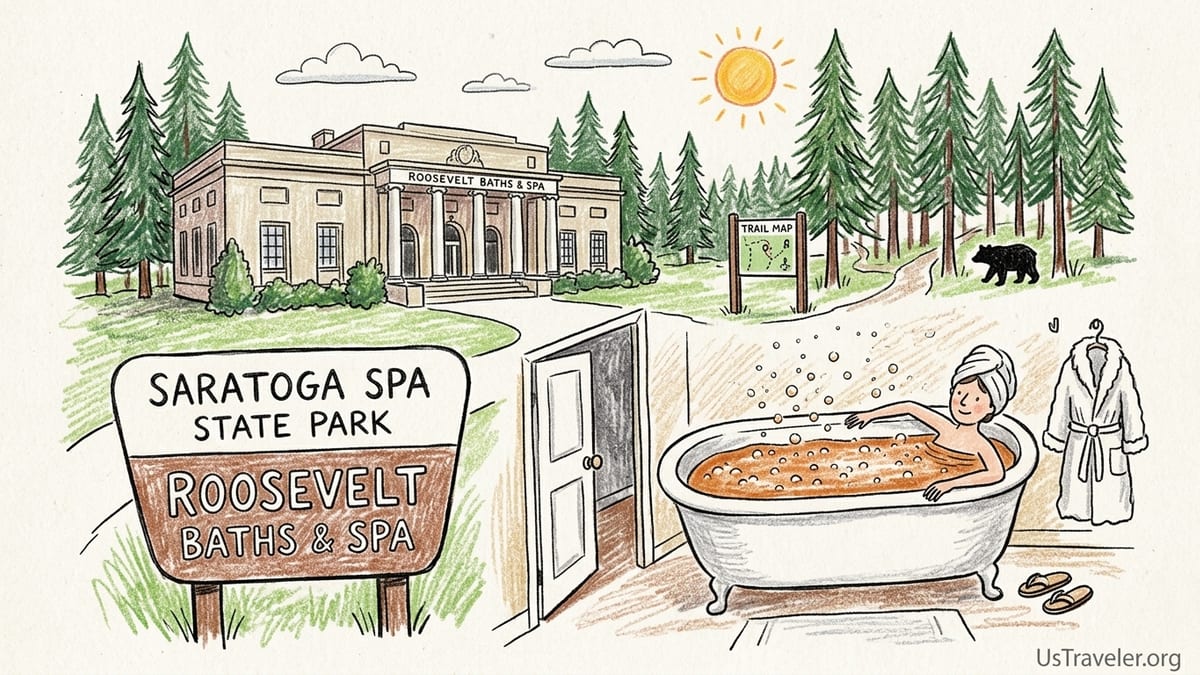
Booking the Mineral Bath: What I Reserved, and What It Cost
I booked my appointment directly through Roosevelt Baths & Spa at the Gideon Putnam, inside Saratoga Spa State Park. The menu is refreshingly straightforward: you can book a standalone mineral bath for 40 minutes, or you can book a shorter 20-minute bath that’s designed to happen before another spa service. I chose the 40-minute standalone option because I wanted to understand the experience on its own, without a massage or facial becoming the real highlight.
Right before publication, I verified the current pricing on the spa’s published service menu: a Mineral Bath (40 min) is $70, and a Mineral Bath (20 min prior to treatment) is $55. The wording matters because the 20-minute bath is positioned as an add-on before another service, not just a shorter standalone bath. If you’re building a full spa day, that 20-minute version can be the most efficient way to experience the Saratoga soak without doubling up on relaxation time.
One booking detail I appreciated: the spa makes it clear that hydrotherapy should be scheduled prior to arrival. In real-world terms, that means this isn’t the kind of place where you should assume you can roll in on a Saturday afternoon during track season or a summer concert weekend and snag an opening. If you’re visiting Saratoga Springs for a quick overnight, lock in your bath time first, then plan the rest of your day around it.
As a reality check for travelers: $70 for 40 minutes is not a bargain bathhouse deal, and it’s not trying to be. It’s closer to what you’d pay for a specialty experience in a destination spa setting, and the price is anchored by privacy, staffing, and the fact that this is a purpose-built, historic facility rather than a casual public pool.
Arrival at Saratoga Spa State Park: Parking, First Impressions, and Timing
Roosevelt Baths & Spa sits inside Saratoga Spa State Park, a big, tree-filled property that feels a world away from Broadway, Saratoga’s lively main drag. The park’s official address is 19 Roosevelt Drive, Saratoga Springs, NY 12866, and it’s worth putting that into your GPS rather than a generic “Saratoga Spa State Park” pin, which can land you at a different entrance.
Because it’s a state park setting, the arrival vibe is different from a typical spa tucked into a shopping district. You’re driving under tall pines, passing trailheads and classic park buildings, and then pulling into a lot that’s serving multiple park uses. If you’re the kind of traveler who gets stressed by last-minute logistics, give yourself a time cushion so you’re not speed-walking in flip-flops with damp hair anxiety before you even start relaxing.
Inside, the first impression is old-school in the best way: this is a bathhouse with history, not a minimalist “wellness studio.” The building has the kind of solid, institutional calm you get from 1930s-era public works architecture: hallways that feel substantial, doors that close with authority, and a quiet that seems designed into the walls.
For timing, I treated it like any appointment-based spa service: arrive early enough to check in, change, and decompress before the bath starts. A mineral bath is one of those experiences where you don’t want to be mentally sprinting when you slide into the tub. You want your brain to arrive before your body does.
Check-In and Changing: Robes, Quiet Rules, and What to Bring
At check-in, the process felt like a spa, not a public bathhouse: confirm your reservation, then you’re directed into the changing and locker routine. If you’ve been to any hotel spa where you change into a robe and slippers, this will feel familiar. The difference here is what comes next: you’re not heading to a shared hydrotherapy circuit; you’re heading to your own private room with a deep tub.
One thing I’d heard before arriving, and that the spa itself has acknowledged publicly, is that the mineral baths are completely private and typically enjoyed in the nude, with robes and sandals provided. That privacy piece shapes the entire experience. You’re not navigating awkward co-ed soaking etiquette, and you’re not trying to keep a swimsuit strap from digging into your shoulder while you’re supposed to be unwinding.
What I brought that felt genuinely useful: a simple hair tie (if you have long hair), a spare pair of dry underwear for afterward, and an un-fussy outfit. The mineral water has a personality, and I didn’t want to dress in anything precious. I also skipped jewelry entirely because I didn’t want to worry about where I set a ring while my hands were wet.
What I didn’t need: special water shoes, a swim cap, or any complicated “spa kit.” This isn’t a day at a Korean spa where you’re rotating through stations. It’s a focused appointment: change, soak, rinse, re-enter the world. The simpler you keep your stuff, the calmer the experience feels.
Inside the Private Bath Room: The Tub, the Light, and the Setting
The private bath room is where Roosevelt Baths & Spa makes its case. You’re not paying $70 for a communal pool; you’re paying for a space that feels deliberately contained. There’s a door that closes behind you, a deep porcelain tub that’s ready to be the center of attention, and lighting that’s intentionally soft rather than clinical. It’s the kind of room that cues your shoulders to drop.
My room felt purpose-built for one thing: a soak that’s quiet enough to notice. That matters because mineral water is subtle in some ways and loud in others. You need silence to pick up on the small sensations: the bubble pattern on your skin, the mineral smell that’s not “perfume” but distinctly real, the way the air feels when you’re surrounded by warm water in an old building.
The tub itself is deep enough to feel immersive. I could sit back and get that classic bathhouse posture where your shoulders are near water level and your spine stops negotiating with gravity. If you’re tall, you’ll still likely need to choose between fully submerging your legs or fully submerging your shoulders, but that’s normal bathtub physics.
Privacy is not an abstract promise here. It’s a practical one. For solo travelers, it means you don’t have to perform relaxation in front of strangers. For couples traveling together, it means this is not inherently a “together bath” unless you book accordingly and the spa’s setup supports it. The experience is fundamentally designed as one person, one room, one tub, one timer.
What the Mineral Water Actually Felt Like: Color, Smell, Carbonation, Temperature
I’ll start with the detail that most first-timers mention in a slightly startled tone: the water’s color. In my tub, it had a noticeable tint rather than looking like standard clear bathwater. Depending on the draw, it can read as coppery or rusty, which tracks with how people describe Saratoga’s iron-rich mineral water. It’s the opposite of a “blue lagoon” fantasy, and that’s precisely what makes it feel authentic.
Then there’s the smell. This is not a scented spa soak where the dominant note is lavender oil. The mineral water has a distinct mineral odor: metallic, earthy, and “natural” in a way that can surprise you if you expected nothing but warm water. It wasn’t an overpowering sulfur punch to my nose, but it also wasn’t neutral. I noticed it most when the tub was freshly filled and the room was still.
The carbonation is the signature. Saratoga’s mineral waters are naturally effervescent, and in a bath it reads like thousands of tiny, persistent bubbles clinging to your skin. It’s not a jacuzzi with jets blasting you. It’s finer than that: a constant, prickly shimmer across your arms and legs that makes your skin feel newly awake. The best comparison I can offer is the sensation of stepping into a glass of sparkling water, except warm enough to settle into.
Temperature-wise, this is not a “hot spring” in the steamy, volcanic sense. The mineral water is naturally cold at the source and then warmed for bathing, so it lands at a comfortable soaking temperature rather than a scalding one. For me, that meant the first minute felt pleasantly warm, and then the bath settled into a steady, soothing baseline where I could focus on the feel of the bubbles rather than negotiating heat.
The 40-Minute Soak: How My Body Reacted, and What I Did in the Tub
I stayed in for the full standalone session I booked: 40 minutes. In practical terms, it felt like the right amount of time to move through phases. The first phase was sensory: noticing the smell, the color, the bubbles, the way the water sat on my skin. The second phase was physical: feeling my breathing slow down and my muscles stop holding the day so tightly. The third phase was the one I didn’t expect: a kind of quiet mental drift that felt closer to meditation than to “spa entertainment.”
The water made my body feel slightly more buoyant than a normal bath. Not floating like a Dead Sea vacation ad, but buoyant enough that small shifts felt easier. I found myself subtly repositioning: shoulders down, legs extended, then a slight bend at the knees, then back again. The bubbles on my skin stayed constant, and I kept noticing them most on my forearms and shins where the sensation was crisp and unmistakable.
Because this is a timed appointment and not an open-ended soak, I didn’t treat it like a bath at home where you scroll your phone until the water goes lukewarm. I left my phone out of reach on purpose. Instead, I did simple, real things travelers actually do when they’re trying to relax without performance: I closed my eyes for a few minutes at a time, then opened them and watched the bubbles gather along the porcelain. I focused on slow breathing, especially when my mind tried to snap back to dinner reservations and driving directions.
It’s important to say what I’m not claiming. I’m not qualified to say the bath “fixed” anything medical, and I don’t think you need to treat this like an evidence-based therapy to enjoy it. What I can say honestly is that it felt physically calming while I was in it, and it left me with that post-bath softness where your body feels quieter than it did an hour ago.
After the Bath: Rinsing, Cooling Down, and Whether It Felt Worth the Price
When the bath ended, the transition back to normal life felt gentle, not abrupt. I toweled off, took my time, and did what you’ll want to do after any mineral soak: rinse thoroughly. Mineral water leaves a subtle “presence” on the skin, and while some people like that feeling, I preferred a clean rinse so I wasn’t carrying the mineral scent into the rest of my day.
Once I changed back into my clothes, I noticed the main after-effect was not dramatic. It was the kind of post-soak calm you can recognize in your own posture: looser shoulders, slower movements, fewer tiny muscle clenches. If you’ve ever taken a long bath on a cold day and then stepped into clean clothes, you know the sensation. The difference here was the effervescence and mineral character that made it feel like a destination experience instead of a home routine.
So, was the standalone 40-minute bath worth $70? For me, it depends on what you’re traveling for. If you’re in Saratoga Springs for a quick visit and you want one iconic experience that’s rooted in the place, I think the standalone soak makes sense. It’s a specific, local ritual tied to Saratoga’s mineral-water identity, and it’s hard to replicate elsewhere in quite the same way.
That said, I think the smartest value play for many travelers is combining the mineral bath with another treatment, using the 20-minute bath option priced at $55 before a massage, facial, or body treatment. Not because the bath isn’t enjoyable on its own, but because the bath functions beautifully as a “threshold” experience, the thing that quiets your body before hands-on work. If you’re already considering a 60-minute massage (with prices on the current menu reaching well into the mid-$100s and beyond), paying $55 to arrive pre-relaxed can feel more logical than paying $70 to treat the bath as the whole show.
My personal recommendation, grounded in how it felt: do the standalone bath if the bath is the point of your visit. Choose the 20-minute bath add-on if your real goal is a full spa day and you want the mineral water as an opener, not the finale.
The Takeaway
Roosevelt Baths & Spa is not trying to be a trendy wellness concept. It’s an old-school Saratoga experience that still feels distinct because the water is distinct: naturally effervescent, mineral-scented, and visibly different from the clear water you’re used to at home. The privacy of the room turns the soak into something intimate and focused rather than social or performative.
If you’re the kind of traveler who collects place-specific rituals, the bath feels like an authentic Saratoga checkmark, especially since it happens inside Saratoga Spa State Park where the mineral-water story is woven into the landscape. If you’re purely price-sensitive and you mainly want “relaxation minutes per dollar,” the 20-minute bath before another treatment is usually the more efficient way to experience it without making the bath your entire spend.
The most honest way I can sum it up is this: the Roosevelt mineral bath is not a miracle. It’s a memorable, sensory, quietly unusual soak that feels grounded in the region’s identity. I left feeling calmer, cleaner, and unmistakably like I’d done something I couldn’t have done in my own bathroom, even with the fanciest bath salts money can buy.
FAQ
Q1. How much does a mineral bath cost at Roosevelt Baths & Spa right now?
A 40-minute standalone mineral bath is $70, and a 20-minute mineral bath before another treatment is $55.
Q2. How long is the bath, and do they time it?
You book either 40 minutes (standalone) or 20 minutes (before another service), and the bath is run as a timed appointment.
Q3. Are the mineral baths private?
Yes. The mineral baths are taken in private rooms with a single tub, not in a shared public pool.
Q4. Do you wear a swimsuit in the mineral bath?
The baths are completely private and are typically enjoyed nude, though you can choose what you’re comfortable with. Robes and sandals are provided.
Q5. What does the Saratoga mineral water smell like?
Expect a natural mineral odor that many people describe as metallic or earthy rather than perfumed or neutral.
Q6. What color is the mineral bath water?
The water can look tinted rather than clear, with many bathers noticing a coppery or rusty tone.
Q7. Does the water really feel fizzy?
Yes. The mineral water is naturally effervescent, and you can feel fine bubbles on your skin throughout the soak.
Q8. Is the water very hot, like a natural hot spring?
It’s warmed for bathing, but it’s not a scalding, volcanic-style hot spring experience. It feels like a comfortably warm soak.
Q9. Is it better to book the standalone bath or the bath before a massage?
If the mineral bath itself is your main goal, the 40-minute standalone soak makes sense. If you’re already booking another service, the 20-minute pre-treatment bath is often the better value and a great lead-in.
Q10. Is Roosevelt Baths & Spa inside Saratoga Spa State Park?
Yes. The spa is located within Saratoga Spa State Park in Saratoga Springs, New York.