


The first time I visited Saratoga Springs, I learned quickly that “Saratoga” isn’t one destination. It’s a calendar. In July and August, the town runs on a different voltage: post times, concert starts, dinner reservations, and the constant shuffle of coolers and sundresses between the track, Broadway, and Saratoga Spa State Park. Then I came back in fall, when the same sidewalks felt wider, the history had more room to speak, and I could get a table without strategizing like I was handicapping a stakes race. Winter surprised me most of all: not a ghost town, but a quieter cultural weekend that made Saratoga feel like a small city again.
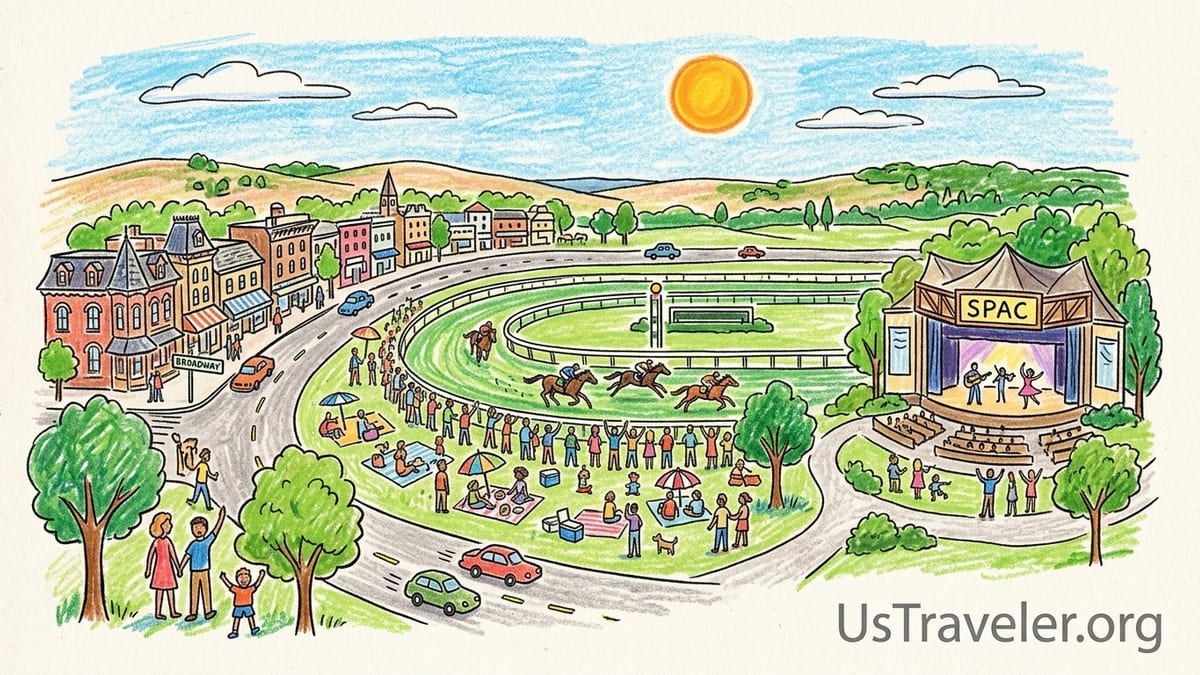
Summer Saratoga Is A Different Town (And I Mean Fundamentally)
My “aha” moment came during racing season, walking toward Saratoga Race Course on a bright, sticky afternoon and realizing the crowd wasn’t just large, it was purpose-built. People weren’t wandering; they were arriving. The morning belonged to picnic-table strategy and “what gate are you entering?” texts. The afternoon belonged to the paddock ring and the rail. Evening belonged to dinner on or near Broadway, and if you had concert tickets, Saratoga Performing Arts Center was the gravitational pull that kept the night going.
That’s the big difference summer makes: it layers major, schedule-driven events on top of Saratoga’s everyday charms. In 2026, NYRA ran a 46-day Saratoga summer meet from July 3 through September 7. That calendar creates the kind of consistent crowd energy you don’t get from a single festival weekend. Even on “regular” days, the track has its own ecosystem: live music at the Purdy’s Summer Music Stage, the Big Red Spring water station, and a picnic culture that feels closer to a family reunion than a stadium event.
SPAC amplifies that summer rhythm. In 2026, SPAC marked its 60th anniversary season, and it didn’t feel like a footnote, it felt like the town’s second headline. One of the signature moments was the New York City Ballet residency, July 8 through July 11, with programming tied directly to SPAC’s history, including “A Midsummer Night’s Dream,” the same title performed on SPAC’s opening night in 1966.
And yes, summer weather is part of the story, but I’ll keep it personal: the heat and humidity I experienced during race season changed how I planned my days. I started treating midday like a logistics problem. I packed more water than I thought I’d need, I took shade seriously, and I stopped pretending I could do a full day at the track and then a full night out without building in downtime.
Race Season Reality Check: Crowds, Costs, And Whether It’s Worth It
If you’ve never been, the racetrack day can be surprisingly accessible and surprisingly expensive, sometimes in the same breath. NYRA’s general admission for the 2026 summer meet was posted at $7 in advance or $10 day-of. That price gets you into the grandstand and clubhouse areas plus the backyard, which is where Saratoga’s DIY personality really shows itself.
The backyard is where I felt Saratoga’s racing culture most clearly: people hauling soft coolers, folding chairs, and tablecloths like it’s a competitive sport. NYRA allows coolers (with size limits), and you can bring food and beverages including alcohol as long as it’s in plastic or cans, with no glass. The detail that mattered in real life during 2026: if you bring a cooler with ice, NYRA required ice to be sealed in bags before arrival, and cooler inspection lanes were designated for certain gates. That rule alone changed how I packed, because it’s the difference between strolling in and getting stuck in a security bottleneck.
Costs beyond admission are where summer can start to sting. Even if you’re not chasing hospitality packages, the busy season pushes you toward paid solutions: ride-shares when parking feels daunting, pricier last-minute hotel nights, and dinner reservations that require planning. I felt it most acutely when I tried to “play it spontaneous” and ended up choosing between a long wait or an early dinner that didn’t fit the track schedule. In summer, Saratoga rewards planners.
Was it worth it? For me, yes, once, in the way a big-deal trip is worth it: you go for the atmosphere as much as the activity. There’s an electricity to seeing the paddock fill, hearing the crowd’s volume rise, and then watching people pour out toward Broadway afterward. But I also learned I wouldn’t choose race season every year. If what you want is a relaxed Saratoga that lets you focus on museums, historic architecture, spa-state-park walks, and unhurried meals, race season can feel like trying to read in a room where the TV is always on.
SPAC In Summer: How A Concert Night Changes The Whole Trip
I used to think of SPAC as “a show you go to,” not “a force that reshapes your itinerary.” That changed the first time I paired a track day with a performance night. Suddenly the whole day had a countdown: when to leave the track, where to grab a fast dinner, how to avoid feeling wrung out before the first note.
In 2026, SPAC’s 60th anniversary programming made summer timing even more meaningful. The New York City Ballet residency ran July 8 to July 11 and leaned into SPAC’s origin story, including “A Midsummer Night’s Dream.” SPAC also promoted concrete ways to make summer nights more affordable, such as its $19.66 anniversary lawn ticket promotion for many New York City Ballet and Philadelphia Orchestra performances, an on-the-nose nod to SPAC’s founding year.
Here’s the practical travel-author part: SPAC nights and racing days can compete for the same limited resources, your energy, your parking patience, and your dinner reservations. If you’re building a summer Saratoga itinerary, I found it smarter to pick one “big night” and design the rest around it. That might mean a morning at the Spa State Park trails, an early afternoon at the track, then a shower and a simple dinner before SPAC. The mistake I made once was treating it like two separate days, and the result was a version of Saratoga that was impressive but exhausting.
Summer also adds “special night” opportunities you don’t get the rest of the year. SPAC’s gala-style fundraiser, for example, had ticket tiers published with real price tags, and it’s the sort of event that attracts visitors who aren’t here for the races at all. That mix is part of what makes summer Saratoga feel larger than the town’s size.
Fall Saratoga: Foliage, History, And The Saratoga I Could Finally Hear
Coming back in fall felt like returning to the same set after the extras went home. I didn’t need the mental spreadsheet of gates, inspection lines, and “if we leave now we’ll miss…” conversations. Instead, Saratoga’s details came forward: the architecture, the slower meals, the way Saratoga Spa State Park feels more meditative when your day isn’t anchored to post time.
I’m careful with foliage talk because it’s easy to become poetic in a way that’s unhelpful. What I can say from personal experience: fall was when I finally wanted long walks. The weather I experienced made it easier to spend more of the day outside without feeling like I needed to constantly hunt shade or air conditioning. It also made history-focused stops feel more natural, the kind where you linger rather than rush back to “the main event.”
For objective timing advice, fall travel works best when you treat it like a weekend of layers: a light jacket in the morning and evening, comfortable shoes for downtown and park walks, and a plan that doesn’t rely on packed calendars. You’re not coming for the big summer machine; you’re coming for space. Saratoga’s downtown still feels lively, but the trip becomes less about securing access and more about choosing what you actually want to do.
If you’re the type who likes a “recognizable” Saratoga souvenir moment, fall is also when I found it easiest to do the classic loop: coffee on or near Broadway, a wander through shops, a calm hour in the park, and an unhurried dinner that doesn’t feel like you’re racing a curtain time.
Winter Weekends: Culture-Forward, Quieter, And Surprisingly Complete
My winter trip rewired my assumptions. I expected Saratoga to feel dormant. Instead, it felt curated. With fewer visitors, my days naturally leaned toward the cultural and the cozy: museums, bookstores, long lunches, and a version of nightlife that’s more “good cocktail and conversation” than “let’s make the 9:00 reservation before it disappears.”
Winter is also when Saratoga’s value proposition changes. You’re less likely to pay peak-season pricing for the privilege of being in the middle of everything. The tradeoff is obvious: fewer marquee events and less of the summer outdoor buzz. But if your ideal Saratoga includes actually hearing yourself think, winter delivers that without feeling like a compromise.
Because I personally experienced winter conditions that could change quickly, I’ll keep the weather talk grounded: I dealt with cold that made short outdoor walks feel better than long ones, and I planned my days around being indoors for stretches. That didn’t make the trip worse. It made it different, more intentional, and honestly more restorative than my race-season sprint.
Objective planning advice for winter is simple: build a trip around two anchors per day, not four. Choose a cultural stop, then a long meal, then something else only if you still feel like you have energy. Saratoga in winter is at its best when you stop trying to force it into a summer-shaped itinerary.
Spring In Saratoga: The Quiet Reset Before The Big Switch Flips
Spring is the season I now recommend to friends who want Saratoga without the race-season pressure, but still want it to feel awake. It’s a shoulder season that can feel like you’re getting the town before it puts on its summer outfit. You’ll still find plenty to do, but you’re less likely to feel like you’re competing for every table, ticket, and parking space.
From a planning perspective, spring is when you can test-drive Saratoga’s core attractions without the summer intensity. If your goal is to understand the layout, how downtown connects to Saratoga Spa State Park, where SPAC sits inside the park, and how the racetrack area relates to Broadway, spring gives you the breathing room to learn it. That knowledge pays off if you decide to come back for racing season later.
It’s also the easiest season for what I call “two versions of Saratoga in one day.” You can do an active morning outdoors, then a slow afternoon downtown, and still have energy left. In summer, I often felt like I had to pick which version of myself I was going to be: the early-tablecloth track person or the relaxed museum-and-dinner person. Spring makes it easier to be both.
If you’re timing spring travel around major events, do current research right before you book. NYRA and SPAC calendars move year to year, and Saratoga’s vibe can shift dramatically when a single weekend stacks multiple draws. The good news is that even when something is happening, spring crowds tend to feel more manageable than midsummer.
The Takeaway
If you want Saratoga at maximum volume, come in summer and commit to it. The 2026 summer meet ran July 3 through September 7, and that long arc is exactly what makes summer feel like a season-long festival rather than a one-off event. Add SPAC’s summer programming, including its 60th anniversary celebrations and the New York City Ballet residency July 8 through July 11, and you get a Saratoga that feels bigger than the map suggests.
Just know what you’re trading for that energy: higher prices, busier streets, and the feeling that your trip is being scheduled by forces larger than you. For me, paying more and dealing with a busier Saratoga was worth it once because the summer atmosphere is genuinely singular. But it also taught me that the Saratoga I return to most happily is the off-season town, when I’m not constantly negotiating crowds.
Fall gave me Saratoga’s beauty with room to breathe, and winter gave me Saratoga’s culture with a calmer pulse. Spring became the sweet spot for travelers who want a preview of the place without the peak-season pressure. The best time to visit, in other words, depends on what you want Saratoga to be: a spectacle, a stroll, or a weekend that feels like a reset.
FAQ
Q1. What is the best time to visit Saratoga Springs for the full “Saratoga” experience?
For the most iconic version, visit during the NYRA Saratoga summer meet, when racing, downtown, and SPAC all overlap and the town feels like an ongoing event.
Q2. When did the 2026 Saratoga summer meet run?
NYRA’s 2026 Saratoga summer meet ran for 46 days from July 3 through September 7, 2026.
Q3. Is Saratoga Springs worth visiting outside of race season?
Yes. Fall and winter are especially rewarding if you prefer fewer crowds, easier reservations, and a more relaxed pace focused on history, culture, and parks.
Q4. How much is general admission at Saratoga Race Course?
For the 2026 summer meet, NYRA listed general admission at $7 in advance or $10 on the day of the event.
Q5. Can you bring your own food and drinks into Saratoga Race Course?
NYRA allows outside food and beverages, including alcohol, as long as alcohol is in plastic containers or cans and no glass is brought in; coolers are allowed within posted size and security rules.
Q6. What cooler rule caught people off guard in 2026?
NYRA required ice to be sealed in bags before arrival for 2026, which changed how many visitors packed and entered security screening.
Q7. What made SPAC’s 2026 summer season different?
SPAC celebrated its 60th anniversary season in 2026, including special programming and a New York City Ballet residency designed to honor SPAC’s history.
Q8. When did New York City Ballet perform at SPAC in 2026?
New York City Ballet’s SPAC residency in 2026 ran July 8 through July 11.
Q9. What is a good strategy if you want racing season energy without burning out?
Plan fewer major commitments per day, bring what you need for heat and sun, and choose either a full track day or a SPAC night as your main anchor instead of trying to max out both.
Q10. If I only have one weekend, which season should I choose?
Choose summer if you want spectacle and major events, fall if you want foliage and history with breathing room, winter for a calmer cultural weekend, and spring for an easy, lower-stress introduction.