


I’ve done the New York Capital Region in three very different ways: a workday-style stay in Albany built around big public buildings and museums, a Saratoga Springs weekend where everything revolved around Broadway after dark and water (mineral and otherwise), and a Troy escape that felt like time travel through brick, cast iron, and steep streets down to the Hudson. On a map, these places are close enough that you can day-trip between them. In real life, they don’t blur together. Where you sleep changes how the whole trip feels from your morning coffee ritual to how late you’ll stay out because you can walk home.
Arrival, First Impressions, And How Each Place “Runs”
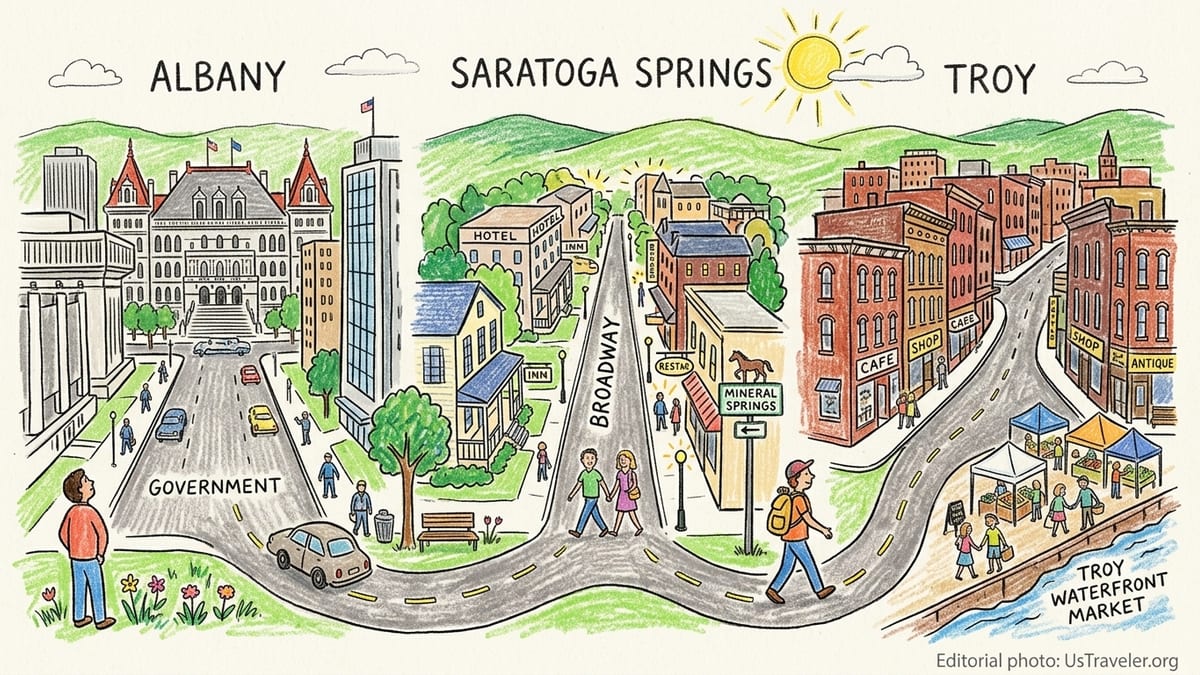
Albany hit me first as the region’s engine room. Even on a casual visitor day, the city’s center of gravity is obvious: government blocks, office rhythms, wide streets, and those moments where you turn a corner and the scale suddenly jumps. My first afternoon I did exactly what most first-timers do: I walked up toward the New York State Capitol and the Empire State Plaza and immediately felt like I’d chosen the “capital city” option, not just another upstate weekend.
Saratoga Springs, by contrast, greeted me like a resort town with a serious cultural calendar. My arrival there felt less like checking into a city and more like slipping into a scene: manicured streets, porch-front hotels, and a downtown where you can sense that evenings are the main event. I didn’t need a mental map for long. Broadway acts like a spine, and you can build a whole weekend around a few blocks without feeling like you’re repeating yourself.
Troy’s first impression was architectural, and it was immediate. I remember thinking, “This is a city you look at.” It has that compact, older Northeastern city feel where the streets do not apologize for hills or odd angles. Walking the Victorian streets and then dropping down toward the waterfront gave me a clear sense of how Troy’s story is tied to industry and the river, and why a stay here feels more like a neighborhood-by-neighborhood exploration than a checklist of marquee attractions.
Where I Slept: Accommodation Styles, What You Actually Get, And What It Costs
In Albany, I prioritized being able to walk to the Capitol, museums, and dinner without turning every outing into a parking plan. Downtown hotels make that easiest. On one trip I stayed near State Street and noticed how much the midweek “government is in session” factor can influence the vibe and room rates. I also learned a very Albany detail fast: even if you pick a hotel that’s “right there,” you still want to think through garage parking fees and the reality that some streets quiet down early.
Saratoga Springs accommodations felt more personality-forward. If you’re near Broadway, you’re buying walkability and nighttime energy. I stayed close enough to stroll out after dinner and still decide, last-minute, to catch live music without checking rideshare pricing. But Saratoga also makes you pay attention to timing: racing season and big event weekends can shift availability and pricing dramatically, so my most “easy” Saratoga stays were the ones I booked with the calendar in mind, not just the map.
Troy surprised me with how many stays feel like you’re borrowing a piece of the city’s building stock: older structures repurposed, boutique-leaning options, and dependable chain hotels near the waterfront that are practical if you want to be close to River Street. When I stayed near downtown, the payoff was simple: I could end a night with one more drink or one more walk past illuminated brick facades and still be back at my door quickly.
Researched note: recent local guidance has quoted the Renaissance Albany on Broadway around $170 to $220 on some dates, while noting downtown can jump to roughly $210 to $290 midweek when the Legislature is in session. Those ranges move, but the pattern is real: in Albany, your rate can be dictated as much by the weekday calendar as by tourist demand.
Walkability, Car Dependence, And How Easy It Feels To Do A “Car-Light” Trip
Albany is walkable in bursts, and those bursts are anchored by big magnets. The Capitol and Empire State Plaza complex, the State Street corridor, and museum stops can create a satisfying day on foot. But I also felt the seams: a few blocks can shift quickly from lively to empty, and some distances that look short on a map feel longer when you’re crossing wide streets or navigating around large complexes. My Albany sweet spot was staying downtown and planning a day that was mostly concentrated, not sprawling.
Saratoga Springs is the easiest of the three to do without a car once you arrive, especially if you stay downtown. I walked to breakfast, wandered shops, spent time in parks, and still had plenty of evening options, all without thinking about parking. Even when I did go out to Saratoga Spa State Park, the whole day still felt “vacation simple,” the kind of place where you can let the day unfold rather than schedule it around driving and meters.
Troy is walkable in a different, more urban way. It’s compact, but it’s also textured: hills, stair-like blocks, and those “one more turn” streets that make a neighborhood stroll feel like a mini-adventure. I didn’t mind that it’s not as polished as Saratoga because the trade-off is character. For a car-light stay, Troy worked well for me when I focused on downtown, River Street, and the waterfront, with occasional rides out if I wanted to bounce farther.
Researched note: travelers often use Empire State Plaza visitor parking for Albany’s core government sights, which can simplify a day even if you’re driving in from a different base. That’s useful context if you’re staying in Troy or Saratoga and plan to day-trip into Albany for the Capitol.
Signature Days And Evenings: Capitol Grandeur, Broadway Glow, And Troy’s Victorian Streets
Albany gave me my most “only-in-the-capital” moments. Touring the New York State Capitol felt like the sort of experience you’d expect to pay for in another city, yet it’s presented as a public resource. Inside, the building delivers that layered sense of history and civic theater, and stepping back out toward Empire State Plaza underscores the contrast between ornate interiors and the Plaza’s modernist, monumental sweep.
One Albany evening that stuck with me was simply being outside around Empire State Plaza after the daytime bustle thinned out. The architecture can feel imposing in daylight, but at night it becomes more atmospheric. If you time your stay with a performance, The Egg, which sits within the Plaza complex, adds a clear “evening plan” to a city that can otherwise feel like it’s more about daytime institutions than late-night wandering.
Saratoga’s signature memory for me is an evening on Broadway that started casually and kept extending itself. Dinner didn’t feel like the end of the night; it felt like the opening act. I remember walking a few blocks, ducking into a bar with live music energy nearby, and noticing how the sidewalks keep a steady pulse. In Saratoga, the evening atmosphere is not an accident. It’s the town’s superpower.
Troy’s signature moments were quieter but more immersive: walking Victorian streets at a pace that let me notice cornices, old signage, and the way brick buildings catch late light. I wandered toward the waterfront and felt the city re-orient around the river. Troy’s evening mood is less about a single strip and more about the pleasure of moving through a historic downtown where the buildings do half the storytelling for you.
Researched note: weekday walk-in tours of the New York State Capitol are commonly offered at set times, and official guidance also notes that larger groups should reserve in advance. I treated that as a “show up early” situation, especially when Albany felt busy.
Food And Restaurants: Where I Ate, How It Felt, And What Each City Does Best
In Albany, my best meals tended to come from targeting specific neighborhoods rather than assuming the whole downtown grid would deliver. When I did it right, I could string together a museum afternoon and a satisfying dinner without moving the car, but I also noticed Albany can feel a little more “choose your spot” than Saratoga, where the concentration of restaurants makes decision-making easier. Albany dining worked best for me when it was part of a plan: sights, then a meal, then maybe a show.
Saratoga Springs made eating out feel like the main attraction. The variety is obvious as you walk Broadway: from casual deli energy to date-night dining, it’s built for visitors who want options at every price point. I liked how easy it was to pivot mid-evening, for example, going from dinner to a quick dessert stop to a final drink, without feeling like I was commuting across town.
Troy, on the other hand, felt like the region’s most “food weekend” friendly base for me, in a way that surprised me. The city’s downtown scale encourages grazing: coffee, a late breakfast, a browse in shops, then a sit-down meal later. When I lined up my trip with market time on the waterfront, the experience felt especially grounded, like I wasn’t just consuming the city, I was participating in it.
Researched note: the Troy Waterfront Farmers Market has advertised Saturday hours of 9 a.m. to 2 p.m. in recent seasons, and local materials also indicate a return in summer 2026 after a hiatus. Because market operations can shift by season and location, I treat those hours as something to confirm before building a whole morning around them, but it’s still one of the most “Troy” experiences you can plan.
Nightlife And Evening Atmosphere: Late Music, Quiet Corners, And What “Going Out” Means Here
Albany nightlife felt more situational for me. When I had a specific plan, like a show at The Egg or a targeted bar stop, the night worked. When I tried to “just wander until something happens,” the city felt less cooperative, especially on quieter nights. Albany’s evening atmosphere is at its best when you anchor it to an event or a neighborhood you already know you like.
Saratoga Springs is the easiest place of the three to have a spontaneous night. Broadway supports the classic travel fantasy: step outside, feel the buzz, choose a place that looks good, and keep moving. One of my most enjoyable Saratoga nights ended at a live-music venue that was close enough to everything that it didn’t require a transportation decision, just a “Do we want one more song?” decision.
Troy nightlife landed somewhere in between. It didn’t feel like a constant party street, but it did feel social, especially on weekends. The vibe is more “smart casual night out in a historic downtown” than “resort energy.” I liked that I could have a real evening with cocktails or beer and still end it with a calm walk where the city’s architecture and streetlights did the heavy lifting.
Researched note: Putnam Place in Saratoga Springs is promoted as a 400-capacity live music venue and nightclub steps from downtown hotels and restaurants, and it’s a good shorthand for Saratoga’s advantage: you can build a whole night with very little friction.
Museums, History, Architecture, And Events: What I’d Prioritize In Each Base
Albany is where I would base myself for a first regional trip focused on big-ticket civic history and museums. The New York State Museum is a natural half-day, and pairing it with the Capitol and Empire State Plaza creates a “capital culture” itinerary that feels coherent. Albany’s architecture story is also a story of contrasts: historic government interiors against a bold modernist plaza complex. It’s not always pretty in the way Saratoga is pretty, but it’s undeniably distinct.
Saratoga Springs is the best base when the trip is really about entertainment and the “classic Saratoga” mix of racing culture, mineral springs, and nights out. I also like it for a racing-and-spa weekend specifically, because the town supports that rhythm: daytime activity, a reset at the park or a soak, then a Broadway evening. The town’s schedule can be packed, and that’s part of the appeal if you’re the kind of traveler who wants your weekend to feel like a lineup.
Troy is where I’d stay for an architecture and history break that’s more about streetscapes than singular institutions. The downtown historic district feel is tangible, and the city leans into its Victorian identity in a way that makes a casual walk feel like a self-guided tour. If you’re the traveler who takes photos of doorways, cornices, and old storefronts, Troy quietly becomes the richest canvas of the three.
Researched note: Troy’s downtown has been listed on the National Register of Historic Places for decades, and official preservation and heritage materials emphasize River Street’s role as an early commercial area. This aligns with what you feel on foot: Troy’s “attraction” is the intactness of the urban fabric.
The Takeaway
I wouldn’t call a universal winner here because the best base depends on what you want the trip to feel like. For a first-ever Capital Region visit where you want the state-capital essentials, I personally found Albany the most efficient and satisfying base, especially if your days are built around the Capitol, museums, and the Empire State Plaza complex.
For a racing-and-spa weekend or an entertainment-forward couples’ getaway, I found Saratoga Springs the most suitable base because it’s designed for walkable evenings, live events, and that distinctive Saratoga “water and nightlife” identity. It’s the place where you can plan very little and still feel like you’re in the middle of something.
For an architecture-and-history break or a food-leaning weekend that feels local and textural, I found Troy the most rewarding base. It’s the place where a simple walk becomes the activity, and where the waterfront and Victorian streets give you a sense of discovery without needing a formal itinerary.
For a car-light stay, Saratoga Springs made it easiest to live on foot from morning coffee to late-night music, while Troy worked well for me if I committed to a compact downtown radius. Albany can be car-light if you stay downtown and keep your plans clustered, but it felt the most “event-anchored” of the three once the workday energy faded.
FAQ
Q1. Which is best for a first-time Capital Region trip with classic sights?
Albany, because the Capitol, Empire State Plaza, and major museums sit close together and set the context for everything else.
Q2. Which base feels most walkable for restaurants and nightlife?
Saratoga Springs, especially if you stay near Broadway, where dinners, bars, and live music cluster tightly.
Q3. Where should I stay for a racing-focused weekend?
Saratoga Springs, since the race culture, nightlife, and visitor infrastructure are all built around the season and the track.
Q4. Where is the best place for mineral springs and a true spa vibe?
Saratoga Springs, because Saratoga Spa State Park and classic mineral-water experiences are central to the town’s identity.
Q5. Which town is most rewarding for architecture lovers?
Troy, thanks to its dense Victorian-era streetscapes and preserved historic downtown that makes walking feel like a tour.
Q6. Can I do this region without renting a car?
Yes if you choose carefully: Saratoga Springs is easiest car-light, Troy can work in a compact downtown stay, and Albany works best when you stay downtown and plan tightly.
Q7. Which base is best for museums?
Albany, where major institutions and civic sites are concentrated near the Capitol and Empire State Plaza area.
Q8. Which is better for a food weekend with market energy?
Troy, especially if you time your stay around the waterfront market and plan to graze through downtown cafés and restaurants.
Q9. Which place feels most “evening atmospheric” for strolling after dinner?
Saratoga Springs for lively strolling on Broadway, and Troy for quieter, beautifully lit Victorian streets and waterfront walks.
Q10. How do I choose if I only have one weekend?
Pick Albany for capital history and museums, Saratoga Springs for racing, springs, and nightlife, or Troy for Victorian architecture and a slower-paced, neighborhood-style stay.