


I came to Saratoga Race Course thinking the hard part would be figuring out where to watch the races. I was wrong. The real learning curve is the logistics: picking the right day, buying the right kind of ticket, arriving at the right time, and knowing what “general admission” actually gets you once you’re inside. After spending a full race day at the Spa, here’s the extremely practical, step-by-step guide I wish I’d had, written for first-timers who want the classic Saratoga day without making it all about betting slips.
How I Picked the Date (And Why It Matters More Than You Think)
Saratoga in 2026 wasn’t a single, simple “summer meet” in the way longtime fans describe a traditional eight-week run. The track hosted the five-day Belmont Stakes Racing Festival at Saratoga from June 3 through June 7, 2026, and then the Saratoga Summer Meet ran from July 3 through September 7, 2026. That calendar matters because crowds, gate times, and what you can realistically do with general admission shift dramatically depending on which part of the season you choose.
I chose a regular live racing day in the summer meet rather than one of the marquee days (like Whitney Day or DraftKings Travers Day) because I wanted a first visit that was busy but not overwhelming. NYRA’s own guidance makes it clear that the table rush can be “within minutes” on marquee days, and in practical terms that changes your entire day: you’re either committed to the early-morning sprint for a picnic table or you need a paid reserved option so you can arrive later without stress.
My rule of thumb after going: if your group includes first-timers, kids, or anyone who cannot comfortably do a long day in the sun, don’t make your first Saratoga day a mega-crowd day. Save that for visit two, after you’ve learned the flow and your personal tolerance for heat, lines, and walking.
Buying Admission: General Admission vs Reserved Seating vs Picnic Tables vs Premium Areas
I bought general admission in advance because in the completed 2026 season, general admission was cheaper ahead of time ($7 in advance vs $10 at the gate), and it was the simplest “get me in the building” option. In 2026, kids 12 and under were free with an adult, which is a big deal for families planning a full day and trying to keep costs predictable.
Here is what I learned about what general admission actually means at Saratoga: it is access, not a seat. With a GA ticket you can enter and roam the Rivers Casino Backyard, the Clubhouse, the Grandstand, and the trackside apron. You can bring a cooler, a picnic basket, and lawn chairs, and you can use communal seating like backyard picnic tables if you find one. But GA does not come with a reserved chair in the grandstand or clubhouse, so if you picture yourself sitting in one specific seat all afternoon, GA alone is not the plan.
Reserved seating is the “I want a guaranteed place to sit” category. Saratoga sells reserved Grandstand and Clubhouse seats and other reserved areas, and those reserved seat prices generally include admission when bought in advance. Practically, reserved seats are what I recommend if you are coming with someone who cannot stand for long stretches, if your group wants a single home base without the morning table rush, or if you’re traveling in from out of town and cannot arrive early.
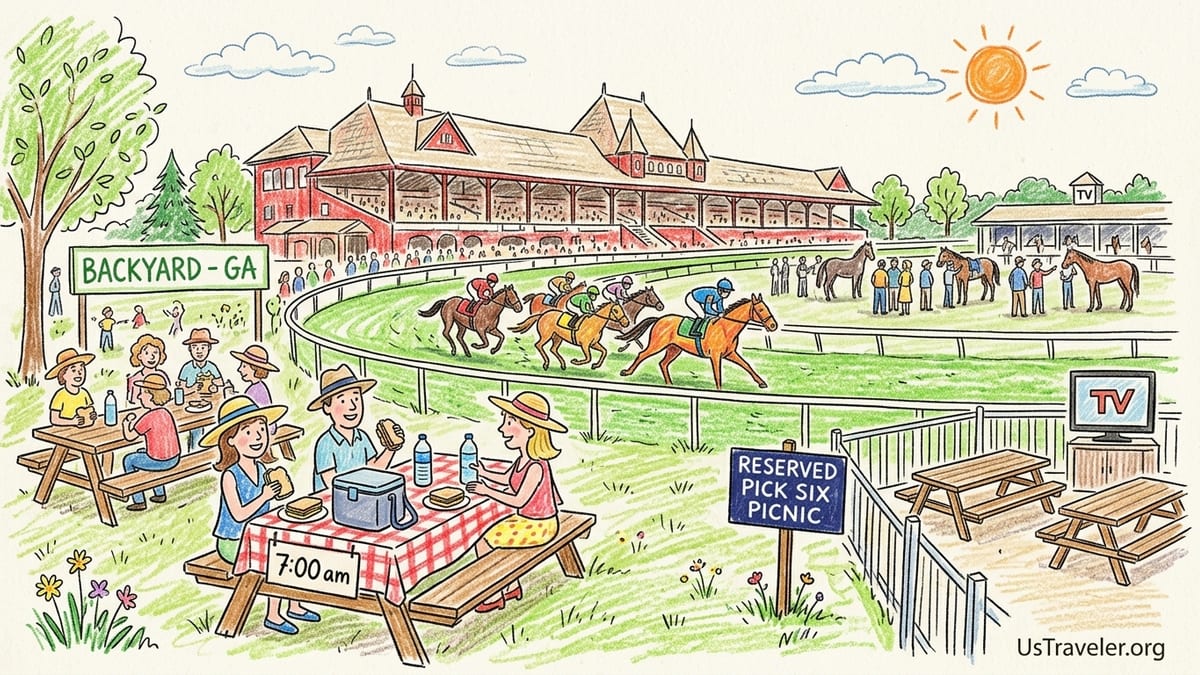
Picnic tables come in two very different flavors. The first is the Saratoga tradition: free backyard picnic tables that are first-come, first-served and usually claimed by early birds with tablecloths. The second is a reserved picnic table product, which is a paid upgrade that guarantees a table and lets you show up on your own schedule. In 2026, one of the best-known reserved picnic options was the Pick Six Picnic Paddock, which is positioned for paddock views and is built for groups up to six, with TVs nearby. If the romance of “we’ll just grab a table” stresses you out, the reserved picnic route is the pressure-release valve.
Premium areas are a separate universe: hospitality and elevated experiences like the 1863 Club and other hosted spaces, often sold as packages and typically designed for entertaining, dining, and comfort. If you want shade, air conditioning, and a predictable experience on a high-demand day, this is where you end up. The trade-off is cost and the fact that your Saratoga day becomes more “planned” and less wandering picnic culture.
Arrival Strategy: The Tablecloth Rush, Gate Times, And a Realistic Timeline
The biggest Saratoga timing lesson is that there are effectively two gate openings on most days. There is early-morning access at 7:00 a.m. for people trying to claim a backyard picnic table, and then there is the official gate opening at 11:00 a.m. when tickets are scanned. The early entry is the moment you will see veteran Saratoga behavior in the wild: brisk walking that becomes speed-walking, tablecloths folded in arms, and a very specific kind of polite intensity.
If you use early-morning access to claim a table, NYRA’s current process is not “set it and forget it for the rest of the day.” You fasten your tablecloth, then you are asked to vacate before the official 11:00 a.m. opening, and you come back through the ticketed entrance when admissions begin. That means you need a plan for what you will do between claiming the table and coming back, especially if you are visiting from out of town and don’t have a nearby house or rental to retreat to.
If you are not trying to claim a free picnic table, the day gets much simpler. NYRA’s own guidance is that guests with assigned seating can arrive any time they wish. That is exactly how it feels: when you know you have a reserved seat or a reserved table, you can time your arrival around traffic and your tolerance for lines rather than racing the sunrise.
One more timing detail first-timers miss: public parking and first post times can vary by day and by major event. For example, NYRA listed first post at 12:35 p.m. on Saturdays and 1:10 p.m. on many other days, and it also noted earlier gate openings on major days like Travers Day. The practical point is not memorizing every number; it’s checking the specific day you plan to go, because it changes how early you should eat, park, and get through the gates.
Parking, Shuttles, And What I’d Do Differently Next Time
Saratoga is not a “pull up, step out, and you’re at your seat” venue unless you pay for proximity. In 2026, NYRA described free general parking with complimentary shuttle service that operates to and from the Union Avenue drop-off point across from Gate A. That shuttle detail is what makes free parking workable for many visitors: it turns what can be a long walk into a more manageable arrival, particularly if you’re carrying chairs or a cooler.
If you want to pay for closeness, NYRA’s map guidance breaks premium parking into two categories. Preferred Parking includes lots like East, Madison, and Rec Hall, available via pre-paid reservations. Silver Trackside Parking is a priority area on the same side of Union Avenue as the racetrack. In practical terms, those paid lots are about buying back time and energy, especially on hot days or when you have kids, older relatives, or a group hauling gear.
My on-the-ground takeaway: if you are doing the 7:00 a.m. tablecloth rush, parking convenience matters more than you think because you are moving at the most chaotic time of the day. If you are arriving at 11:00 a.m. or later with reserved seating, you can be more relaxed about parking, because your success is not determined by beating anyone to a table. Next time, for a casual midweek trip, I would use free parking and shuttle without hesitation. For a Saturday, a holiday weekend, or a day I know will be crowded, I would seriously consider reserving Preferred or Silver Trackside to reduce friction.
If you are using rideshare or a local taxi, treat your drop-off like a mini-plan, not an afterthought. Saratoga Springs traffic patterns around the track can bottleneck. Give yourself a buffer, especially if you care about catching the paddock for an early race or if your group has a fixed meetup time.
Getting In, Getting Settled, And Understanding Shade, Chairs, Coolers, And Walking
Once I reached the gates, the next practical reality was security and bag checks. Coolers are allowed at Saratoga, but they are subject to search, and there are size and content rules that matter if you’re trying to avoid a frustrating reset at the entrance. NYRA’s cooler policy in 2026 allowed one cooler per guest up to 12 inches by 18 inches, with medical exemptions. Food and beverages were allowed, including alcohol for personal consumption by patrons 21 and older, but glass was not permitted. For 2026, NYRA also added a specific operational detail: ice needs to be sealed in bags before arrival. That is the kind of rule that’s easy to miss until you’re standing in a line holding a half-melted loose bag of ice and regretting your convenience-store choices.
My packing approach after seeing the scene: bring a medium soft-sided cooler you can carry comfortably, and assume you will walk more than you think. Saratoga is a campus. Between the backyard, paddock, grandstand, clubhouse areas, apron views, and food stands, you rack up steps quickly. If your group is bringing chairs, keep them lightweight and truly portable. It is fun to “set up camp,” but it’s also easy to overpack and spend the day lugging gear instead of enjoying the place.
Shade is its own strategy. Saratoga can feel idyllic under trees and brutal in open sun, sometimes within a few yards. If you’re doing free seating, the best first move is not “find the perfect view.” It’s “find survivable shade.” I noticed experienced visitors prioritizing tree cover in the backyard, then using the many TVs throughout the facility to keep track of races when their picnic spot wasn’t trackside. That is the Saratoga hack: you don’t need line-of-sight to the finish line all day to have a great day.
Seating-wise, I treated the venue like a loop. I’d settle my base, then rotate: paddock for the pre-race energy, apron for the live run, then back to shade for a breather. The walking is part of the charm, but only if you plan for it with shoes you’d wear to a street festival, not shoes you’d wear for a quick dinner reservation.
One key operational note for 2026: Saratoga was cashless for most non-wagering purchases, including admission, parking, and food and beverage, with a noted exception for the official Saratoga store. Practically, that meant I kept a card and a phone wallet ready and did not assume I could solve problems by finding an ATM. For a first-timer, “cashless” is not a vibe; it’s a bring-the-right-payment-method requirement.
My Race-Day Loop: Backyard, Paddock, Food, And Where I Actually Watched the Races
After I got inside and oriented myself, I built the day around three anchor points: the backyard for decompression, the paddock for atmosphere, and the apron for actually watching the race. The paddock is where Saratoga feels most alive: the horses circling, the crowd tightening, the last-minute photos, the sense that something is about to happen. Even if you don’t know a thing about racing, the paddock is the most intuitive “this is why we came” spot on the grounds.
The backyard is where the day becomes sustainable. With general admission, I found myself returning there between races to cool down and reset. It’s also where Saratoga’s “bring your own day” culture shows up: coolers, picnic blankets, folding chairs, and families who look like they’ve done this for years. If you want a classic Saratoga day without needing a high-end reservation, the backyard is the center of gravity.
When it came time to watch the races, I moved closer to the trackside apron for the live action, then stepped back to less congested areas right after the finish to avoid getting trapped in slow-moving crowd currents. A practical crowd tip: the five to ten minutes before a race can feel like a rush hour wave, and then it releases quickly once the horses are down the stretch. If you time your movement for just after the finish, you can cover ground while the lines are shorter and the walkways are looser.
Food was straightforward, but the timing mattered. The easiest way to avoid long lines was to eat in the gaps rather than at obvious peak moments. I also saw how many visitors build their food plan around the fact that outside food is allowed in many areas: they bring a cooler with sandwiches, water, and snacks, then buy one or two iconic track foods as a treat instead of relying on concession lines all day.
I also learned to treat hydration like an item, not an idea. Even if you’re not drinking alcohol, the heat and walking can sneak up. I kept water in my cooler and refilled when I could rather than trusting I’d “grab some later.” Later is when everyone else also decides they need it.
The Takeaway
Saratoga Race Course rewards practical planning more than insider knowledge. You don’t need to understand past performances to have a great day, but you do need to understand the difference between access and a seat, and you need to respect the track’s time-based rhythms: early entry for tables, official gates at 11:00 a.m. on most days, and surges around each race.
If you want the lowest-stress first visit, my personal recommendation is simple: buy general admission in advance, arrive with a lightweight setup (not a full campsite), prioritize shade over perfection, and build your day around a repeating loop of backyard, paddock, apron, and breaks. If your group needs guaranteed comfort, upgrade to reserved seating or a reserved picnic option so your day is about enjoying Saratoga, not competing for it.
Most importantly, decide what kind of day you want before you pick your ticket. Saratoga can be a relaxed picnic under trees, a packed-shoulder stakes-day spectacle, or a premium-hosted event with buffet service. The right choice is the one that fits your group’s stamina, budget, and willingness to arrive early.
FAQ
Q1. What were the 2026 Saratoga Race Course dates?
In 2026, Saratoga hosted the Belmont Stakes Racing Festival at Saratoga from June 3 to June 7, and the Saratoga Summer Meet from July 3 to September 7.
Q2. How much was general admission in the completed 2026 season?
General admission was $7 in advance or $10 at the gate, and children 12 and under were free with an adult.
Q3. What does a general admission ticket actually include?
General admission provides access to the Rivers Casino Backyard, Clubhouse, Grandstand, and trackside apron, plus communal seating if you can find it, but it does not guarantee a reserved seat.
Q4. What time do the gates open, and what is the tablecloth rush?
On most live racing days, Saratoga offered early entry at 7:00 a.m. for guests trying to claim free backyard picnic tables, and official ticketed entry began at 11:00 a.m.
Q5. Can I bring a cooler, and what size is allowed?
Yes. NYRA’s 2026 policy allowed one cooler per guest up to 12 inches by 18 inches, subject to search, with no glass permitted.
Q6. What was new about coolers and ice in 2026?
For 2026, Saratoga required that ice in coolers be sealed in bags prior to arrival for safety and efficiency.
Q7. Is Saratoga cashless?
In 2026, Saratoga operated cashless for most non-wagering purchases, including admission, parking, and food and beverage, with an exception noted for the official Saratoga store.
Q8. How does reserved seating differ from general admission?
Reserved seating is a separate ticket category that gives you an assigned Grandstand or Clubhouse seat, which is helpful if you want a guaranteed place to sit all day.
Q9. What is a reserved picnic table option like Pick Six Picnic Paddock?
A reserved picnic table is a paid upgrade that guarantees your table. Pick Six Picnic Paddock was marketed for groups up to six with paddock views and nearby TVs.
Q10. What should first-time visitors bring to stay comfortable?
Plan for sun and walking. Bring comfortable shoes, sun protection, a small allowed cooler with water, and lightweight chairs if you want a backyard base.