


I came to New York’s Capital-Saratoga region expecting a quick loop of “government, horses, and history.” What I didn’t expect was how strongly the place expresses itself through spaces you can physically move through: a staircase carved like a political scrapbook, Victorian streets that feel lived-in rather than preserved, spring water that tastes like geology, and a battlefield whose quiet is the point. This is not a generic checklist of attractions. It’s the set of experiences that, in my view, best explains why the Capital Region feels like its own pocket of New York State, equal parts civic stage, industrial-era grit, and summer-season sparkle.
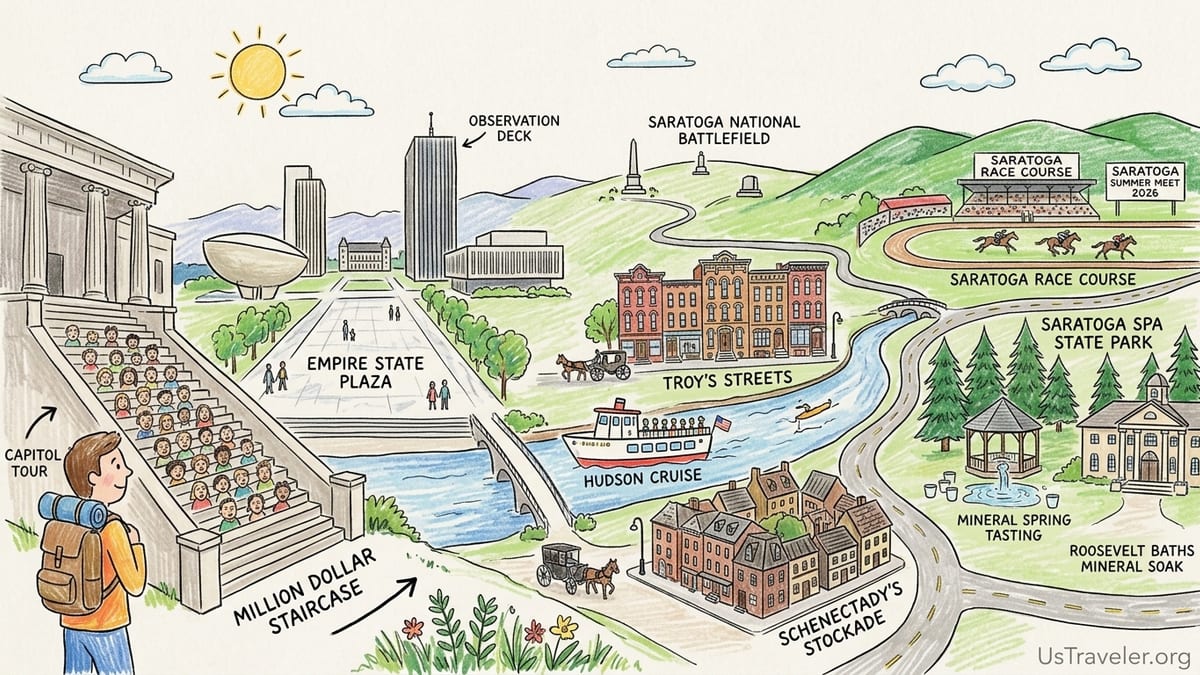
Albany’s Capitol And Empire State Plaza: Where The Region Puts On Its Public Face
I started in the heart of Albany, because it’s the fastest way to understand the Capital Region’s DNA: big ideas expressed in stone. I planned a half-day and it was just about right, including security, wandering, and the “I’ll just pop over there” detours that always happen inside monumental buildings. The easiest approach, if you’re driving, was using the Empire State Plaza visitor parking and entering the concourse so I could move between the Plaza and the Capitol without worrying about weather.
The New York State Capitol is the anchor experience, and the thing that genuinely surprised me is how much it feels like a museum you happen to be allowed to use. I joined a free guided tour (tours are generally free, with the Plaza Visitor Center as the organizer), and I made sure the route included what I most wanted to see: the Million Dollar Staircase. In person, it reads less like a staircase and more like a carved narrative wall that happens to have steps attached. I spent a long time just looking closely at the faces and details, because the fun is in noticing that it’s not “decorative” so much as intensely specific. If you’re traveling with a teen who thinks government tours are boring, this is where you win them over: it’s essentially a scavenger hunt in stone.
After the Capitol interior, I walked straight into Empire State Plaza, which is its own kind of statement. The scale is the first thing you feel: broad marble expanses and long sightlines that make you walk a little slower. I gave myself roughly an hour to roam the plaza level and then drop down into the concourse to see art and the everyday rhythm of a working government complex. What I didn’t expect was how cohesive the modernist vision feels once you’re inside it, even if you wouldn’t call it “cozy.” It’s an experience of New York State saying, “Here is what we built when we wanted to look confident.”
I ended this segment with the Corning Tower Observation Deck. It’s free to enter, but it is weekday-limited, so it’s worth planning around the posted hours. From up there, Albany and the Hudson River stop being separate ideas: you can visually connect neighborhoods, bridges, and the direction you’ll be traveling next. I budgeted about 20 minutes for the deck itself plus the stop-and-start time of security and elevators, and that estimate held true.
Hudson River Time: A Cruise In Albany That Reframed The Whole Geography
If you only look at the Hudson from bridges and roadside pull-offs, you miss the way it organizes this region. I wanted at least one on-the-water experience, so I booked a 90-minute Hudson River sightseeing cruise that departs from Albany. The duration was perfect: long enough to settle into “river time,” short enough to still keep the day moving.
Onboard, what I saw was a mix of working river and scenic river, and that’s the point. You’re not floating through a theme-park landscape; you’re moving through an economic corridor that’s still alive. I liked being able to watch the riverbanks slide by at a pace that let me actually notice details: the way the city thins out, the industrial edges, the green stretches that feel surprisingly quiet considering how close you are to downtown.
Concrete planning details matter here. The operator I used posts a public cruise calendar and clear pricing, which made it easy to decide whether it fit my budget and schedule. The cruise felt like the kind of activity that works for a lot of traveler types: couples who want something calm, families who need an easy win between museums, and solo travelers who want a “structured” break without feeling trapped in a long tour.
The biggest surprise was how much the cruise improved my next stops. After seeing the river from the middle, Troy’s streets and Schenectady’s river-adjacent history stopped feeling like separate day trips. They felt like chapters in one story.
Troy’s Victorian Streets: The Capital Region’s Most Photogenic “Ordinary” Walk
Troy was my favorite “no ticket required” part of the trip. I went specifically to walk its historic streets and let the architecture do the talking. If Albany gives you the grand public face, Troy gives you the lived-in texture: rows of brick, decorative facades, and the kind of details you only notice when you slow down and look up.
I gave myself about 90 minutes for a first pass, which included plenty of pauses for storefront windows, street-corner angles, and those small moments where you spot an architectural flourish and think, “Someone paid for that, and they wanted it to last.” I didn’t come with a checklist of buildings. Instead, I treated the walk like a pattern-recognition game: how many variations of arches, cornices, and ironwork can you spot before you turn the next corner?
What surprised me most is that the Victorian character doesn’t feel staged. In some historic districts you can sense the “museumification.” Here, the charm is tied to day-to-day city life: a coffee run, a quick errand, someone unlocking a storefront. That mix of beauty and normal life is exactly what gives Troy its character. It’s not just the architecture; it’s the sense that the architecture still belongs to people.
If your trip is short, Troy is the place I’d use as a flexible filler between bigger timed activities. You can do 30 minutes and get a taste, or you can linger for half a day. Either way, it reinforces why the I LOVE NY-style “Victorian streets” recommendation isn’t just marketing language; it’s a real experience that translates immediately once you’re on foot.
Schenectady’s Stockade District: Colonial Layers You Can Still Walk Through
Schenectady’s Stockade District feels different from Troy in a way I appreciated: older, lower, more intimate. I approached it as a walking neighborhood rather than a single attraction, and I spent roughly an hour just wandering at a deliberate pace. The point for me wasn’t to rush; it was to let the sense of age accumulate through small cues: street layout, building materials, and how close together everything feels.
The Stockade is often described as one of the country’s oldest neighborhoods with continuous habitation, and you can feel that continuity even if you’re only there briefly. It’s not a blockbuster sight; it’s a place where you start imagining who lived here and how they moved through the same compact blocks. The Mohawk River proximity adds to the feeling that this was a strategic, river-oriented settlement first and a modern city neighborhood second.
One practical tip I’d share from my own visit: I looked up events before I went, because the Schenectady County Historical Society periodically runs a “Stockade Walkabout” open-house style tour that can change what you can see inside. Even if your visit doesn’t line up with that specific day, it’s worth knowing whether there’s a special program happening, because it can turn a simple walk into a rare interior peek. I love when a destination rewards a little planning without demanding it.
What ended up being more interesting than expected was the contrast effect. After the scale of Empire State Plaza, the Stockade’s tight streets feel almost like a whisper. That shift in tone is, in a way, the region’s character in miniature: New York State’s big civic stage, then a few miles away, an older neighborhood that still feels human-sized.
Saratoga Race Course: A Morning That Explains The Saratoga Summer Myth
I saved Saratoga Race Course for a day when I could arrive early and not rush. The Saratoga summer meet is not an abstract “sports season” here; it’s a social rhythm that shapes the town. For 2026, the NYRA schedule has the summer meet opening on Friday, July 3, 2026 and running through Labor Day, Monday, September 7, 2026, and NYRA publishes special events schedules and calendars that help you pick a day that fits your style.
When I went, I treated it like a “choose your own intensity” morning. I gave myself at least three hours on-site so I could do it properly: walk the grounds, get oriented, watch the pre-race motion and rituals, and then settle into the simple pleasure of watching thoroughbreds do what they do. What I saw was a place that’s simultaneously iconic and very practical: grandstand space, trackside vantage points, and the flow of people figuring out their own routines.
One of the most useful, real-world details is admissions. NYRA sells single-day general admission and also season passes, and general admission gets you access to big swaths of the facility, including the backyard and grandstand areas. Even if you’re not a hardcore bettor, it’s an easy place to spend a summer day because you can keep the experience simple: buy a ticket, pick a viewing spot, and let the spectacle come to you. If you do want to bet, I found it helpful to keep it intentionally small, the way many casual visitors do, so you’re paying for the fun of participation rather than trying to “win” your day.
The surprise for me was how much I enjoyed the non-race moments: the in-between time, the pacing of the day, the way Saratoga encourages you to linger. The Race Course didn’t feel like an isolated venue; it felt like one of the reasons Saratoga is Saratoga. That’s why the region’s promotional guides emphasize the racecourse and spa pairing: it’s a genuinely distinctive combination of energy and ease.
Saratoga Spa State Park And SPAC: Tasting The Springs Versus Booking The Soak
Saratoga Spa State Park is where I felt the “spa town” identity click into place. I planned a half-day here because the park rewards both wandering and intentional stops. The setting is part of the experience: piney paths, classic park architecture, and the feeling that multiple Saratoga identities coexist in one landscape, from mineral springs to performing arts.
I wanted to be very clear about the two different spring experiences, because they are not the same. First, I did the low-cost, high-curiosity option: tasting mineral spring water at the public springs. I brought a small cup and sampled a few sources, taking quick sips rather than chugging. What I saw were simple spring structures that invite you to compare water like you’d compare coffee: carbonation, mineral bite, and aftertaste. The surprise was how strongly different springs can taste from each other, ranging from relatively mild to unmistakably mineral. This is one of those “you have to try it to understand it” activities, and it takes less time than you think. I spent about 45 minutes total, including walking between spring points and pausing to read signage and watch other visitors do their own tasting rituals.
Then, on a separate day segment, I did the paid version: a mineral bath at Roosevelt Baths & Spa at the Gideon Putnam. This is not the same as tasting spring water, and it’s worth budgeting for if you want the classic Saratoga “soak” story. Roosevelt Baths publishes a service menu with current pricing, which made it easy to choose a treatment without guessing. What surprised me was how much the experience feels rooted in Saratoga’s history rather than being a generic modern spa. It felt like an extension of the town’s long relationship with mineral water, just in a more structured, controlled setting.
SPAC, right in the park, is the other half of this area’s character: nature and culture on the same walk. Even if you don’t attend a performance, I recommend physically visiting the SPAC grounds so you understand how it sits in the landscape. When I did attend an event, I planned extra time for arrival because the park setting invites pre-show wandering and people-watching. SPAC’s official calendar and ticketing pages are the places to confirm what’s on during your travel dates, and because schedules shift, I treated those listings as my final word before committing to a night out.
What ended up being more interesting than expected was how well the day flowed: a spring tasting that feels quirky and local, a soak that feels classic, and then an evening that feels like a summer ritual. Saratoga’s racecourse-spa pairing gets talked about a lot, but in practice it’s the park that makes the pairing easy to live, not just easy to advertise.
Saratoga National Historical Park: The Quiet Battlefield Drive That Stayed With Me
Saratoga National Historical Park was the most emotionally quiet stop on my itinerary, and that’s exactly why it belongs in an experiences-based story. I went because I wanted something beyond buildings and entertainment, a place where the region’s history feels like landscape rather than signage. I arrived with a simple plan: do the tour road at a measured pace, get out at several stops, and give myself time to listen to the place.
The park’s Battlefield Tour Road is a practical way to understand the space. The National Park Service provides guidance on operating hours and seasonal closures; the tour road, for example, is closed to motor vehicles during the winter season (December 1 through March 31), and conditions can extend closures if snow or ice makes it hazardous. That kind of operational detail matters if you’re visiting in shoulder season. On my visit, I treated it as a roughly half-day experience, though you could compress it if you only want the highlights.
What I saw was not a single dramatic “scene,” but a sequence of perspectives that add up: open fields, forest edges, monuments, and the feeling of distance between points that makes you realize this happened across real terrain, not a compact stage set. I used the park’s self-guided resources and took my time at overlooks and pull-offs, letting the story come through slowly. The surprise was how physical the history feels. The park isn’t trying to entertain you; it’s giving you space to do the work of imagining.
In a region that can feel very active in summer, this was my reset button. If you’re traveling with someone who thinks they “don’t like history,” this park is a good test case. It’s not a lecture. It’s a drive, a walk, and a chance to connect dots between the Capital Region’s civic identity and the deeper national story that unfolded here.
The Takeaway
If you want the Capital-Saratoga region to make sense quickly, don’t think of it as one destination with scattered attractions. Think of it as a set of experiences that each explain one layer of character. Albany’s Capitol and Empire State Plaza show you the public, official face of New York State. Troy’s Victorian streets show you the prosperous, design-forward past that still frames daily life. Schenectady’s Stockade brings you down to a human scale of older settlement patterns. Saratoga Race Course shows you the summer heartbeat, while Saratoga Spa State Park lets you taste and soak the mineral-water identity in two totally different ways. And Saratoga National Historical Park gives you the quiet context that makes all the flashier parts feel grounded.
If I had to describe the region in one travel sentence after doing this loop, it would be this: it’s a place where New York State’s big, public ambitions meet a landscape and a set of towns that keep insisting on texture, tradition, and summer rituals you can still join.
FAQ
Q1. How much time should I budget for the New York State Capitol and Empire State Plaza?
Plan about 3 to 4 hours to do a free Capitol tour, explore the Plaza and concourse, and fit in the Corning Tower Observation Deck during its open hours.
Q2. Are New York State Capitol tours free?
Yes. Guided tours are generally free, and the Plaza Visitor Center is the key contact point for tour timing and group reservations.
Q3. Is the Corning Tower Observation Deck worth it if I’m short on time?
Yes. It’s free and the view quickly explains Albany’s layout and how the Hudson River threads through the region, but it’s typically limited to weekday hours.
Q4. What’s the difference between tasting Saratoga’s spring water and taking a mineral bath?
Tasting is free at public springs and focuses on flavor and mineral character. A mineral bath is a paid spa service, usually in a private tub at Roosevelt Baths & Spa, designed for soaking rather than sipping.
Q5. Do I need to be a horse racing fan to enjoy Saratoga Race Course?
No. General admission lets you walk the grounds and watch the day unfold. Many visitors go for the atmosphere and a classic Saratoga summer experience, not serious betting.
Q6. When is the Saratoga summer meet in 2026?
The NYRA schedule lists the 2026 Saratoga summer meet as opening Friday, July 3, 2026 and running through Labor Day, Monday, September 7, 2026.
Q7. Can I drive the Battlefield Tour Road at Saratoga National Historical Park year-round?
No. The road is closed to motor vehicles during the winter season (December 1 through March 31), and weather can affect opening dates.
Q8. What’s the quickest way to get a feel for Troy if I only have an hour?
Do a focused architectural walk through the historic core: give yourself time to look up at facades and details, because the Victorian street character is the main event.
Q9. What makes Schenectady’s Stockade District different from Troy’s historic areas?
The Stockade feels older and more intimate, with a compact, colonial-era street feel and a strong river-oriented history, while Troy reads more Victorian and industrial-era grand.
Q10. What’s one Hudson River experience that works well between Albany and Saratoga stops?
A short sightseeing cruise departing from Albany is an easy, time-boxed way to understand the river as the region’s organizing feature, without committing to a full-day excursion.