


Planning a California road trip can feel overwhelming. Between San Francisco’s hills, Los Angeles’ sprawl, Highway 1’s cliffs and the granite walls of Yosemite, it is easy to string together a fantasy route that looks great on a map but collapses once real-world driving times, traffic and check-in hours are factored in. This guide lays out realistic 5, 7, 10, 14 and 21 day California itineraries that combine major cities, classic coastal scenery and marquee national parks, with practical notes on driving distances, domestic flight options and sensible overnight allocations.
How to Use This California Itinerary Guide
The itineraries below are designed as building blocks. Each one assumes a typical arrival from within North America, uses realistic daily driving windows of 3 to 6 hours on most days, and avoids backtracking where possible. They can be run in either direction, and you can often shorten or lengthen a route simply by removing or adding overnights in key hubs such as San Francisco, Los Angeles or Yosemite.
Driving times use current typical estimates. For example, driving directly between San Francisco and Los Angeles on inland Interstate 5 is usually around 6 hours for roughly 380 miles, while the slower but scenic coastal Highway 1 route via Big Sur is closer to 9 or 10 hours of actual wheel time and is commonly split into two days with an overnight in Cambria or San Luis Obispo. These broad time frames assume normal traffic and no major construction delays.
Hotel prices fluctuate, but in popular coastal towns such as Santa Monica, Carmel and Santa Barbara you should expect mid-range rooms in high season to fall roughly between 250 and 450 dollars per night before taxes and parking. Inside or immediately adjacent to national parks, demand is even higher, and many lodges and campsites open their reservation calendars 6 to 12 months ahead, so booking early is strongly recommended.
All sample routes mix driving with walking and short hikes, and they assume you are renting a standard car rather than an RV. If you are planning to visit multiple parks such as Yosemite, Sequoia and Joshua Tree, consider a national park annual pass, which typically pays for itself by the third or fourth park entrance on a single trip.
5-Day Taste of California: Cities and Coast
A 5 day itinerary does not allow time for both the classic Pacific coast and the Sierra Nevada national parks without turning the trip into a forced march. A more satisfying approach is to focus on California’s signature cities and one stretch of dramatic shoreline. A common and very workable route runs from San Francisco to Los Angeles via the central coast.
On Day 1, arrive in San Francisco, stay near Union Square or Fisherman’s Wharf, and explore on foot instead of picking up your rental car immediately. You can ride a cable car, walk the Embarcadero and visit neighborhoods like North Beach without worrying about downtown parking rates that often exceed 40 dollars per night. On Day 2, pick up your car late morning and drive roughly 2.5 to 3 hours, around 120 to 130 miles, to Monterey or Carmel-by-the-Sea for an overnight, arriving in time to visit Cannery Row or the Monterey Bay Aquarium.
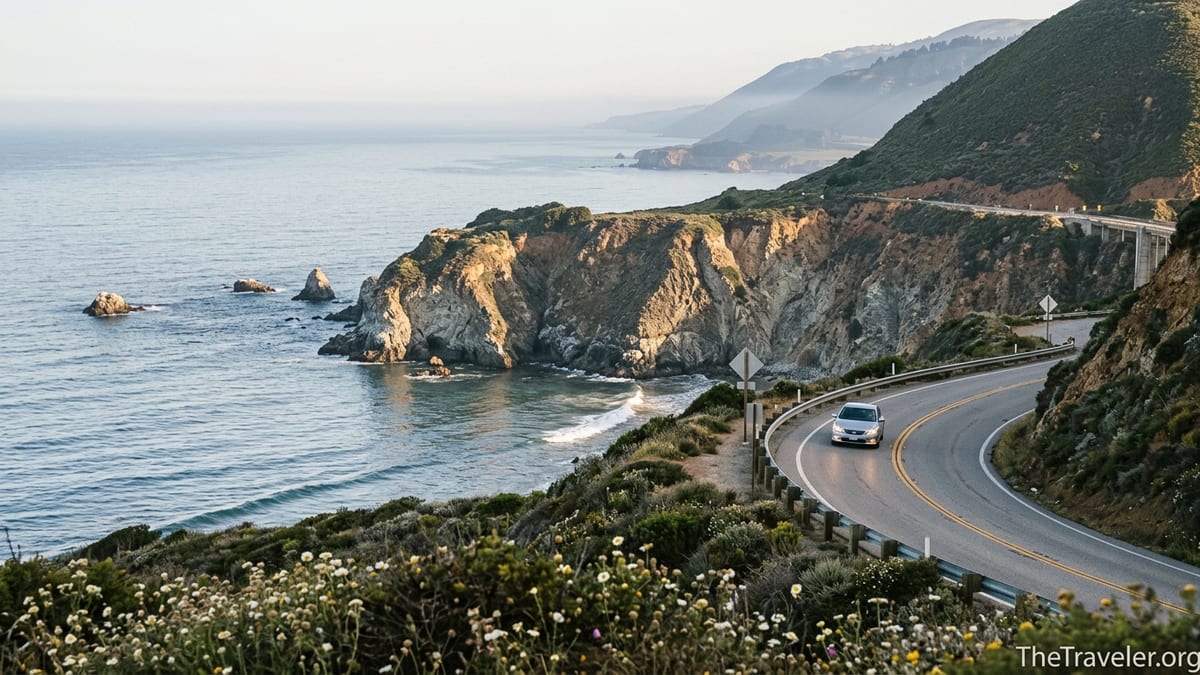
Day 3 covers the most scenic section of Highway 1 through Big Sur. From Carmel to Cambria is only about 100 miles, but the narrow, winding coastal road and frequent photo stops at places like Bixby Creek Bridge and McWay Falls mean many travelers spend 5 to 7 hours on this section alone. Stay overnight in Cambria, San Simeon or San Luis Obispo. On Day 4, continue 3 to 4 hours, roughly 200 miles, to Los Angeles, where you might base in Santa Monica or Hollywood and drop the car if you prefer to rely on rideshares. Day 5 is for Los Angeles highlights such as the Griffith Observatory, Venice Beach or a studio tour before departure.
This 5 day route trades the national parks for ease and variety. It keeps your longest day of driving to a manageable level and uses two dense urban bases, San Francisco and Los Angeles, where you can choose car-free days to offset the time spent on the highway.
7-Day Classic: Coast plus Yosemite
With 7 days, you can add one major national park to the coast and city combination, though you still need to be selective. A common pattern is to start in San Francisco, loop to Yosemite, then finish in Los Angeles. This avoids retracing your steps while keeping total drive times realistic for a week-long vacation.
Days 1 and 2 are spent in San Francisco, including time to adjust if you have flown across time zones. On Day 3, collect your rental car early and drive to Yosemite Valley via Highway 120 or 140. From downtown San Francisco to Yosemite Valley is typically 4 to 5 hours of driving, around 180 to 200 miles depending on your chosen entrance. Staying either in the Valley itself or in gateway towns such as El Portal or Mariposa puts you within reasonable reach of classic viewpoints like Tunnel View and Yosemite Falls.
Day 4 is a full day in Yosemite, which in high season often means arriving at popular trailheads such as Mist Trail or Sentinel Dome parking areas early in the morning to secure a spot. In late spring and early summer, you can expect snow to linger on higher-elevation roads such as Tioga Pass, occasionally affecting access, so checking current conditions shortly before you depart is important. Day 5 is your transition day to the coast: drive 4 to 5 hours to Monterey or Carmel, arriving by late afternoon for a walk on Carmel Beach or along the 17-Mile Drive toll road near Pebble Beach.
Day 6 runs south through Big Sur to Cambria, as in the 5 day itinerary, with plenty of scenic stops. On Day 7, drive the remaining 3 to 4 hours into Los Angeles for a final night or schedule an evening departure flight. If you are short on time, you could return the car at Los Angeles International Airport and stay near the terminal, but many travelers prefer a base in Santa Monica or West Hollywood that allows for a final walk or dinner before heading home.
10-Day Highlights: Three Hubs and Two Parks
Ten days allows time to include two national parks while still enjoying city culture and the Pacific coast. A practical loop begins in San Francisco, runs to Yosemite and Sequoia, then drops to the coast before finishing in Los Angeles. This pattern keeps individual drive days within 3 to 6 hours while giving you multiple two-night stays.
Days 1 and 2 are spent in San Francisco without a car, exploring neighborhoods like the Mission District, the Ferry Building food hall, and the Presidio. On Day 3, pick up the car and drive 4 to 5 hours to Yosemite Valley for a two-night stay. This gives you Day 4 to explore Yosemite, perhaps combining a valley loop with a half-day hike such as the Mist Trail to Vernal Fall footbridge or the Panorama Trail if conditions allow.
On Day 5, depart Yosemite for Sequoia or the combined Sequoia and Kings Canyon region. Recent estimates put the distance between Yosemite and the Sequoia gateways at roughly 140 to 170 miles, with typical drive times around 3.5 to 5 hours depending on your exact start and end points and seasonal road conditions. Many visitors base themselves in the small town of Three Rivers just outside the Ash Mountain entrance for easier access and more lodging options. Day 6 is a full day to see the giant sequoias around the General Sherman Tree and, if time permits, drive the Generals Highway towards Kings Canyon viewpoints.
Day 7 is a transition across California’s Central Valley to the coast. From Sequoia’s foothills to, for example, Pismo Beach or San Luis Obispo is often 3.5 to 4.5 hours of driving across agricultural country. Staying in a coastal town here breaks up the journey and gives you an evening on the beach or a seafood dinner near the pier. On Day 8 you drive the Big Sur coast north or south depending on your exact route; one common option is to overnight in Monterey or Carmel again, adding another evening for the aquarium or a coastal walk.
Days 9 and 10 are spent in Los Angeles. From Monterey to Los Angeles via the inland route is around 5.5 to 6.5 hours of driving, while following Highway 1 through Big Sur and Santa Barbara will take most of the day with stops. Once in Los Angeles, you can allocate one day to the beach areas and the other to cultural sites such as the Getty Center and Griffith Observatory. Returning the rental car your final evening can simplify your departure day.
14-Day Grand Circuit: Cities, Coast and Multiple Parks
A 14 day itinerary lets you slow down and add either more depth in the parks or extra regions such as San Diego or the Northern California redwood coast. One popular two-week pattern for first-time visitors is a grand circuit that includes San Francisco, Yosemite, Sequoia, the central coast, Los Angeles and San Diego, using domestic flights only if you need to reposition quickly at the start or end.
Days 1 and 2 might focus on San Francisco, followed by 3 nights in Yosemite from Days 3 to 5. Three overnights in or near the park provide two full days to combine valley highlights with a higher-elevation drive, such as up to Glacier Point if the road is open, or along Tioga Road to Tuolumne Meadows. From there, you can drive to Sequoia on Day 6, spend Days 7 and 8 exploring giant sequoia groves and canyon overlooks, then exit via the foothills to reach the central coast on Day 9.
The coastal portion can span Days 9 to 11, with one night in either Pismo Beach or San Luis Obispo and one in Monterey or Carmel, plus time to drive the Big Sur section of Highway 1. That drive, between roughly San Simeon and Carmel, remains one of the most photographed stretches of road in the United States and rewards slow travel: many visitors build in time for short walks at Julia Pfeiffer Burns State Park or Pfeiffer Beach to stretch their legs.
From Monterey you can head to Los Angeles on Day 12, spending two nights there to explore neighborhoods and perhaps fit in a studio tour or theme park day. If you want to add San Diego, use Day 13 to drive the 2 to 3 hours south, with optional stops in Orange County beach towns such as Laguna Beach or Dana Point. An overnight in San Diego on Day 13 and a partial Day 14 to visit Balboa Park, La Jolla Cove or the waterfront gives a satisfying end to the trip before flying home from San Diego’s compact airport.
For travelers who prefer fewer hotel changes, an alternative 14 day itinerary can drop San Diego and instead add extra nights in Yosemite or Sequoia for hiking or photography. In that case, leaving a blank day between long drives allows you to absorb weather delays, wildfire-related closures or simply a day of slower sightseeing.
21-Day Deep Dive: Adding the Redwoods and Desert Parks
With 21 days, you can layer in slower travel and additional regions, including Northern California’s redwood forests and at least one desert park. This kind of itinerary suits travelers who want variety and are comfortable with a handful of longer 5 to 6 hour drives, balanced by two- and three-night stays at key stops.
One effective 21 day route begins in Los Angeles, swings east through Joshua Tree and possibly Death Valley, then arcs north through Yosemite and the Sierra before following the coast north to the redwoods and finally finishing in San Francisco. For example, allocate Days 1 to 3 to Los Angeles, picking up your car only when you leave the city or on Day 2 if you plan to visit more spread-out sights. On Day 4, drive around 2.5 to 3 hours, approximately 130 to 150 miles, to Joshua Tree National Park via Palm Springs, staying either in one of the small desert towns like Joshua Tree or in Palm Springs itself.
Days 5 and 6 can cover Joshua Tree and a transit day towards the Sierra. Some travelers choose to add Death Valley at this point, especially in cooler months, but in mid-summer temperatures regularly soar well above 100 degrees Fahrenheit, so many road trippers only drive through briefly or omit it entirely. You then continue to Yosemite for a three-night block, giving Days 7 to 9 in and around the park, followed by two nights in Sequoia and Kings Canyon on Days 10 and 11. As before, expect roughly 3.5 to 5 hours of driving between these two regions, depending on your route.
From there you head for the Northern California coast. Day 12 could be a longer transfer, 5 to 6 hours, to the Sonoma Coast or Mendocino region, which offers dramatic headlands, farm-to-table dining and a quieter atmosphere than the central coast. Days 13 and 14 might be spent in the redwood region farther north, such as near Humboldt Redwoods State Park or Redwood National and State Parks, where scenic drives like the Avenue of the Giants run through towering old-growth forests.
The final week can trace the coast south towards San Francisco, with nights in places like Mendocino, Sonoma wine country and finally San Francisco itself for Days 19 to 21. Spreading out the coastal section at the end of your trip means many of your last drives are shorter 2 to 4 hour hops between seaside towns, giving you space to decompress after the more ambitious cross-state legs earlier in the itinerary.
Driving Distances, Domestic Flights and Overnights
Understanding how long it actually takes to get between California’s highlights is key to designing a realistic plan. For example, the San Francisco to Los Angeles drive on Interstate 5 is roughly 380 miles and typically 6 hours without heavy traffic, whereas the scenic Highway 1 route between the same cities is closer to 450 miles and 9 to 10 hours of actual driving, even before adding time for viewpoints and meals. Similarly, the link between Yosemite and Sequoia is often cited at around 140 to 170 miles, with non-stop drive times in the 3 to 4.5 hour range, but road grades, summer roadwork and slow vehicles commonly extend that.
Within California, domestic flights can help if your goal is to minimize one-way rental car fees or avoid a repeat long haul. Typical non-stop flight times between major airports such as Los Angeles and San Francisco, or San Diego and San Jose, are in the 60 to 90 minute range from takeoff to landing, though you still need to factor in security lines, boarding, and travel between the airport and city center. On a 5 or 7 day trip, many travelers still prefer to drive the coastal sections, but for a dense 10 day national-park-heavy itinerary, flying into San Francisco and out of Los Angeles or San Diego can save you a full day of backtracking.
When allocating overnights, favor spending at least two nights anywhere you plan to do serious hiking, photography or in-depth sightseeing. In practice, that usually means two or three nights in Yosemite, two in Sequoia, and at least two in each major city. On the coast, single-night stops in towns such as Cambria, Pismo Beach or Monterey are more workable because the draw is often the drive itself, supplemented by walks to accessible viewpoints rather than long, early-morning trail days.
Travelers with limited flexibility often overlook the impact of check-in times and daylight. In summer, you can arrive in a park at 5 p.m. and still have light, while in winter the early sunsets mean a 4 p.m. arrival often coincides with darkness. When plotting your daily driving, assume you will rarely be underway before 9 a.m. after breakfast and packing, and try to target arrival by late afternoon to avoid driving in the dark on unfamiliar mountain or coastal roads.
Lodging, Budgeting and Seasonal Considerations
Lodging in California’s gateway towns and along the major scenic corridors is diverse but often more expensive than visitors expect. In Yosemite Valley, for instance, in-park hotels and cabins often book out months ahead, and even basic options outside the park boundaries in places such as El Portal or Oakhurst can exceed 200 to 300 dollars per night in peak summer. Coastal boutique hotels in Carmel or Santa Barbara routinely charge upwards of 350 dollars in July and August, especially on weekends, though more modest motels are available a short drive from the water.
To keep costs manageable, consider mixing accommodations types: perhaps two nights in a central, walkable hotel in San Francisco, followed by a vacation rental or motel when you reach the Central Valley, and then a splurge night at a coastal inn with ocean views. In cities, staying a block or two inland from the beach can noticeably reduce nightly rates and parking charges. In Los Angeles, basing in neighborhoods like Culver City or North Hollywood instead of Santa Monica or Beverly Hills can trim the budget while still keeping you within a reasonable drive of most attractions.
Season affects not just pricing but feasibility. Summer, roughly June through early September, brings the fullest access to Sierra mountain roads and longer daylight hours, along with the heaviest crowds and the highest lodging costs. Spring and fall often balance snow-free park access with milder temperatures and lower prices, though higher passes such as Tioga Road into Yosemite can remain closed into late spring in big snow years. Winter delivers the quietest cities and cheapest coastal stays, but certain park routes may be closed or require tire chains, especially around Sequoia and the higher elevations of Yosemite.
Whatever the season, fuel and food prices in remote areas are typically higher than in the cities. Filling your tank in larger Central Valley towns before climbing into the Sierra and carrying a cooler with picnic supplies from supermarket chains in Fresno, Merced or Bakersfield can soften the cost of multiple national park days, where in-park cafes and small markets charge a premium.
The Takeaway
Designing a satisfying California itinerary is ultimately an exercise in subtraction. It is rarely possible to see San Francisco, the entire Big Sur coast, Los Angeles, San Diego, Yosemite, Sequoia, Joshua Tree, Death Valley and the Northern redwoods in a single week without spending most of your days behind the wheel. By accepting the time it genuinely takes to move between these regions, and by grouping sights into realistic 5, 7, 10, 14 and 21 day routes, you can match your ambitions to your schedule.
Think in terms of hubs rather than pins on a map: two or three nights in a city, two or three in a national park, and single overnights on the road where the journey is the point. Use the sample itineraries here as a framework, then adjust them based on your own interests, whether that means more nights among the granite walls of Yosemite, extra time tasting wine in Sonoma, or a slower drift along Highway 1. With thoughtful pacing, California’s cities, coast and national parks can feel less like a checklist and more like a coherent journey.
FAQ
Q1. Is it realistic to drive from San Francisco to Los Angeles in one day?
Yes, if you take the inland Interstate 5 route, the drive is typically around 6 hours without major delays, which many travelers do in a single day. The more scenic Highway 1 coastal route between the same cities usually takes 9 to 10 hours of driving and is more comfortable when split into at least two days with an overnight stop.
Q2. How many days do I need in Yosemite on a California road trip?
For most first-time visitors, two to three full days in or near Yosemite works well. That usually means three nights, giving you one arrival afternoon and two complete days to explore valley highlights and, if conditions allow, a higher-elevation drive or hike.
Q3. Can I visit Yosemite and Sequoia in one day from a single base?
It is technically possible but not recommended. The drive between the two areas typically runs 3.5 to 5 hours one way, depending on your exact start and end points and road conditions. Trying to visit both parks in a single day would mean spending the majority of your time in the car instead of on trails or at viewpoints.
Q4. Should I fly or drive between San Francisco and Los Angeles?
Both options are viable. Non-stop flights usually take around 60 to 90 minutes in the air, but you need to add airport transfer times and security. Driving offers flexibility and the chance to see the coast, especially along Highway 1. On shorter trips focused on the parks, some travelers fly into one city, rent a car for a one-way road trip and depart from another city to avoid backtracking.
Q5. Is Highway 1 along Big Sur safe to drive for visitors not used to mountain roads?
Highway 1 through Big Sur is a paved, two-lane road with guardrails and frequent pullouts, but it includes curves, cliffs and limited passing zones. Most cautious drivers manage it comfortably by allowing extra time, driving during daylight, and using turnouts to let faster traffic pass. If you are anxious about heights or tight curves, consider limiting your distance on the road and stopping frequently at viewpoints.
Q6. When is the best time of year for a California coast and national parks itinerary?
Late spring and early fall often provide the best balance of conditions. Coastal areas are generally mild year-round, but Sierra Nevada parks like Yosemite and Sequoia see snow at higher elevations in winter and sometimes into late spring. Summer offers the widest park access and long days but also the heaviest crowds and highest lodging prices, especially in July and August.
Q7. How far in advance should I book lodging in Yosemite and along the coast?
For peak periods such as summer, major holidays and popular event weekends, it is wise to book Yosemite lodging 6 to 12 months ahead, especially for in-park accommodations. Along the coast, booking 3 to 6 months in advance for places like Carmel, Big Sur and Santa Barbara usually secures more options and better rates, though midweek stays outside school holidays can sometimes be found closer to the travel date.
Q8. Is a one-way rental car between San Francisco and Los Angeles expensive?
One-way rental fees vary by company, season and pickup location, but many major rental brands allow one-way trips between California cities without a large surcharge, especially on routes between San Francisco, Los Angeles and San Diego. It is still important to check for any drop-off fees when you compare quotes, as they can add noticeably to your overall cost on shorter trips.
Q9. Can I do a California itinerary using only public transportation?
You can connect major cities like San Francisco, Los Angeles and San Diego by rail or bus, and there are shuttle services to some national parks in season. However, a car greatly increases flexibility for reaching viewpoints, trailheads and coastal pullouts, especially in Yosemite, Sequoia and Big Sur. Travelers relying solely on public transport often focus on cities and a limited set of day tours rather than a full road trip.
Q10. Do I need a special pass or permit for California national parks?
Entry to most national parks is covered either by a per-vehicle fee or by a national park annual pass. Some high-demand hikes and activities, such as specific Yosemite trails in peak periods, may require advance permits or day-use reservations, which are usually managed through official reservation platforms. Checking park websites a few months before your trip is important, as reservation rules can change from year to year.