


In the Capital-Saratoga region, it is easy to build a satisfying day with self-guided stops: a loop of Saratoga Spa State Park springs, a drive through Saratoga National Historical Park, or a downtown Albany architecture wander capped by a drink near the river. But on my most rewarding days here, the best moments did not come from what I saw. They came from what I finally understood, after following a guide who knew where to stand, what to look for, and how to read the landscape and the buildings like primary sources. Below are the guided experiences that genuinely added something, plus the attractions I explored independently for comparison, so you can decide where a ticket buys more than convenience.
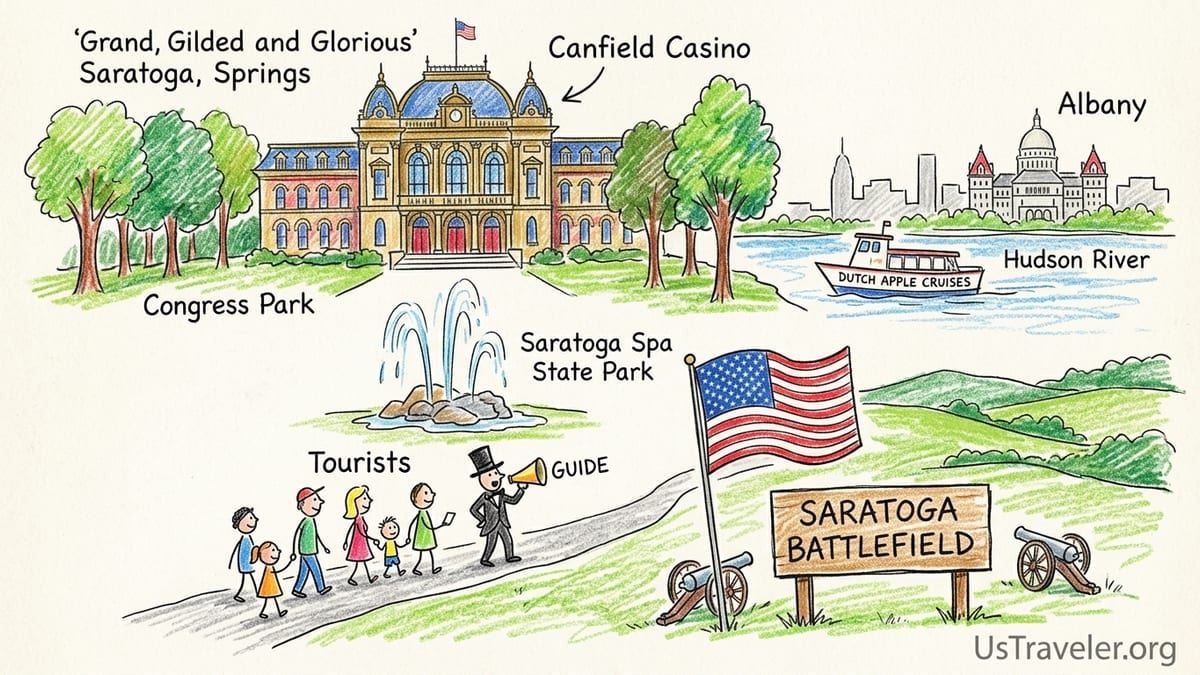
Grand, Gilded and Glorious: Saratoga’s Visitor Center Walk That Changes How You See Broadway
I booked the Saratoga Springs Heritage Area Visitor Center’s “Grand, Gilded and Glorious: A Saratoga Stroll” specifically because it is built around the city’s strongest hand: Saratoga as a Gilded Age resort town. The tour starts at the Visitor Center at 297 Broadway and heads toward Congress Park before finishing inside the Canfield Casino with admission to the Saratoga Springs History Museum included. It is a 90-minute walk, and the 2026 season is structured enough that it can anchor a day trip: Fridays and Saturdays in June at 10:30 a.m., then Tuesday through Saturday from July 1 through mid-October, with adult tickets at $25 and youth (12 to 17) at $10, while kids under 12 are free.
The day I took it, the group felt intentionally manageable, closer to a small cluster than a crowd, which mattered because the guide regularly paused at street corners and park paths to point out details you would walk straight past on your own. Weather-wise, it was one of those upstate summer mornings that starts cool in the shade and turns bright quickly once you step into open lawn, so the pace and stop-and-talk rhythm was welcome. The walking itself is easy, mostly flat, with the biggest “work” being paying attention.
What I would have missed alone was not the headline history, but the connective tissue. A guide can link the springs, the grand hotels, and the social world that formed around them, and then tie those stories to why certain buildings sit where they do and how Congress Park became a stage for it all. Even if you are the kind of traveler who reads historical markers, you do not get the same sense of sequence or motive just by drifting from plaque to plaque.
To compare, I also did a self-guided loop through downtown Saratoga and Congress Park on a different afternoon, using my own notes and what I could glean from signage. It was pleasant, and you can absolutely enjoy the scenery without paying for a tour. But without a guide, I found myself moving too quickly, treating gorgeous architecture like background instead of evidence. This is the kind of walk where paying for the tour buys interpretation, not transportation.
Free Saratoga Spa State Park Mineral-Spring Tours: The Tastings Are Only Half the Point
Saratoga’s spring culture is famous enough that many visitors try to “take the waters” on their own, and you can. But the most useful entry point I found was the Visitor Center listed free guided mineral-spring tours in Saratoga Spa State Park, offered Friday through Sunday at 11:00 a.m. and 1:00 p.m., meeting at the Creekside Classroom on Geyser Loop Road. That schedule makes it practical as a quick add-on before lunch, or as a reset between museums.
I joined the late-morning tour on a humid day that threatened rain, the kind of weather that makes the park smell extra green and earthy. The group skewed mixed: couples, a family or two, and a few solo visitors, with everyone holding a bottle or cup. The walking time was moderate, and the overall experience felt like a short, focused program rather than an endurance hike. There is no need to overthink footwear, but you do want something you can walk in comfortably on park paths.
What I gained, beyond tasting different springs, was orientation: which springs are close together, which are worth seeking out first if you only have an hour, and how to think about the differences you are tasting. Alone, it is easy to treat the springs like a scavenger hunt, rushing from spouter to spouter. With a guide, the experience becomes more legible. The guide’s explanations made the park feel less like a collection of odd little structures and more like a historic landscape shaped by geology, health tourism, and a long public fascination with mineral water.
I did a self-guided spring tasting later, which is fun in a “choose-your-own-adventure” way, especially if you want to bounce between spots and take photos at your own pace. But I also noticed how quickly I started second-guessing what I was tasting, where I was in relation to other springs, and which detours were worth it. The free guided tour gave me a mental map I relied on for the rest of the trip. If your schedule is tight, do the guided tour first, then wander independently after you know what you are looking at.
Saratoga National Historical Park: Why a Private Battlefield Guide Is Worth the $120
Saratoga National Historical Park is one of those places where you can have a great visit and still misunderstand what happened. The roads are beautiful, the stops are well marked, and the visitor center context helps. But the battlefield is ultimately a landscape story, and landscape stories are easy to flatten if you tour it like a checklist. That is why I booked the park’s Official Saratoga Battlefield Guide program for a private tour, which the park lists for the 2026 season at $120 for groups of 1 to 10. The standard battlefield tour runs roughly 2.5 to 3 hours and begins at the visitor center, with the route built around the park’s tour road stops.
My tour was a private group of two, which changed everything. Instead of trying to keep up with a big group, I could ask the obsessive questions that pop up when you are actually looking at terrain: why this ridge, why that clearing, how much visibility would a unit have had from a specific angle. The guide’s style was the difference between hearing names and dates and understanding cause and effect. The guide also managed the time well, balancing vehicle time on the tour road with moments outside the car where you can look across a field and finally grasp distance, slope, and the problem commanders were solving.
The weather for me was classic early fall in the region: comfortable in the sun, brisk in the shade, and the kind of day where you appreciate being able to step in and out of a vehicle. That mix matters because a 2.5 to 3-hour battlefield experience without a vehicle component can become physically demanding for travelers who are not used to long walks. This format keeps the focus on interpretation, not stamina.
Here is what I genuinely would have missed alone: how to read the tour road stops as a single narrative instead of disconnected vignettes. When you drive yourself, you tend to arrive at a stop, read signage, and leave. With a guide, you get transitions: what changed between stops, what commanders knew, what they did not know, and how the day’s momentum shifted. That kind of connective explanation is hard to replicate with even the best museum panels.
For comparison, I also did a self-guided drive of the tour road on a separate visit. It was still worthwhile, and if you are disciplined, you can do it with printed material and spend extra time at the overlooks. But self-guiding made it tempting to speed up when I hit a stretch that looked similar to the last one. A guide prevents that shortcutting, because they can show you what makes two similar-looking fields strategically different.
Albany’s Architecture and History: Two Guided Options, Two Different Payoffs
Albany rewards slow travel. It is old enough to have layers, and compact enough that you can absorb those layers on foot. The problem is that without context, you can walk past “big” buildings and never understand why they matter. I tested two guided approaches in Albany: a classic preservation-minded architecture walk and a more flexible visitor-services style tour, then compared both to time spent exploring independently.
First, I joined a Historic Albany Foundation style of walk, the kind of tour that focuses on historic neighborhoods, architecture, and urban development. For private tours, the foundation lists a 90-minute guided tour at $200 for up to 15 people, with a discounted rate for nonprofits and an option to bundle tours. That price point makes the most sense if you are traveling with a family group, a club, or friends who want to split the cost, but even as a traveler tagging along on a scheduled public date, the guiding approach stands out: it is deeply detail-oriented. Expect a measured pace, frequent stops to point out material choices and design features, and a guide who is comfortable explaining how a neighborhood “works” beyond just pointing at landmarks.
Second, I booked a group walking tour through Discover Albany’s visitor-services side, which lists in-person lectures and private walking tours with a weekday price of $75 and weekend price of $100, with many sessions running about an hour to an hour and a half. That format is lighter, more adaptable to mixed-interest groups, and easier to fit into an itinerary that also includes a museum visit or riverfront time. If you are bringing relatives who want history but do not want a deep architectural seminar, this is the comfortable middle ground.
Weather matters more than you might expect in Albany, because the experience relies on standing still while looking up. On a day with strong sun, it can be surprisingly tiring to pause in bright intersections. On a breezy, overcast afternoon, the same tour feels effortless. Both guiding styles helped me understand Albany faster than wandering alone, but in different ways: the architecture-first guide trained my eye, while the visitor-services guide organized the city into an understandable story you can keep building on.
When I explored independently, I loved the freedom to detour, linger on a street that caught my attention, or duck into a café. But I also noticed how quickly “independent exploring” can become “pretty building collecting.” The guided tours gave me frameworks: what to look for, what questions to ask, and how to connect one area to the next. After doing a guided tour, my independent walk improved because I had a sharper sense of what details were actually meaningful.
Saratoga Food Tours: The Most Delicious Way to Learn Local History
Food tours can be gimmicky, but Saratoga’s version surprised me because it uses tastings as a delivery system for local history. I booked the Saratoga Food Tour, which is scheduled Saturdays at 11:30 a.m. from May through October. The company describes the tour as 2.5 to 3 hours, capped at 12 guests, with a walking distance of roughly 1 to 1.5 miles, and priced at $75 per adult and $45 for children under 12. The route focuses on downtown, so it pairs naturally with an afternoon in Congress Park or shopping along Broadway.
My group size was close to full, which actually worked in the tour’s favor because it felt social without being chaotic. The guide handled it like a moving dinner party: gathering everyone at each stop, explaining what we were about to taste, and folding in quick historical context between bites. Weather-wise, it was one of those days when downtown Saratoga is lively and you are grateful the walking distance is modest. You get enough movement to feel like you have toured the city, but not so much that you are counting steps.
The “missed alone” factor here is access and curation. You can absolutely build your own progressive lunch. But on your own, you are unlikely to hear the stories behind why specific shops and restaurants matter, or get the same behind-the-counter context that comes from pre-arranged relationships. The tour also reduces decision fatigue. Instead of debating where to eat and risking a mediocre pick, you get a structured sampling that helps you choose where to return for a full meal later.
On a separate day, I tried the independent version: I picked a few places I had heard about, ordered what looked good, and wandered. It was enjoyable, but it did not teach me much. The food tour left me with both a list of personal favorites and a clearer sense of Saratoga’s downtown identity. If you only have one day in town, the food tour can double as lunch and a primer.
Hudson River Cruises From Albany: A 90-Minute Reset That Makes the Region Click
After days of walking tours and museums, the simplest “tour” can be the one that forces you to sit down and look outward. From downtown Albany, I booked a Hudson River sightseeing cruise with Dutch Apple Cruises. Their public cruise calendar lists a 90-minute Hudson River sightseeing cruise with 2026 pricing that clearly separates online and walk-up tickets: adults at $31.50 online and $34.50 walk-up, with discounted online pricing for seniors and certain membership categories, and children priced lower. The departure point is downtown Albany near the river, making it easy to combine with a morning in the city and a late lunch afterward.
This is not a strenuous experience, but it is still a guided one in the sense that you are being narrated through a landscape: bridges, riverfront infrastructure, and the way Albany sits on the Hudson. The group size depends on the sailing, and mine felt like a classic mix of locals, families, and visitors, with enough room to move between indoor and outdoor viewing. The weather the day I went was breezy enough that the river felt cooler than the street. That microclimate shift is part of the appeal. The cruise acts like a palate cleanser between heavier historical sites.
What you miss without the cruise is perspective. You can stand on a riverfront path and watch the water, but you do not get the sense of Albany’s shoreline shape, the way industry and history sit alongside each other, or the simple pleasure of drifting past the city. It also makes later driving in the region feel more coherent. After seeing the Hudson from the water, the map in your head becomes three-dimensional.
I compared it to independent riverfront time: walking near the water, visiting nearby attractions, and grabbing a drink with a view. That is a great low-cost option, and if you are short on time, it can substitute for a cruise. But the boat ride is the most efficient way to get the “Hudson River is the backbone of this region” feeling without committing to a longer trip south into the Hudson Valley.
The Takeaway
The best guided experiences in the Capital-Saratoga region share one trait: they do not merely move you around. They teach you how to see. Saratoga’s Visitor Center walking tour makes Broadway and Congress Park readable, not just pretty. The free mineral-spring tours transform the springs from quirky stops into a system you can navigate confidently. The Saratoga battlefield guide is the clearest example of why guidance matters: the landscape is the text, and a tested guide helps you read it with far fewer blind spots.
Albany’s guided walks provide the frameworks that independent wandering lacks. Even one well-structured tour can upgrade the rest of your self-guided exploration. Saratoga’s food tour earns its place by turning tastings into cultural context and by solving the problem of where to start downtown. And the Hudson River cruise, while not “deep history,” delivers the kind of calm perspective that makes the whole trip feel more dimensional.
If you are building a short itinerary, my practical approach is simple: pay for one interpretation-heavy tour (the Saratoga battlefield guide or a strong Albany architecture walk), then layer in one lower-effort guided experience (the mineral-spring tour or Hudson River cruise). Use the rest of your time to explore independently with your newly trained eye. That mix is what makes a day trip feel like a story you can retell, not just a set of photos you took.
FAQ
Q1. What is the best Saratoga walking tour if I only have one morning?
“Grand, Gilded and Glorious: A Saratoga Stroll” is a strong choice because it combines downtown context, Congress Park, and a Canfield Casino finish in about 90 minutes.
Q2. How much does the Saratoga National Historical Park private battlefield guide cost in 2026?
The park lists the Official Saratoga Battlefield Guide program at $120 for groups of 1 to 10 for the standard battlefield tour in the 2026 season.
Q3. How long should I plan for a private battlefield tour at Saratoga?
Plan roughly 2.5 to 3 hours, plus extra time if you want to visit the museum exhibits at the visitor center before or after.
Q4. Are there free guided mineral-spring tours in Saratoga Spa State Park?
Yes. The Saratoga Visitor Center lists free guided mineral-spring tours offered Friday through Sunday at 11:00 a.m. and 1:00 p.m., meeting at the Creekside Classroom in Saratoga Spa State Park.
Q5. Is a Saratoga food tour worth it if I can just book restaurant reservations?
It can be worth it because you get curated tastings, insider context, and an efficient way to identify where you want to return for a full meal later, all in one walk.
Q6. What are the key specs for the Saratoga Food Tour?
The company describes it as 2.5 to 3 hours, up to 12 guests, about 1 to 1.5 miles of walking, with adult tickets listed at $75 and children under 12 at $45.
Q7. What is a realistic guided-tour option for Albany architecture and neighborhoods?
Historic Albany Foundation offers private 90-minute guided tours listed at $200 for up to 15 people, focused on architecture, social history, and neighborhood development.
Q8. Is there a lower-cost guided walk option in Albany for groups?
Discover Albany lists private in-person lectures and walking tours priced at $75 on weekdays and $100 on weekends, typically running about one hour to 1.5 hours.
Q9. How much is a Hudson River sightseeing cruise from Albany in 2026?
Dutch Apple Cruises lists adult tickets at $31.50 online and $34.50 walk-up for a 90-minute Hudson River sightseeing cruise, with discounted categories and child pricing also listed.
Q10. If I prefer self-guided travel, which guided experience adds the most value here?
The Saratoga National Historical Park private battlefield guide tends to add the most value because the interpretation and terrain-reading are difficult to replicate on your own.