


There’s a particular kind of nerves that hits when you pull into Roscoe, New York with a fly rod tube rattling in the backseat and two famous names in your head: the Beaverkill and the Willowemoc. I’d read the lore for years, watched enough Catskills tying videos to recognize a Catskill-style dry fly silhouette, and still felt underprepared the way you do before your first day on a revered trout river. So I did what I recommend most travelers do on day one here: I booked a guide for a walk-and-wade trip, not to “buy fish,” but to buy time, access knowledge, and learn how to move safely and effectively through two rivers that look friendly until you’re standing on algae-slick stones with current tugging at your knees.
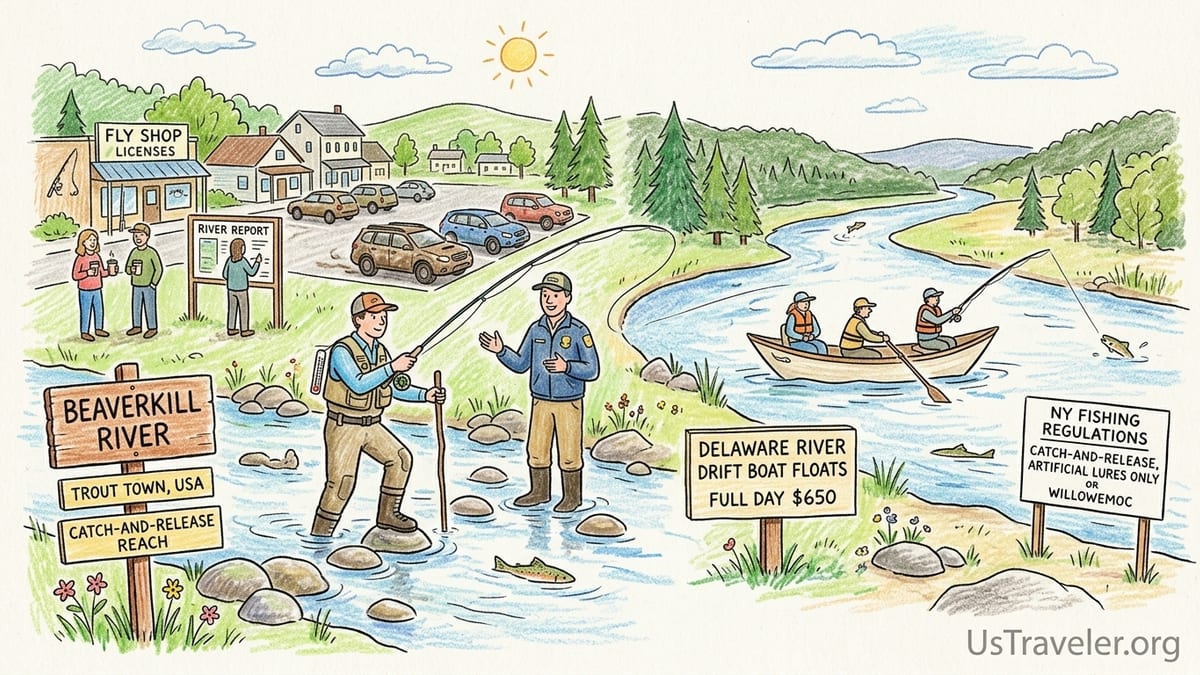
Morning in Roscoe: Meeting the Guide, Buying the License, Getting Honest About Expectations
I met my guide in Roscoe, the hamlet that markets itself as Trout Town, USA for good reason. We used a fly shop as the rendezvous point, the kind of place where the parking lot is a mix of mud-splattered Subarus and shiny SUVs, and nearly everyone inside is holding a coffee while scanning a river report board. I’d booked a walk-and-wade day through Beaverkill Angler, a full-service shop on the Beaverkill that publicly posts its guided trip rates. For 2026, its walk-and-wade rates are listed at $350 for a half day (for one or two people) and $450 for a full day (for one or two people), with rod, reel, and line included and waders available as an add-on rental.
Before we did anything else, the guide confirmed I had a valid New York State fishing license. If you’re traveling, handle this before the morning rush: you don’t want to burn the first half hour of a four-hour trip dealing with paperwork. Licenses are a non-negotiable, and the guide treated it that way, asking to see it and reminding me to keep proof accessible. We also talked regulations, because in the Catskills you’re often crossing between different special-regulation reaches without realizing it. One practical takeaway from that conversation: you cannot assume “standard trout rules” apply just because you’re on a famous river. Specific sections of both the Beaverkill and Willowemoc have special regulations, including catch-and-release and “artificial lures only” requirements in designated reaches.
We set expectations in plain language. I told him I wanted instruction more than hero shots. He told me something I appreciated: a guided day on the Beaverkill and Willowemoc doesn’t guarantee fish, especially if weather or water conditions are off. That honesty matters in a place with a reputation as big as this one. My goal became simple: learn how to read Catskills pocket water, practice clean drifts, and get through my first day without falling in or getting swept off a slippery rock.
Gear Check: Borrowed Rods, Rented Waders, and What “Included” Really Means
I arrived with my own boots but no waders and only a basic trout setup. The shop made it easy to avoid overpacking: Beaverkill Angler lists rod, reel, and line as included in its guided trips, and it also lists waders as a separate rental, priced at $35 per trip if needed. That breakdown mattered because many travelers assume waders are automatically part of the guide fee. Here, at least with this operator, you should plan for the wader rental if you need it, plus flies if you don’t already have the right boxes.
The rod we used was an Orvis Clearwater 9-foot 5-weight, paired with an Orvis Battenkill reel, which matches what the shop describes as its primary rental fleet. I liked that setup for day-one Catskills fishing because it’s forgiving enough for instruction but still capable of turning over a dry-dropper rig or a small nymph setup when needed. We added a leader suitable for trout dries and small nymphs, and the guide emphasized that the goal wasn’t to cast far, but to cast accurately and mend intelligently.
Waders were the other headline item. The guide had me try on a pair in the shop before we drove anywhere, because nothing ends a day faster than a poor fit. We checked belt placement, boot fit, and mobility for stepping over boulders. He also gave me a quick safety talk that felt refreshingly unromantic: use a wading staff if you need one, never assume a rock is stable just because it’s above the surface, and avoid “hero wades” that push you deeper than you can safely manage. That last point would become very real once we hit the river.
Water Conditions: Reading USGS Flows and Paying Attention to Temperature
Before we picked a run, the guide pulled up current water data. For travelers, it’s worth knowing that the Beaverkill has an established USGS gauge at Cooks Falls (USGS 01420500), which provides discharge and water temperature data. That’s not trivia. On a freestone river system, flow and temperature shape everything: where trout hold, how safe wading is, and how long fish can be played without unnecessary stress.
On my trip, the conversation was less about chasing an exact “perfect number” and more about interpreting what the river was doing right now. We used flow to decide how aggressively to wade and whether certain seams would be reachable without pushing into unsafe water. If you’re new to Catskills rivers, this is a big difference from fishing smaller brooks where you can simply hop bank-to-bank. The Beaverkill can look manageable from shore and still surprise you once current hits your thighs and pushes hard against your legs.
Temperature came up repeatedly. The guide carried a thermometer and checked periodically, not for obsession’s sake, but to keep us honest about trout stress. That influenced how long we stayed in one spot, how hard we pushed for additional water, and how we approached any fish that might come to hand. Even without a fish landed, I came away understanding that a guided day here is as much about stewardship as it is about tactics.
First Steps Into the Beaverkill: Slippery Stones, Wading Angles, and Casting That Actually Works
My first steps into the Beaverkill were slow and awkward. The riverbed was a mix of rounded stones and larger boulders, and more than a few rocks were slick enough that my boots felt like they were skating. The guide had me stop after only a few yards and look upstream, not downstream, and then showed me how to “shuffle” rather than step, keeping more contact points and reducing the chance of a sudden slip.
He also corrected my body position immediately. I had the instinct to face straight upstream and march toward “better water,” which is exactly how you lose balance. Instead, he demonstrated crossing at an angle, presenting less surface area to the current, and using the rod for balance without relying on it like a cane. It wasn’t glamorous instruction, but it was the kind that keeps you from taking a fall on day one.
Then we got into the real purpose of the morning: casting and drift. On the Beaverkill, we focused on short, controlled casts with deliberate mends. The guide showed me a tight loop for accuracy, then had me slow down, open the loop slightly, and prioritize a straight leader and a clean presentation over “pretty” form. When I rushed, he could see it immediately in the leader pile-up and the micro-drag. When I slowed down, the fly tracked naturally and I finally understood why anglers talk about a Catskills dry fly drift like it’s a craft.
I’m not going to claim we raised fish to every cast or that I connected with some legendary Beaverkill brown. What happened was more ordinary and more valuable: I missed opportunities. I watched a subtle rise form near a seam and lifted too quickly on the next drift, ripping the fly away. On another pocket, I felt a light hesitation on the line, hesitated myself, and set too late. Those moments were the real “first day” story, because they revealed what I needed to learn: patience, timing, and line control.
Flies We Actually Tied On: Simple, Local Logic Instead of Internet Myth
We kept fly selection practical and adjusted based on what we saw. I’m deliberately not presenting this as a definitive hatch-matching report, because conditions change quickly and I’m not going to invent a magic combination. The guide leaned on Catskills staples: small mayfly dries in natural tones when we saw surface activity, and a nymphing approach when we didn’t.
Early, we started with a dry-dropper rig to cover water efficiently while I worked on casting and mending. The top fly was a small, classic-style dry that was easy for me to see in broken water. Below it, we ran a small nymph intended to ride near the bottom without constantly snagging. The guide explained why that setup works for instruction: the dry is both a potential food item and a strike indicator, and it forces you to manage slack and drift correctly. When my dry twitched in an unnatural way, I learned to mend. When it stalled, I learned I’d thrown too much line. When it disappeared, I learned to set gently but decisively.
Later, when we committed more fully to subsurface fishing, we shortened up and focused on getting a clean drift through seams and pockets rather than stretching distance. The guide tied the knots, talked me through what he was doing, and then made me repeat the process until I could do it without fumbling. That was one of the day’s quiet victories: I left with better rigging habits and fewer “mystery tangles.”
We also talked cost. Even when rods and reels are included, flies can become a surprise expense for travelers who arrive with a box built for western rivers or bass ponds. Here, the guide was transparent: if you need shop flies, you pay for them. In my case, we leaned on what I had where it made sense and supplemented only where it didn’t. That approach felt like good faith, not upselling.
Lunch Break Reality: What a Full Day Feels Like in Cold Water
I opted for a full-day walk-and-wade because I wanted time to learn and to settle into the rhythm of the rivers. At Beaverkill Angler, full-day trips are explicitly described as including a meal, which becomes a meaningful part of the experience once you’ve been standing in moving water for hours. Lunch wasn’t a luxury. It was the reset that kept my energy and concentration from collapsing in the afternoon.
We ate simply, on the bank, with wet boots and waders still on because getting in and out of layers repeatedly is its own hassle. The guide used lunch the way good instructors do: he asked what felt difficult, what felt different from my expectations, and what I wanted the second half of the day to be. I admitted that wading was more tiring than I anticipated. Even when you’re standing still, you’re bracing against current, keeping balance on uneven stones, and trying not to slip while watching your drift. It’s low-level effort that accumulates until your legs feel thick and your feet feel numb.
The guide also checked in about safety and comfort. Did the waders feel right? Any cold spots? Any ankle pain? These questions are easy to dismiss until you realize a minor discomfort can become a real problem after eight hours. This is another underappreciated value of a guide on day one: they keep you from stubbornly pushing through something that turns into a sprain, a blister, or an accident.
Willowemoc Afternoon: Easier Wading, Different Water, Same Need for Precision
In the afternoon we shifted to the Willowemoc, which gave me a clean comparison within the same day. The Willowemoc’s reputation for accessibility is earned in many stretches. In places it felt less pushy underfoot than the Beaverkill, with more gentle gradients and a bit more room to reposition. That doesn’t mean it’s “easy,” but it did feel like a friendlier classroom once I’d already burned some nervous energy on the Beaverkill.
Regulations matter here too. New York’s 2026 Freshwater Fishing Regulations Guide includes specific special-regulation reaches for Willowemoc Creek near Roscoe. One reach is explicitly categorized as catch-and-release, with “artificial lures only” and open all year in that designated section. Those kinds of details are the difference between a relaxed afternoon and an accidental violation, so we treated them as part of trip planning, not an afterthought.
Fishing-wise, the Willowemoc rewarded the same fundamentals we’d worked on all day: short casts, controlled drifts, and smart positioning. I had a couple of moments where I felt the line tighten in a way that could have been a trout, but I didn’t come tight and I’m not going to call it a hookup. What I can say honestly is that I began to see water differently. By late afternoon I could identify where faster surface water met slower seams, where a bubble line hinted at a deeper channel, and where a small pocket behind a boulder could hold a fish without looking like “a pool.” That kind of perception shift is exactly what I wanted from a first guided day.
By the end, fatigue was the headline. Eight hours in and around water is tiring in a way that a casual traveler might not expect. It’s not just the walking. It’s the constant mental load of balance, the repetitive motion of casting, the cold seeping into feet, and the decision fatigue of reading water and changing tactics. When we finally stepped out and peeled off wet layers, I felt like I’d done a full day’s work. In a good way, but still work.
Walk-and-Wade vs Delaware-System Floats: Why Format and Price Are Not the Same Trip
If you’re comparing Catskills guide options, you’ll quickly see two broad formats: walk-and-wade on rivers like the Beaverkill and Willowemoc, and drift boat float trips on larger Delaware-system waters. Even when they’re both marketed as “guided fly fishing,” they are fundamentally different days, and pricing reflects that.
For walk-and-wade in Roscoe, Beaverkill Angler’s posted 2026 rates make a clear, traveler-friendly benchmark: $350 half day and $450 full day for one or two anglers. That’s a strong reminder that some operators price by the trip rather than per person, which can make a guided day far more approachable for a pair of travelers splitting the cost.
Float trips add another layer: boats, shuttles, additional safety considerations, and the reality that you cover miles of water. Beaverkill Angler lists float trips at $525 for a full day (for one or two people) and also lists half-day floats at $425, noting that floats are on bigger water like the Delaware system rather than the Beaverkill and Willowemoc. Separate from that shop-based pricing, I also found a local Catskills operator listing a full-day float around $650, which is consistent with what many travelers will see when they compare independent guide services and outfitters across the region. The point is not that one price is “right,” but that you must compare format to format: a wade day is not a float day, and the costs behind them are different.
Personally, I did not float the Delaware system on this first day, and I’m not going to pretend I did. But the guide walked me through what changes when you step from wading the Beaverkill and Willowemoc to floating tailwater-influenced Delaware reaches: you’re often making longer casts from a boat or while hopping out to wade select runs, timing your drifts with the boat’s pace, and reading different kinds of water. It’s typically less about balancing on slippery stones for hours and more about efficient coverage and boat positioning. If your main travel goal is to maximize time fishing while minimizing physical strain, a float can be appealing. If your goal is skills, river reading, and the classic Catskills wade experience, the Beaverkill and Willowemoc are a deeply satisfying place to start.
The Takeaway
My first guided day on the Beaverkill and Willowemoc didn’t give me a story about a trophy trout, because I’m not going to invent a catch I didn’t land. What it did give me was something that lasts longer: the confidence to wade safely, the muscle memory for better casting and mending, and a realistic understanding of how demanding and rewarding a Catskills walk-and-wade day can be. I left Roscoe tired, a little sore, and genuinely grateful that someone more experienced had stood beside me in moving water and helped me learn the river honestly, one careful step at a time.
For travelers planning a similar trip, the practical headlines are straightforward. Confirm New York licensing before you arrive. Read the special regulations for the exact reaches you’ll fish, because both rivers include sections with catch-and-release and artificial-lures-only rules. Budget for wader rental if you need it, plus flies. And when you compare prices, compare formats: a $350 half-day wade trip for one or two people is not the same product as a $650 full-day float on bigger Delaware-system water. In the Catskills, choosing the right first day is less about chasing a guarantee and more about picking the experience that matches how you want to learn and how you want to feel at the end of the day.
FAQ
Q1. Do I need a New York State fishing license to fish the Beaverkill and Willowemoc?
Yes. You need a valid New York State fishing license, and many guides will confirm you have it before the trip begins.
Q2. Are there special trout regulations on the Beaverkill and Willowemoc?
Yes. Certain reaches have special regulations, including catch-and-release sections and “artificial lures only” requirements in designated areas.
Q3. What does “artificial lures only” mean for fly anglers?
It means no bait. Standard flies and typical fly-fishing presentations qualify as artificial lures in these regulated reaches.
Q4. What are typical Roscoe walk-and-wade guide rates right now?
One Roscoe operator publicly lists $350 for a half-day and $450 for a full-day walk-and-wade trip for one or two anglers, which is a useful local benchmark.
Q5. Do guided trips usually include rods and reels?
Many do, but not all. One Roscoe shop-based guide service lists rod, reel, and line included in the trip rate, with waders as an additional rental if needed.
Q6. How much do waders cost to rent for a guided day?
One Roscoe operator lists wader rentals at $35 per trip if you need them, separate from the guide fee.
Q7. Is the Beaverkill hard to wade for beginners?
It can be. The current can be pushy in spots, and slippery river stones are common. A guide helps with safe angles, footwork, and choosing manageable water.
Q8. Is the Willowemoc easier than the Beaverkill?
In many stretches it can feel more forgiving for wading and instruction, but it still demands careful footing and precise drifts to fish effectively.
Q9. What’s the main difference between a wade trip and a Delaware-system float trip?
A wade trip focuses on moving on foot between runs and fishing from within the river; a float trip uses a drift boat to cover more miles and fish larger water with different casting and positioning demands.
Q10. How do float-trip prices compare to walk-and-wade pricing in the Catskills?
Floats often cost more due to boat, shuttle, and logistics. In 2026, some local guides list full-day floats around $650, which is a different format than a $350 to $450 walk-and-wade day.