


In the Catskills, the best overnight stories rarely start with a lobby. They start with a turn off a two-lane road, a last stretch of gravel, and the moment the forest swallows your phone signal. Cabins, tiny homes, and domes are the Catskills at their most honest: you came to hear the wind in hemlocks, to watch condensation bead on a window at dawn, to smell woodsmoke on your sweatshirt, and to learn whether “secluded” feels restorative or just inconvenient when you realize you forgot olive oil. This guide focuses on intentionally tucked-away properties, the kind where waking up in the woods was the point, with real-world notes on arrival, parking, check-in, heating and cooling, kitchens and bathrooms, Wi-Fi or the lack of it, and how far you will actually drive for dinner and groceries.
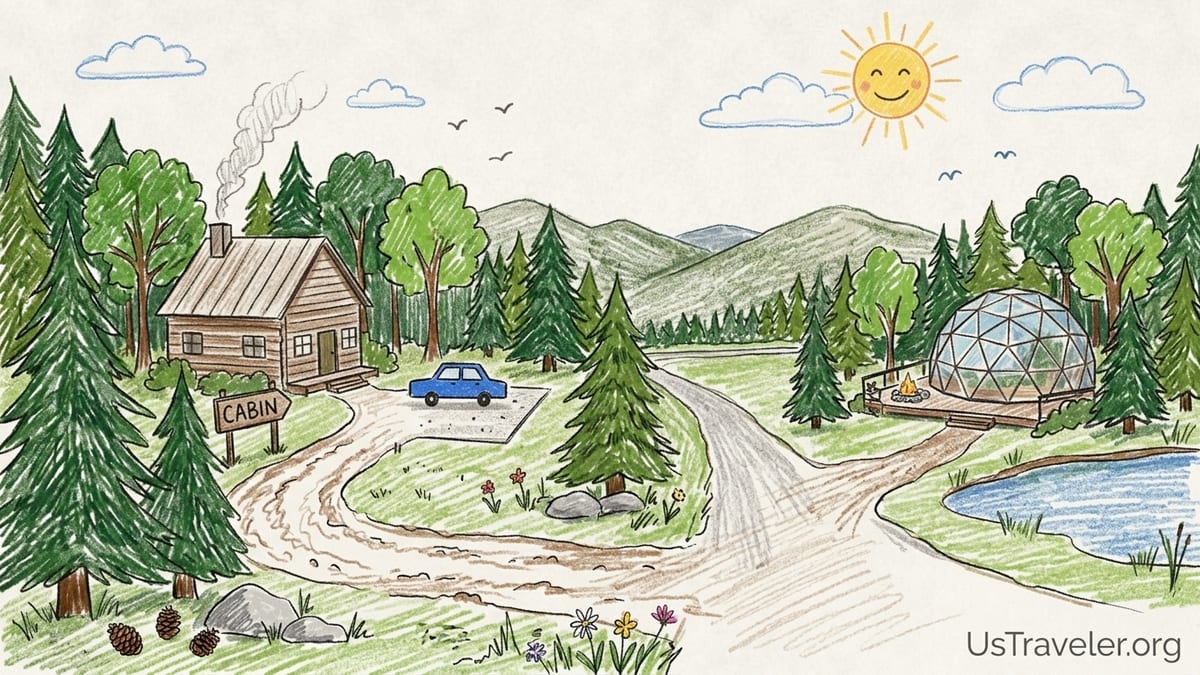
What “Secluded” Really Means in the Catskills
The Catskills are close enough to New York City to be a weekend default, but once you leave the Thruway and start threading county roads, “close” becomes a sliding scale. A cabin stay can mean anything from a polished glamping resort with a front desk to a one-lane driveway where you are very glad you arrived before dark. The practical questions are the same either way: Can two cars pass on the access road? Is parking flat and close to the door? Is there outdoor lighting at night? What happens when it rains hard and the gravel turns to ruts?
For travelers, the most common surprise is not wildlife. It is logistics. In many corners of the Catskills, dinner is a drive, not a stroll. Even if your cabin has a kitchenette, you will likely want groceries, ice, and a backup plan for a rainy night when grilling feels heroic. The “secluded but easy” sweet spot is typically a stay that feels wrapped in trees on site, yet remains within a manageable drive of a real town center or a dependable general store.
Isolation becomes restorative when it is deliberate: the cabin is quiet, the bed is comfortable, the heat is reliable, and the fire setup is safe and straightforward. It becomes inconvenient when you are fighting indoor temperatures, struggling with unclear check-in instructions, or realizing your “fully equipped kitchen” is missing a cutting board. This is why the best cabins and domes are not just pretty. They are operational.
Year-Round Domes in Sullivan County: When Glamping Is a Real Building
Sullivan County has leaned into dome glamping in a way that feels purpose-built, not improvised, and that matters in winter. Domes at Catskills positions itself as luxury glamping on the shores of a lake in the Sullivan County Catskills, and it is explicitly designed for four-season comfort. The site emphasizes central heating and air conditioning with individual temperature controls and radiant heating, plus high-speed Wi-Fi and full bathrooms with hot and cold running water and showers. The domes are presented with real “hotel-grade” touches that change the experience in shoulder season, when nights can get cold fast.
Inside the domes, the details are what separate a true year-round stay from a “three-season tent with ambition.” Domes at Catskills describes features like a queen bed, a galley-style kitchen setup with a refrigerator and induction cooktop, and an indoor gas fireplace in at least some dome types, along with outdoor cooking via grill and a wood-burning firepit. That combination, heat plus an indoor fire feature plus an actual bathroom, is the difference between romantic and uncomfortable when the wind picks up off the lake.
On the ground, dome glamping still comes with the practical rhythms of a secluded property. You drive in, park, and transition quickly into quiet. The dome’s curved shell changes how sound behaves at night: rain becomes a soft percussion, and wind can feel closer, like it is pushing directly on the room. For some travelers, that is the magic. For light sleepers, it is a reminder to pack earplugs.
Where this kind of isolation can become inconvenient is food. A dome with a kitchenette makes breakfast and simple dinners realistic, but you still need ingredients. If you plan to cook, arrive with a grocery list and do a real shopping run before you turn onto the last back roads. If you plan to eat out, assume you will be driving, and do not build your evening around last-minute spontaneity. When the property is the destination, the smartest move is to treat dinner like a planned activity, not an afterthought.
Themed Dome Glamping Near Monticello: A Different Kind of “Cabin Weekend”
If you want your glamping to feel playful rather than purely rustic, Unique Escapes has become one of the county’s most recognizable names for custom-designed, themed geodesic domes. The Sullivan County Chamber of Commerce listing describes it as luxury glamping in differently themed domes and notes it operates seven days a week, year-round, with self check-in and walk-ins welcome based on availability. That year-round note is crucial for travelers booking late fall, winter, or early spring, when many tent-forward glamping operations pause.
The practical feel here is less “backcountry” and more “set piece in the woods,” but the goal is still the same: sleep in the trees. The themed approach can make domes feel less like a minimal retreat and more like a small private world. For travelers celebrating something, the biggest advantage is that the dome itself becomes the evening plan. You can arrive, settle in, and stay put without feeling like you are missing out on nightlife.
Because Unique Escapes is tied to self check-in, you should approach arrival like you would for any remote stay: screenshot the door code and instructions, download offline maps, and assume your signal may fade at the least convenient moment. If your group is arriving in more than one car, confirm parking details in advance. In a forest setting, “parking” can mean anything from a neat gravel pad to a narrow pull-off, and it is better to know before you roll in late.
The isolation is restorative when you treat the dome like a retreat: plan meals, bring what you want to drink, and leave room in your itinerary for doing nothing. It becomes inconvenient if you expect to wing it. In dome country, the most common frustration is realizing you are a longer drive from dinner than you imagined, then finding that rideshare coverage is unreliable. The fix is simple: either cook, or choose one dinner destination and commit to it early.
Airstreams, Cabins, and BaseCamps: Resort-Run Glamping at AutoCamp Catskills
AutoCamp Catskills sits in the “easy mode” lane of a woodsy weekend: you get nature without giving up the structure of an onsite team. The tradeoff is that it functions more like a hotel in the woods than a solitary cabin in deep forest, and you will see neighbors. Still, for travelers who want firelight, privacy at night, and a reliable bathroom, AutoCamp can be the right compromise.
Operationally, AutoCamp is transparent about rules and fees. The company’s booking policies state that most weekends require a two-night minimum stay and that holiday and event weekends may require three or more nights. It also lists a nightly amenity fee of $35 plus tax, and it spells out that check-in is after 4 p.m. with checkout at 10 a.m. The same policy page also makes clear that dogs are allowed for an additional $75 per stay for up to two dogs, that quiet hours run 10 p.m. to 8 a.m., and that smoking inside accommodations triggers a minimum $350 cleaning fee. Those numbers are not small, and they matter when you are comparing “cabin” pricing apples to apples.
Third-party booking channels reflect how those fees show up in the real world at checkout. Expedia and Hotels.com both list a resort fee of $39.20 per accommodation, per night for AutoCamp Catskills, and Expedia shows example pricing snapshots for future dates. In practice, this is the moment many travelers realize that “nightly rate” is only part of the story. If you are booking for a quick one- or two-night trip, the combination of a nightly fee plus taxes can shift the final cost meaningfully.
From a comfort standpoint, AutoCamp is built around four-season lodging expectations: the accommodations are not improvised cabins, and the resort is set up for guests who want dependable heat, air conditioning, and Wi-Fi. The property’s own arrival guidance reiterates the non-smoking rules and pet policy, and the overall experience is designed to be frictionless: drive in, park, check in with staff or key retrieval, and settle into a controlled version of the woods.
Where AutoCamp feels restorative is the predictability. You can plan a workday around Wi-Fi. You can arrive in bad weather and still be comfortable. You can buy essentials and get help if something is not working. Where it becomes less magical is if you want true solitude. AutoCamp is a shared-property environment, which means you may hear other guests, and your firepit time lives within quiet-hour boundaries. If your ideal Catskills night is silence so deep you can hear leaves falling, you will likely prefer a standalone cabin or a private-site rental.
A Glass-Walled Tiny Home by the Water: The Camptons Pod in Haines Falls
For travelers who want modern design with a “you are definitely in nature” setting, tiny homes can hit the sweet spot. The Camptons Pod in Haines Falls is described as a romantic, glass-walled tiny house perched on a serene pond in the heart of the Catskills, with amenities that read like a checklist for a comfortable off-grid feeling stay: Wi-Fi, a fully equipped kitchenette, and a private hot tub, plus a fire pit for nights when you want to stay outside until the cold drives you in.
Fees and minimums are clearly outlined: pricing is listed at $299 per night Sunday through Thursday, $349 per night Friday and Saturday, and $499 per night on holidays, with a $99 flat cleaning fee and a minimum two-night stay. Check-in is listed as 4 p.m. to 9 p.m., and checkout is 10 a.m., with rules that include no pets, no smoking, and no parties or events. That last point is worth taking seriously in a small glass-forward structure where sound travels.
The location is what makes this type of stay feel like a true woods wake-up. The listing’s “stay like a local” notes place it about 1.5 miles from Kaaterskill Falls and about a 12-minute drive to Hunter Mountain. Those are not just attractions. They are your reference points for practical planning. If you plan to hike Kaaterskill Falls early, you can treat the pod like a trail-adjacent base. If you are there for skiing or leaf season, you are close enough to move around, but far enough to return to quiet.
Where isolation feels restorative here is obvious: morning coffee facing water, a hot tub under stars, and the kind of stillness you only get when your “front yard” is a pond. Where it can become inconvenient is food. Haines Falls is not a late-night, anything-you-want town. The easiest fix is to do groceries on the way in and treat the kitchenette as part of the trip. If you prefer dining out, plan one dinner destination and accept that you are driving both ways, likely on dark roads.
Budget Cabins That Still Feel Like the Catskills: A Prattsville Bungalow Reality Check
Not every Catskills cabin has to be a $400-a-night architectural flex. There are older-school rentals that trade design drama for value, and for some travelers, that is the right call. Catskill Getaway’s Catskill Bungalow in Prattsville publishes a detailed rate sheet that reads like a time capsule in the best way: in several seasons, weeknights are listed in the $69 to $75 range and weekend nights in the $84 to $89 range, with three-night bundles for non-holiday weekends and higher holiday bundles. It also lists a basic cleaning fee of $45 per stay, plus an online reservation fee percentage.
The point of including a property like this in a glamping and cabins guide is not to argue that it competes with domes or boutique resorts. It is to show what “simple cabin logistics” look like when you are trying to keep the trip affordable. The rental agreement documents that Wi-Fi is shared and asks guests to limit device usage, and it outlines a security deposit and the possibility of extra cleaning fees if checkout instructions are not followed. In other words, the low nightly rate is paired with very clear expectations.
This is the Catskills in a more old-fashioned mode: you arrive, park, unlock a straightforward place, and spend most of your time outside exploring. It can be restorative because it removes decision fatigue. You are not paying for constant programming or a curated scene. You are paying for a base. It can become inconvenient if you expect luxury-level comfort without doing any prep. When the kitchen is simpler and the Wi-Fi is shared, you plan accordingly: download what you need, bring what you care about cooking with, and build your fun around hikes, drives, and river time rather than “staying in and streaming movies.”
Prattsville’s location, in Greene County, also underlines a broader point: the Catskills are not one centralized destination. Your driving realities depend on where you stay. A budget cabin can be a great deal, but it may place you farther from the restaurant clusters you had in mind. The fix is to match the cabin to the itinerary, not the other way around.
The Takeaway
The best Catskills cabin or glamping trip is the one where the woods are the feature, not the background. In Sullivan County, purpose-built dome stays make the year-round promise feel real, with heat, air conditioning, and full bathrooms that keep the romance intact in winter. Resort-run glamping like AutoCamp smooths out the friction of remote travel, but you trade solitude for structure, fees, and shared-property rules. Tiny homes like the Camptons Pod turn design into the destination, and older-school cabin rentals prove you can still do the Catskills without a luxury budget if you read the rules and pack with intention.
The practical thread across every property type is planning. Save directions offline, arrive before dark when you can, grocery shop on the way in, and treat cleaning fees, amenity or resort fees, and minimum stays as part of the true nightly cost. Isolation is restorative when it is supported by reliable heat, a good bed, and a bathroom you do not have to brave the cold to reach. It is inconvenient when you forget that dinner is a drive and cell service is not a guarantee.
If your goal is to wake up in the woods, choose the stay that matches your tolerance for friction. Some travelers want a front desk and Wi-Fi. Others want a firepit and no notifications. In the Catskills, you can have either, as long as you book with your eyes open.
FAQ
Q1. Are Catskills domes actually comfortable in winter?
Some are. Look for properties that explicitly advertise year-round operation with central heating and true indoor plumbing. Domes at Catskills highlights radiant heating, individual temperature controls, and full bathrooms, which are the features that matter when it is cold.
Q2. What is the most common minimum stay for Catskills cabins and glamping?
Two nights is common on weekends. AutoCamp states most weekends require a two-night minimum, and holiday or event weekends may require three or more nights.
Q3. Are resort fees and amenity fees normal for glamping resorts?
Yes. AutoCamp lists a nightly amenity fee on its booking policies, and third-party listings may show a resort fee per night. Always compare total price including these fees, not just the base nightly rate.
Q4. Do secluded Catskills stays usually have Wi-Fi?
It varies. Some luxury domes and tiny homes advertise high-speed Wi-Fi, while simpler cabins may have shared Wi-Fi with usage limits. If you need to work remotely, confirm Wi-Fi details before booking.
Q5. How far will I have to drive for dinner and groceries?
Assume you will drive unless you are staying directly in a town center. In many secluded areas, even a quick dinner can mean a significant drive on dark roads. The safest plan is to buy groceries on the way in and treat restaurants as scheduled outings.
Q6. Are firepits allowed at Catskills cabins and domes?
Often, but rules differ. Some properties provide designated firepits and require you to follow quiet hours or fire-safety policies. Confirm whether wood is provided, whether outside fires are allowed during your dates, and whether there are burn restrictions.
Q7. Are pets usually allowed at Catskills glamping properties?
Policies vary widely. AutoCamp allows dogs for a per-stay fee and limits the number of dogs. Other properties, including some tiny homes and resorts, may be no-pet.
Q8. What should I download or screenshot before I lose cell service?
Save offline maps, check-in instructions, gate or door codes, Wi-Fi details, and the host or front desk contact information. Remote roads and valleys can create dead zones even when the nearest town has service.
Q9. What fees should I look for besides the nightly rate?
Common add-ons include cleaning fees, pet fees, resort or amenity fees, taxes, and security deposits. Also look for penalties tied to smoking, unapproved pets, or excessive cleaning.
Q10. Which type of stay is best if I want solitude but not too much hassle?
A standalone tiny home or a small year-round dome property can be the best middle ground: private enough to feel secluded, but built with real heat, bathrooms, and kitchens so you are not improvising comfort.