


I used to think choosing where to stay in the Catskills was basically a hotel decision. After a handful of overnights spread across the region, I learned it is more like choosing a home base on a sprawling map of valleys, reservoirs, ridgelines, and two-lane roads where a 25 mile hop can still take close to an hour. This is the guide I wish I had before I booked my first weekend and then spent half my “relaxing” trip in the driver’s seat. Below is how I chose between Woodstock and Phoenicia for the eastern Catskills, Hunter and its neighbors for mountain access and ski days, and Livingston Manor and Roscoe for the quieter western side where dinner and fly fishing can anchor an entire weekend.
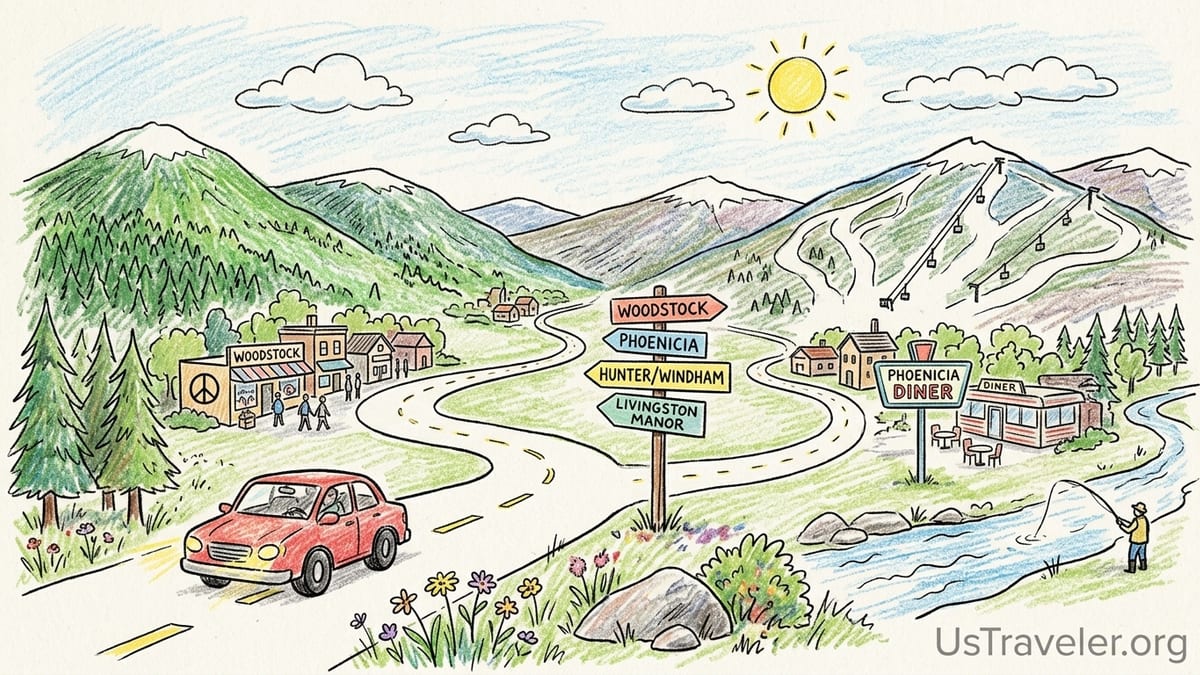
First, the Catskills Are Dispersed (So Your Base Matters More Than Your Room)
The Catskills reward planning because the region does not function like a single compact resort town. It is a patchwork of small villages separated by ridges, reservoirs, and state land. Even when two places look close on a map, your actual drive might be a winding state route with 35 to 45 mph limits, limited passing, and long stretches with no shoulder. That is why “Which part of the Catskills should I sleep in?” is usually the right first question.
On my earliest trip, I booked what looked like a charming, central spot and assumed I would improvise from there. I ended up doing long out-and-back drives for simple basics: trailheads in one direction, a decent dinner in another, and groceries somewhere else entirely. The difference between a great Catskills weekend and a tiring one is often whether you can string together mornings, afternoons, and dinners without a complicated daily loop.
Another reality: after dark, many Catskills towns get quiet quickly. That is not a knock, it is part of the appeal, but it changes logistics. If your lodging is five minutes outside a town center, that can feel like “basically in town” at 3 p.m. and feel very far away when it is raining at 9 p.m., your phone is searching for signal, and the nearest open kitchen is 25 minutes away.
Woodstock and Phoenicia: Eastern Catskills Culture With Different Day-Trip Math
For an eastern Catskills trip, I have treated Woodstock and Phoenicia as two different types of base camps. Woodstock is the culture-forward choice, the one where you can park, walk, browse, and feel like you are “in a place” even if you do not hike that day. Phoenicia, meanwhile, sits closer to classic Route 28 corridor access and the kind of trailhead-and-river rhythm that makes a hiking weekend feel straightforward.
Woodstock’s big advantage is that you can build a day without touching your keys: coffee, a bookstore stop, a gallery wander, an early dinner, then back to your room. It is also the kind of place where you will run into music and events energy on weekends. The practical downside is that Woodstock is popular, and parking can feel like a sport. The town’s own parking information points visitors toward a handful of main public lots, which is helpful, but it still means you are often circling, timing, and walking a few minutes once you land.
Phoenicia is less about strolling boutiques and more about being pointed straight at the mountains. It is also a better fit if you like the “hike first, diner later” routine. One very real logistical detail: Phoenicia Diner’s published hours are 8 a.m. to 6 p.m. (closed Wednesdays), which is fantastic for breakfast and early dinners, but it means a late meal after a long hike usually requires planning, a backup, or a drive.
Where I misjudged it: I once stayed too deep in the Woodstock orbit when what I actually wanted was early starts on Route 28 hikes, quick access to trailheads, and simple post-hike food without navigating town traffic and parking again. I loved the vibe, but my daily driving crept up because I was commuting to the mountains each morning and then commuting again for dinner.
My After-Dark Reality Check: Restaurant Access, Grocery Runs, And the 8 p.m. Problem
The Catskills can feel well-served for food until you look at the clock. A lot of the region runs on daytime and early-evening hours. That shapes your base decision more than most people expect. If your plan includes late trail finishes, sunset swims, or lingering brewery afternoons, your lodging should be close to at least one place you can reliably eat after dark without turning it into a 40 minute round trip.
In the eastern Catskills corridor, one of the most useful “anchor stops” I found for mornings is Bread Alone, which lists its cafes as open 7 a.m. to 5 p.m. daily. That is great for grabbing coffee, pastries, or an early sandwich before a drive. It is not, however, a late-night safety net. If you are used to destinations where you can wander into town at 9:30 p.m. and find dinner, recalibrate your expectations.
For groceries, the Catskills reward doing one intentional shop early in the trip. When I skipped that step and tried to “pick things up later,” I ended up doing an extra evening drive for basics like seltzer, breakfast, or snacks. The best base is often the one where a grocery run does not add a full hour of your day, and where you are not sweating whether a small market is already closed.
My clearest mistake: I stayed in a pretty, quiet spot outside any real center, assumed I would “figure out dinner,” and discovered that the nearest dependable option at night required getting back into the car after I had already driven all day. That is the moment when a slightly less secluded base becomes the more restful choice.
Hunter, Tannersville, And Windham: Mountain Days, Ski Logistics, And Crowd Strategy
If your trip is built around lift-served skiing or big mountain terrain, the Hunter and northern Greene County cluster makes the most sense. Hunter, Tannersville, and Windham can function as a tight triangle depending on your priorities: proximity to a particular mountain, availability of lodging, and how much you care about having a walkable main street versus a quick drive to the lifts.
One reason I treat this zone as its own category is that winter weekends change the region’s rhythm. Roads feel busier, parking lots fill earlier, and your daily schedule becomes more clock-driven: breakfast earlier, first chair goals, dinner reservations, and a clear plan for what you are doing after the lifts close. If you choose a base far away “because it is cheaper,” you can end up paying in stress and time.
For tickets and planning, it is worth noting how much pricing and availability can shift: even Windham’s own lift ticket page emphasizes rescheduling policies and the use of RFID cards, which signals how structured the experience has become. On the pricing front, third-party ski sites publish “from” ranges and remind visitors to check the resort for the most up-to-date prices. The practical takeaway for base selection is simpler: if you care about skiing, sleep close enough that you can adapt. If weather changes overnight or crowds spike, you want the ability to pivot your start time without turning the morning into a road trip.
Where I misjudged it: I once stayed farther south, thinking I would “just drive up” to the ski towns. The drive looked modest on paper, but it meant a longer morning commute, a longer return after a full day outside, and less flexibility if I wanted a break midday. The Catskills are not huge, but winter driving makes every mile feel more consequential.
What The Eastern Bases Feel Like Day-To-Day: Parking, Trailheads, And Signal Gaps
In the Woodstock and Phoenicia orbit, your day-to-day experience is shaped by a few repeating frictions: parking in popular hamlet centers, trailhead congestion on bluebird weekends, and cell signal that can be inconsistent once you slip into valleys and hollows. Even if you do not think of yourself as a “planner,” it helps to screenshot directions and trailhead locations before you lose signal.
For hiking access context, New York State’s DEC describes Slide Mountain Wilderness as one of the most heavily visited wilderness trail systems in the Catskills, and it lays out how corridor trails connect parking areas and campgrounds. That matters because if you stay on the eastern side, you are often deciding between a base that is pleasant at night versus a base that gets you to popular trailheads early enough to park without drama.
Phoenicia has the “corridor convenience” advantage: you are naturally on a route that makes it easier to do a morning hike, then an afternoon river stop, then food without as much backtracking. Woodstock has the “evening quality” advantage: after hiking elsewhere, you can return to a town where it feels normal to browse a shop or sit down for a meal without hunting for a place that is still open.
My practical advice from staying in both: pick Woodstock if you are actually going to use the town at night. Pick Phoenicia if you want to wake up and be in the mountains quickly. The wrong pick is Woodstock if you are leaving town every morning anyway, or Phoenicia if your favorite part of travel is walking a main street after dinner and lingering over a second drink.
Livingston Manor, Roscoe, And Western Sullivan County: Food, Rivers, And A Quieter Weekend That Still Feels Complete
On the western side, my most pleasant surprise has been how well Livingston Manor can support a full weekend without feeling like you are using it as a pit stop. It is the kind of place where you can arrive, check in, eat well, fish or hike, and repeat without the constant feeling of needing to drive east for “the real Catskills.” Current regional travel messaging increasingly reflects that reality: the western side is not just a pass-through.
What anchors the area is the combination of dining, lodging, and fly-fishing culture. The Catskill Fly Fishing Center and Museum is located on a large campus on the Willowemoc Creek, and a visit there makes the region’s fishing identity feel tangible rather than abstract. Even if you are not an angler, it is the kind of stop that gives your weekend structure: morning coffee, a museum visit, an afternoon by the river, then dinner in town.
Livingston Manor also has at least one destination restaurant that is explicitly set up for walk-ins, which matters in small towns where reservations can be hard to land on peak weekends. The Kaatskeller, for example, notes that most of its seating is unreserved and saved for walk-ins, and that you can use an online waitlist via its Google Maps listing. That single detail changes how “spontaneous” your trip can be: you can hike or drive scenic roads and still have a realistic shot at dinner without having booked it a month earlier.
Roscoe adds another layer, especially if you are drawn to the Beaverkill and Willowemoc names you see on fly shop walls and guidebooks. Livingston Manor and Roscoe work well as a paired base because you can keep your nights calm and your days focused on rivers, food, and short drives rather than mountain-hopping. Where I went wrong the first time: I tried to use a western base while still chasing an eastern Catskills itinerary, and I paid for it in daily driving. The western side is ideal when your goals match the geography.
The Takeaway
If you want culture and a town-forward weekend, sleep in Woodstock and actually use Woodstock at night. It is the base that feels like a destination when you are not hiking, which is not true everywhere in the Catskills.
If you want quick eastern trail access and a Route 28 rhythm, Phoenicia is the more efficient base. Just remember that some of the most famous food options run on daytime hours, so plan dinners like you plan hikes.
If you are skiing or building a winter weekend around lifts and vertical, base yourself in the Hunter, Tannersville, or Windham zone. The closer you sleep to the mountain you plan to ride, the more flexible and less stressful your trip becomes.
If you want a quieter weekend where food and rivers are the main event, Livingston Manor and Roscoe are not “secondary” choices. They are a real weekend hub, with enough dining and fly-fishing gravity to keep you close to home base instead of chasing the Catskills across county lines.
FAQ
Q1. Which part of the Catskills should I sleep in for the least daily driving?
Match your base to your main activity: Woodstock or Phoenicia for eastern hikes, Hunter or Windham for ski days, and Livingston Manor or Roscoe for rivers and western Sullivan County dining.
Q2. Is Woodstock or Phoenicia better if I want restaurants after dark?
Woodstock generally gives you more “town energy” at night, while Phoenicia is excellent for mornings and hiking access but some headline food options keep daytime hours.
Q3. How late is Phoenicia Diner open?
Phoenicia Diner lists its hours as 8 a.m. to 6 p.m. daily except Wednesday, which is a key detail if you expect late dinners after hikes.
Q4. What is the best Catskills base for skiing Hunter Mountain?
Sleep in the Hunter and Tannersville area if skiing is the priority so you are not doing a long morning commute and an even longer drive back after the lifts.
Q5. Is Windham still a good place to base a winter weekend?
Yes if Windham is your planned mountain, because proximity matters most in winter. Check lift-ticket rules and day-of policies directly when you book since pricing and availability can shift.
Q6. Is Livingston Manor just a pass-through town?
No. It can support a full weekend with dining and lodging, plus nearby fly-fishing culture anchored by the Catskill Fly Fishing Center and Museum.
Q7. Do I need reservations for Livingston Manor restaurants?
On busy weekends, reservations help, but some destination spots are designed to accommodate walk-ins and waitlists, which makes last-minute weekends more realistic.
Q8. What is a good “anchor stop” for early mornings in the eastern Catskills?
Bread Alone’s cafes list daily hours starting at 7 a.m., which makes it a reliable early stop before heading deeper into the mountains.
Q9. How should I plan for cell service in the Catskills?
Assume it will be inconsistent in valleys and on some back roads. Screenshot directions and trailhead info before you lose signal, especially if you are switching between towns.
Q10. What is the most common Catskills base mistake?
Booking lodging for the vibe of one town while planning most activities in a different zone, then spending the weekend driving across the region instead of relaxing.