


I used to think choosing where to stay in the Adirondacks was a hotel decision. After several overnights spread across the park, I realized it’s almost always a geography decision first: how close you want to be to dinner on foot, how early you need to reach trailheads, whether your trip is built around paddling or peaks, and how much you can tolerate patchy cell service and long, dark drives. I based myself in Lake Placid, Saranac Lake, Tupper Lake, the Lake George and Bolton Landing area, Wilmington near Whiteface, and a quieter central-Adirondack cabin-style stay where the “town” part of town is not the point. Here’s what that felt like on the ground, and how I’d choose again depending on the kind of Adirondacks you’re actually coming for.
How I Chose A Base: The Geography Questions That Actually Matter
Before I booked anything, I wrote down the friction points that can quietly ruin an Adirondack trip: driving after dark on two-lane roads, arriving late to a popular trailhead and circling for parking, not being able to walk to a casual dinner after a hike, and the inevitable “we forgot groceries” moment when you’re 30 to 45 minutes from the nearest full grocery store.
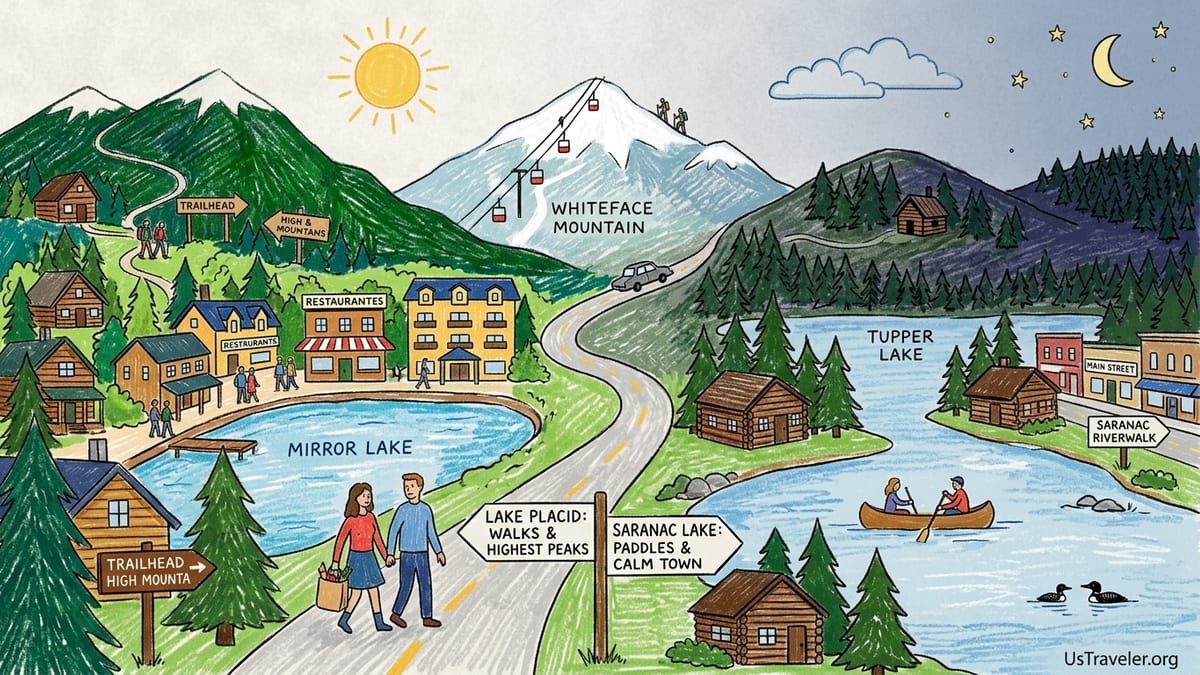
In practice, every Adirondack base is a trade. Lake Placid buys you the highest concentration of restaurants, walkable streets, and classic Adirondack resort energy. Saranac Lake buys you a calmer daily rhythm and still keeps you close to the same northern trail network. Tupper Lake buys you affordability and a more low-key launch point into water-and-woods. Lake George and Bolton Landing buy you a resort-and-boat holiday with marinas and a broader vacation-lake vibe. Wilmington buys you quicker access to Whiteface and the Ausable Valley, with less “village premium.” And then there’s the central Adirondacks, where your reward is darkness, quiet, and a sense of being truly inside the park, but you pay in logistics.
I also planned around connectivity. The Adirondacks are famously patchy for cell service, and you feel it most between towns and in the deeper interior. I treated any base where I couldn’t reliably load a map or place a call as a place where I needed to download offline maps, screenshot reservations, and accept that some time-sensitive decisions would have to happen earlier in the day while I still had signal.
Lake Placid: When The Convenience Really Is Worth The Price
Lake Placid is the Adirondacks’ most “easy mode” base, and I mean that as a compliment. Official destination guidance explicitly calls out Lake Placid for luxury and a broad range of lodging choices, from high-end lakeside properties to more affordable motels and inns. What that translates to on an overnight is simple: you can finish a hike, park once, and do the rest of the evening on foot.
On a Lake Placid night, walking to dinner felt like the trip itself. Main Street and the Mirror Lake area make it easy to string together a casual drink, a meal, and dessert without thinking about headlights, wildlife, or fatigue. That walkability matters more than it sounds because Adirondack days often start early and end tired. When I stayed close enough to stroll, I actually enjoyed evenings more, instead of treating dinner as another driving chore.
The hidden Lake Placid skill is parking literacy. The village has an overnight parking ban on Main Street from 2:00 a.m. to 6:00 a.m., and some municipal lots have their own overnight restrictions on specific nights. If you’re staying in a place that doesn’t provide guaranteed off-street parking, you need to read signs carefully and have a plan before you settle in for the night. I found it easiest to treat parking like a check-in task: handle it immediately, not after dinner when you’re half-asleep.
Lake Placid also made early trail mornings smoother. The north side of the High Peaks region is within easy striking distance, and being based here reduced the “should we even bother” feeling when an alarm goes off at 4:45 a.m. Even small time savings feel big when you’re chasing a sunrise hike or trying to beat crowds to a trailhead.
Saranac Lake: Calmer Streets, Real Town Energy, Still Close To Everything
If Lake Placid is the Adirondacks with a bow on top, Saranac Lake is the Adirondacks with its sleeves rolled up. Official guidance highlights Saranac Lake’s mix of town stays and cabins, and that blend is exactly what I felt: you can have a walk-to-dinner night, but the vibe is more local and less resort-forward.
One evening, I used the Saranac Lake Riverwalk as the “reset button” after a long drive. It’s an approximately one-mile round-trip pedestrian walkway that threads along the Saranac River and links you back into downtown. That kind of simple, public, low-pressure feature makes Saranac Lake feel livable rather than performative, and it’s great if your group includes someone who wants a gentle stroll while others want bigger hikes.
From a practical standpoint, Saranac Lake is a strong compromise base for northern Adirondack trips. You’re close enough to Lake Placid that you can still treat Placid as a dinner option or an Olympic-site day, but you don’t have to pay for the Lake Placid address every night. I also liked Saranac Lake for the “no big plan” evenings: pop into town, find food without fighting for the most coveted reservation in the park, then be back at your lodging quickly.
Getting onto the water felt more immediate here than I expected. The voco Saranac Lake waterfront property, for example, publicly promotes a private dock with canoe, paddleboard, and pontoon rentals plus complimentary self-parking. Even if you don’t stay there, it’s a reminder that Saranac Lake’s daily life is tightly tied to Lake Flower and nearby paddling water. On the nights I stayed in this area, I could picture a paddling-first itinerary that barely uses the car except for trailheads.
Tupper Lake: Affordable, Unfussy, And Surprisingly Good For Active Days
When I needed the trip to cost less without feeling like I’d “downgraded” the Adirondacks, Tupper Lake made sense. Official Adirondacks lodging guidance is blunt about the positioning: Tupper Lake is a haven for affordable lodging. That matched my experience: fewer luxury cues, more simple places that exist to get you fed, rested, and back outside early.
The key advantage of staying here is psychological as much as geographic. Tupper Lake doesn’t pressure you to turn your lodging into the centerpiece. It’s easier to spend money on an extra guided outing, a boat rental day elsewhere, or a nicer dinner because you’re not paying a resort premium just to sleep.
Tupper Lake also slots neatly into multi-town itineraries. One day I treated it as the “active middle” between Saranac Lake and Lake Placid, especially with the Adirondack Rail Trail storyline developing across the corridor. Trail status can change with construction, and there have been periodic closures on the Floodwood Road to Tupper Lake stretch as construction work finishes. In other words, if biking the full corridor is the main reason you’re choosing Tupper Lake, double-check current conditions right before you go and have a plan B ride ready.
In day-to-day terms, Tupper Lake felt like the place to stay when your mornings are early and your evenings are simple. If your ideal Adirondack night is a shower, a casual meal, and planning tomorrow’s route, it’s a strong fit. If your ideal night is strolling a lively main street, shopping, and bar-hopping without driving, it can feel quiet.
Lake George And Bolton Landing: The Resort-And-Boat Holiday Base
Lake George is not “just another Adirondack lake.” It’s a full vacation ecosystem, and it behaved that way the moment I based myself on the lake. If your trip priority is water time, marinas, and a resort rhythm, Lake George and the Bolton Landing area are often the most efficient answer because so much of the infrastructure is designed around getting you onto the lake without friction.
When I stayed near Bolton Landing, the day felt built around boating: coffee, a short drive or walk to the marina, safety briefing, cooler packing, then hours on the water. For concrete examples, F.R. Smith and Sons Marina in Bolton Landing publishes 2026 rental rates and runs daily rentals with a standard 8:00 a.m. to 5:00 p.m. rental window, plus a mandatory safety video for renters. That kind of structure matters because it turns “we should rent a boat one day” into a plan with real time boundaries and logistics you can build a day around.
Lake George is also the base I’d pick for mixed groups where not everyone wants to hike. You can do an easy morning walk, a beach or boat afternoon, and still have a classic vacation dinner without anyone feeling dragged into a 10-mile trail day. It’s particularly strong if you’re traveling with kids or first-time boat renters who want a straightforward marina experience and a lake culture that’s used to visitors.
The trade is crowd energy and driving patterns. The southern end of the Lake George area can feel busy in peak season, and even when you stay farther north, you should expect more traffic and more “vacation town” motion than you’ll feel in Saranac Lake or Tupper Lake. If your fantasy is quiet loon calls and a dark-sky porch, this isn’t the most reliable base for that mood.
Wilmington And Whiteface: A Quieter Mountain Base With Fast Trail And Ski Access
If your Adirondack trip revolves around Whiteface Mountain, Wilmington is the base that made my days feel simplest. You’re close to the ski center and the Ausable Valley, and you’re also near enough to Lake Placid that you can dip into Placid for a meal or an errand without committing to staying in the busiest zone.
Parking at Whiteface was refreshingly straightforward. Whiteface publishes that free daily parking is available in several lots, with a paid Premier Lot option sold per day, and the resort notes that there is no overnight camping in the parking lots. That matters even in summer because it tells you how the mountain expects visitors to arrive and depart. On a day I planned around the mountain, I didn’t have to budget time for complicated paid-lot hunting the way I sometimes did in Lake Placid.
Whiteface’s summer operations also come with real calendar anchors. The mountain’s hiking information has included a clearly stated summer-season opening date in late June for 2026. I like having that kind of official date because it helps you avoid the classic shoulder-season mistake: arriving expecting certain services or access patterns that haven’t started yet.
Wilmington’s vibe is more “base camp” than “village night out,” which can be perfect after a long day. My evenings here were quieter: drive to dinner rather than walk, more stargazing, less browsing. If your group includes early sleepers and dawn hikers, that calm can be a feature, not a bug.
Central Adirondacks And Remote Cabin Stays: When Losing Convenience Is The Whole Point
Some Adirondack trips aren’t improved by a busier town. They’re improved by darkness, quiet, and the feeling that you’re not commuting into wilderness, you’re already inside it. That’s where a more remote central-Adirondack cabin-style stay earns its keep, and it’s also where you should be brutally honest about your tolerance for inconvenience.
On my more remote nights, the logistics became part of the schedule. Groceries had to happen earlier in the day, not “after we check in.” Dinner was often whatever we brought in or cooked, not a spontaneous stroll to a restaurant. Weak cell coverage stopped being a mild annoyance and became a planning constraint. I made sure I had offline maps downloaded, and I treated any drive after dark as something to do slowly and intentionally, not as an afterthought.
The reward was immediate: real quiet, real stars, and mornings that started with coffee outside rather than a scramble to beat traffic. It also made the Adirondacks feel bigger. In busier bases, the park can feel like a set of attractions. In the interior, it feels like a landscape you’re temporarily borrowing.
This is also where the Adirondack Hub concept clicked for me. Official Adirondacks guidance explicitly describes the Adirondack Hub as a rustic region and a base-camp style gateway for getting into the backcountry for hiking, paddling, and gravel biking. That “base camp” framing is exactly how the deeper-in-the-park nights felt: you trade walkable nightlife for being closer to quiet water, trail junctions, and the kind of early starts that don’t feel like you’re racing anyone.
The Takeaway
If I had to boil my Adirondacks stays down to one rule, it’s this: choose your base like you’re choosing your mornings. Lake Placid is the easiest answer when you want walk-to-dinner convenience, a broad lodging menu including luxury, and faster decision-making on the fly. Saranac Lake is the calmer northern alternative with a genuine downtown rhythm and quick access to the same general region. Tupper Lake is the budget-friendlier pivot when you want to spend your money on activities and keep lodging simple. Lake George and Bolton Landing shine for a resort-and-boat vacation where marinas, rentals, and lake days are the main event. Wilmington is a quieter mountain base that keeps Whiteface close and lowers the nightly buzz. And a remote central Adirondack cabin stay is worth it when the goal is to unplug, slow down, and feel the park around you even when you’re doing nothing at all.
I stopped asking, “Which hotel is best?” and started asking, “Where do I want to be at 7:00 a.m., and what do I want evenings to feel like?” In the Adirondacks, that decision is the difference between a trip that looks good on paper and a trip that actually feels good hour by hour.
FAQ
Q1. Should I stay in Lake Placid or Saranac Lake for hiking the High Peaks?
Lake Placid is the most convenient for a lot of northern trail mornings and has the biggest walkable dining scene. Saranac Lake is calmer and often feels easier at night, while still keeping you close enough to reach many of the same trail networks with a short drive.
Q2. Is Lake Placid only for luxury travelers?
No. Official visitor guidance highlights Lake Placid’s luxury reputation, but also notes it has a broad range of lodging options, including more affordable motels, inns, cottages, and village-edge stays.
Q3. What’s the most budget-friendly town base among the ones you tested?
Tupper Lake consistently felt like the best place to keep lodging costs down while still staying in an active Adirondack town base. It’s also officially positioned as a haven for affordable lodging.
Q4. Which base is best if my trip is mostly about boating and swimming?
Lake George and the Bolton Landing area are the most purpose-built for a water-first vacation, with multiple marinas and rental options and an overall resort-lake rhythm that makes lake days easy to execute.
Q5. Is Wilmington a good alternative to staying in Lake Placid?
Yes if you want quieter nights and quicker access to Whiteface and the Ausable Valley. You’ll drive more for dinner compared with a walkable Lake Placid stay, but you can still dip into Lake Placid when you want that atmosphere.
Q6. How hard is parking in Lake Placid overnight?
You need to pay attention. Lake Placid prohibits overnight parking on Main Street from 2:00 a.m. to 6:00 a.m., and some municipal lots have additional overnight restrictions on specific nights. If your lodging doesn’t include dedicated parking, read signs carefully and make a plan before you head to dinner.
Q7. What did you do about weak cell coverage in the Adirondacks?
I downloaded offline maps before leaving town areas and avoided relying on cell service for last-minute navigation, digital tickets, or time-sensitive confirmations once I headed onto remote roads.
Q8. When is it worth staying in a remote cabin deeper in the park?
It’s worth it when you value quiet, stars, and a true wilderness feel more than you value walkable restaurants and quick grocery runs. It’s a great fit for early starts, paddling-focused trips, and unplugged weekends, but it requires more planning.
Q9. What is the Adirondack Hub, and who is it best for?
It’s a central Adirondack region that official guidance describes as a rustic base-camp style area for getting into the backcountry for hiking, paddling, and gravel biking. It’s best for travelers who want an outdoors-first trip and don’t need a busy resort town every night.
Q10. If I only have one long weekend, what base gives the most flexibility?
For a first trip focused on variety, I’d choose either Lake Placid for maximum convenience or Saranac Lake for a calmer home base that still keeps Lake Placid, paddling water, and trail access within easy reach.