


The Adirondack Rail Trail is one of those rides that sounds straightforward on paper: 34 miles of old railroad grade linking Lake Placid, Saranac Lake, Lake Clear, and Tupper Lake. Gentle slopes, no cars, and a surface designed for pretty much everyone. But out on the corridor, the experience is less “simple rail trail” and more a moving story about the Tri-Lakes region itself, one that shifts every few miles from village to wilderness to water to history, then back to storefronts and coffee counters. I rode the entire route point-to-point from Lake Placid to Tupper Lake in one day on a Class 1 pedal-assist e-bike, and what surprised me most wasn’t the distance. It was how the trail kept changing its tone without ever breaking its rhythm.
Planning The Ride: Parking, Permits, And Why I Chose A Class 1 E-Bike
I built this ride around two non-negotiables: I wanted to do the full corridor in one push, and I wanted to finish in Tupper Lake without turning around. That meant solving the point-to-point problem first. The second decision was the bike. The Rail Trail is built for human-powered travel, but it is also long enough that your day changes dramatically depending on what you ride and how strong your legs feel after the first 15 miles.
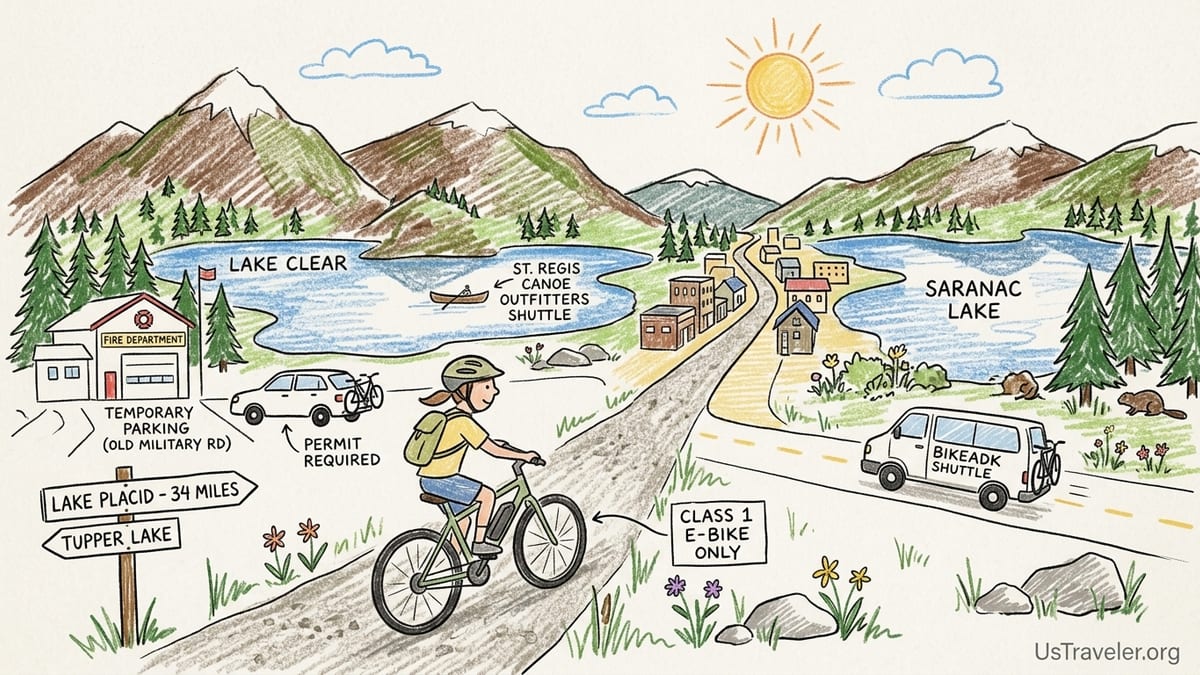
I rode a Class 1 pedal-assist e-bike, the type that only assists while you pedal and stops assisting at 20 mph. That detail matters here because the Adirondack Rail Trail’s current policy allows Class 1 e-bikes, while Class 2 and Class 3 e-bikes are not permitted. If you are used to an e-bike with a throttle, this trail is a place where you should confirm your bike’s class label before you show up, rather than hoping nobody notices.
Before publication day, I also checked the Lake Placid trailhead parking situation, because it has been changing as the new trailhead is built. As of the current construction notice, the Station Street parking lot at the Lake Placid terminus is closed while work is underway, with temporary parking directed to Old Military Road by the Lake Placid Fire Department. In practical terms, that meant I did not plan on rolling up and finding an easy space right at Station Street. I planned to arrive early, park at the temporary area on Old Military Road, and start the ride from there.
If you prefer to skip the e-bike question entirely, a hybrid, gravel, or mountain bike is the classic choice because most of the corridor is compacted stone dust or crushed-stone style surface, with a paved stretch through Saranac Lake. For me, the e-bike was about keeping the experience enjoyable over the full 34 miles, not about going fast. I wanted to roll steadily, stop often, and still have enough energy at the end to wander Tupper Lake on foot without feeling like I had done a stage of a race.
Start Line In Lake Placid: The First Miles Feel Like Leaving Town For Real
Lake Placid has a way of making you feel like you are already doing something athletic before you clip in. Even getting your bike pointed west feels like a purposeful departure. With the Station Street trailhead parking area under construction, the beginning of the day started a little more like a local errand than a grand trailhead moment. I parked at the temporary area on Old Military Road, did a final gear check, and rolled toward the corridor.
The first thing I noticed was width and openness. This is not a skinny singletrack squeezed between trees. It is built to handle families, walkers, runners, cyclists, and adaptive equipment, and you can feel that immediately in how the trail carries you forward. The grade is gentle, the kind of railroad-engineered slope that rarely makes you stand up on the pedals. In Saranac Lake’s visitor guidance for the corridor, the typical slope is described as around 2% with a maximum around 5%, and that matches how it rides: you sense the incline more in your breathing than in your legs.
Surface-wise, the early miles were the first reminder that “crushed stone” can mean different things. Here it rides like a firm, densely compacted stone-dust track where a wider tire feels calmer and quieter. On my e-bike, I was grateful for a slightly larger, stable feel rather than a narrow road tire vibe. It was not technical riding, but it was real riding, not a paved cruise path where you forget you are moving over a trail base.
Wind was the first invisible character of the day. The corridor cuts through open patches and tree cover, and the gusts come and go as the landscape changes. In the open sections you feel it push your shoulder, and in the woods it quiets down so suddenly that your own drivetrain becomes the loudest sound again.
Between Lake Placid And Saranac Lake: The Rail Grade Does The Work, Your Body Just Keeps Time
The stretch toward Saranac Lake is where the Rail Trail begins to feel like a true Adirondack corridor rather than a village connector. You move through long, calm sections of forest where the view isn’t one single postcard scene, but an ongoing, layered Adirondack mood: wetland edges, glimpses of water, and a steady procession of greens that shifts with every change in light.
This is where I started to appreciate the practical side of a long, shared-use trail. Road crossings appear, especially as you approach town, and you need to ride like someone who expects other people to be learning the trail in real time. There are runners wearing headphones, families with kids who drift left and right, and riders who are still figuring out how their rental bike handles on stone dust. The trail’s gentle grade encourages everyone to move, which means you should assume you will be passing and being passed all day.
Water planning is the detail that makes or breaks your comfort. I carried enough to drink steadily, but the corridor’s appeal is that it passes through real communities. If you are riding point-to-point, the easiest way to handle hydration is to treat Saranac Lake as your mid-ride resupply rather than trying to carry everything from Lake Placid. The compacted surface can lull you into thinking it will be effortless, but by mile 15, even a gentle trail starts to add up if you are under-fueled.
Cell coverage along this stretch can be inconsistent in the deeper, quieter parts, which is normal for the Adirondacks. I treated the day like a ride where I might not always have a reliable signal. That meant downloading any navigation I wanted beforehand and not relying on streaming audio to set the pace. The upside is that it encourages you to hear the trail itself, the soft crunch of tires and the sudden quiet when you enter a thicker stand of trees.
Rolling Through Saranac Lake: Pavement, People, And The Most “Town” Feeling Of The Day
Arriving in Saranac Lake feels like a shift in genre. The trail’s roughly two-mile paved section through the village changes the sound under your tires and the energy around you. You go from stone-dust hush to that clean pavement hum, and suddenly you are riding alongside daily life: sidewalks, nearby businesses, and the subtle sense that this trail is not only a recreation facility but a transportation spine.
This is also the section where you should expect more intersections and more decisions. You have to ride with a little more attention because the corridor threads through a living place. In exchange, it is the easiest place to take a meaningful break without feeling like you are stepping off into the wilderness. If you want a coffee stop or a sit-down snack rather than trail mix eaten over a top tube, Saranac Lake is the moment.
For restrooms, Saranac Lake is where your options become more straightforward simply because you are in a village. On a ride like this, I plan restroom breaks around communities rather than hoping for facilities deep in the corridor. The long wilderness sections are exactly what makes the Rail Trail special, but that also means you should not expect a bathroom at every scenic moment. The ride is better when you accept that village amenities are part of the rhythm.
If you are unsure about your stamina, this is also the most logical place to decide whether you are doing the full 34 miles or making it a shorter out-and-back. The trail does not shame you either way. It is built so that a 10-mile day can feel complete, and a 34-mile day can feel like a journey.
Lake Clear And The Middle Miles: Water Views, Quiet Stretches, And The Place Where Fatigue Starts Talking
Past Saranac Lake, the Rail Trail starts to open into a sequence of ponds and lakes that feel deeply Adirondack, especially around the Lake Clear area. This is where the corridor earns its reputation as more than a connector between towns. The water sits close to the route, the light changes quickly, and you begin to feel how the trail threads together paddling country, camping country, and cycling country in the same linear experience.
This is also where fatigue begins to show up in small negotiations. Nothing about the grade is dramatic, but the miles add up. On an e-bike, you still feel the work, especially if you keep the assist low to preserve battery and ride like it is a normal bike with a tailwind. My own strategy was to use a conservative assist level early, then bump it slightly in the later miles when my cadence started to sag. That kept the ride feeling steady rather than like two different days stitched together.
Food here is less about finding a perfect trail-side café and more about being smart before you leave town. I carried snacks I knew I would actually eat, not just aspirational bars that live in a bag forever. The Rail Trail is friendly terrain, but it is still a long corridor through a region where services can be spread out. If you are riding point-to-point without a support car, the best “real-world” move is to buy something you genuinely want in Saranac Lake, stash it, and treat it as your mid-ride reward.
Rest areas and informal pull-offs exist, and you will see other riders stopping to take photos or adjust layers. In shoulder seasons especially, I would expect temperature swings: cool shade in the trees, warmer sun in open wetland stretches, then cool again near water. I used that pattern as a cue to drink and eat even if I did not feel thirsty, because the ride stays comfortable when you stay ahead of the energy curve.
Floodwood To Tupper Lake: The Long Finish, The Best Quiet, And The Last-10-Miles Test
The final approach toward Tupper Lake feels like the part of the story where the trail quiets down again and asks you to simply keep moving. The corridor stays gentle, but the “railroad straight” sections can feel longer now that you have already been riding for hours. This is where a headwind, even a modest one, becomes the day’s biggest hill.
By this point, the surface and the grade were no longer what I was thinking about. I was thinking about cadence, comfort, and the small body signals that show up on longer rides: a hot spot on a palm, a shoulder that wants a different posture, the slow stiffness that appears when you stop too long. The Rail Trail’s biggest challenge is that it is so rideable you can forget to shift your position and stretch. I made myself stop briefly even when I did not need to, just to reset.
Cell coverage continued to be hit-or-miss in the quieter stretches, which reinforced why point-to-point logistics should be set before you start. This is not the sort of ride where you want to finish and then begin improvising a ride back to your car. The best version of this day is the one where you already know exactly where you are ending, exactly how you are getting back, and exactly what time you expect to arrive.
When you finally reach Tupper Lake, the finish feels tangible because the trail delivers you back into a community. The satisfaction is not only the mileage. It is the feeling that you crossed the region at human speed, watching it change gradually rather than through a windshield. You arrive with dirt on your tires, a steady fatigue in your legs, and the distinct sense that 34 miles on a rail corridor is not about conquering anything. It is about noticing everything.
Shuttle Logistics: What Worked, What Cost, And What I’d Do Differently Next Time
For a point-to-point day, a shuttle is the difference between a smooth experience and an overly complicated one. I used a dedicated rail-trail shuttle service rather than asking a friend to do a long, slow car swap. In the Tri-Lakes region, BikeADK offers a book-ahead shuttle model that is designed specifically for this trail, with pricing published by route. For a small group, the listed cost for a shuttle between Lake Placid and Tupper Lake has been posted at $135 per ride, not per person, with larger-group pricing higher. They recommend booking in advance, and the way they structure it is simple: they pick you up at where you want to finish, then drive you to where you want to start, so you can ride without watching the clock.
That “finish-to-start” shuttle direction is the detail I would recommend to anyone. It removes the stress of trying to time your ride to meet a driver. You ride until you are done. If you stop longer in Saranac Lake for food or photos, it does not turn into a problem. It turns into your day actually unfolding the way a travel day should.
Another shuttle option in the region is St. Regis Canoe Outfitters, which publicly advertises Rail Trail transportation between multiple stops including Lake Placid, Saranac Lake, Lake Clear, Floodwood Road, and Tupper Lake. For travelers who are already using outfitters for paddling gear or other Adirondack logistics, that kind of all-in-one coordination can be appealing, especially if your group has mixed plans.
If I were doing this again, I would do two things differently. First, I would plan my final meal more deliberately in Tupper Lake, because finishing hungry is almost guaranteed if you underestimate how long the last miles feel. Second, I would treat Lake Placid’s temporary parking as part of the day’s logistics, not a footnote. With Station Street parking closed during the trailhead construction period and temporary parking routed to Old Military Road, you want extra time for arrival, for finding the correct lot, and for calmly getting yourself organized before you start rolling.
The Takeaway
The newly completed 34-mile Adirondack Rail Trail is not only a long, car-free ride. It is a linear portrait of the Tri-Lakes. The crushed-stone and stone-dust stretches feel quiet and grounded, the paved miles through Saranac Lake feel social and lived-in, and the gentle rail grade lets you look outward rather than down at your front wheel. It is an experience that rewards patience, snack discipline, and a little humility about weather and wind.
Riding the full corridor in one day is absolutely doable for many travelers, especially with a Class 1 pedal-assist e-bike and a pre-arranged shuttle. But the best part is that the Rail Trail does not demand the full 34 to feel meaningful. If you only ride one segment, you still get the essential feeling: leaving one Adirondack town, crossing real wilderness, then arriving somewhere else under your own power.
If you are planning a 2026 ride, the operational details are part of the story right now. Lake Placid’s Station Street trailhead parking area is under construction with temporary parking on Old Military Road, and the trail’s e-bike rule is specific: Class 1 is permitted, Classes 2 and 3 are not. Once you plan around those realities, what remains is the best kind of travel: a long, steady day where the landscape changes one pedal stroke at a time.
FAQ
Q1. Is the Adirondack Rail Trail fully open between Lake Placid and Tupper Lake?
Yes. The current public guidance describes the Adirondack Rail Trail as a continuous 34-mile route between Lake Placid and Tupper Lake.
Q2. What is the trail surface like for cyclists?
Most of the corridor is a firm, compacted stone-dust or crushed-stone style surface, with a paved section of roughly two miles through the Village of Saranac Lake.
Q3. Are e-bikes allowed on the Adirondack Rail Trail?
Class 1 pedal-assist e-bikes are permitted on the corridor. Class 2 and Class 3 e-bikes are not permitted.
Q4. Where should I park in Lake Placid in 2026?
With the Station Street trailhead parking area under construction, current notices direct rail-trail users to temporary parking on Old Military Road near the Lake Placid Fire Department.
Q5. Is there a shuttle so I can ride one-way?
Yes. BikeADK publishes rail-trail shuttle service between Lake Placid, Saranac Lake, Floodwood Road, and Tupper Lake, with advance reservations recommended. St. Regis Canoe Outfitters also advertises transportation between multiple rail-trail stops.
Q6. How long does it take to bike the full 34 miles?
Timing varies widely by fitness, stops, wind, and bike type. Many riders plan a half-day to full-day outing, especially if they intend to stop in Saranac Lake for food and breaks.
Q7. Is the route hilly?
The corridor follows an old railroad grade with very gentle slopes. Visitor guidance describes a typical slope around 2% and a maximum around 5%, so it generally feels steady rather than steep.
Q8. Are there restrooms along the trail?
Restrooms are easiest to find in the communities the trail passes through, especially in village areas like Saranac Lake. In the quieter stretches, services are more limited, so plan breaks around town stops.
Q9. What’s the best mid-ride stop for food and water?
Saranac Lake is the most natural resupply point because the trail runs directly through the village and includes a paved in-town segment near restaurants and shops.
Q10. What’s the simplest way to do a point-to-point ride?
The simplest approach is to book a shuttle that picks you up at your planned finish and drives you to your start. That way you can ride at your own pace without timing a pickup window.