


Central Florida is famous for roller coasters and character meet-and-greets, but what many visitors never realize is how quickly the landscape changes once you drive beyond the resort exits. Within an hour or two of Orlando, you can trade virtual reality for real spring water, neon lights for starry skies and packed midway crowds for quiet small towns on cypress-lined lakes. These are the places that locals retreat to when they want Florida to feel like Florida again.
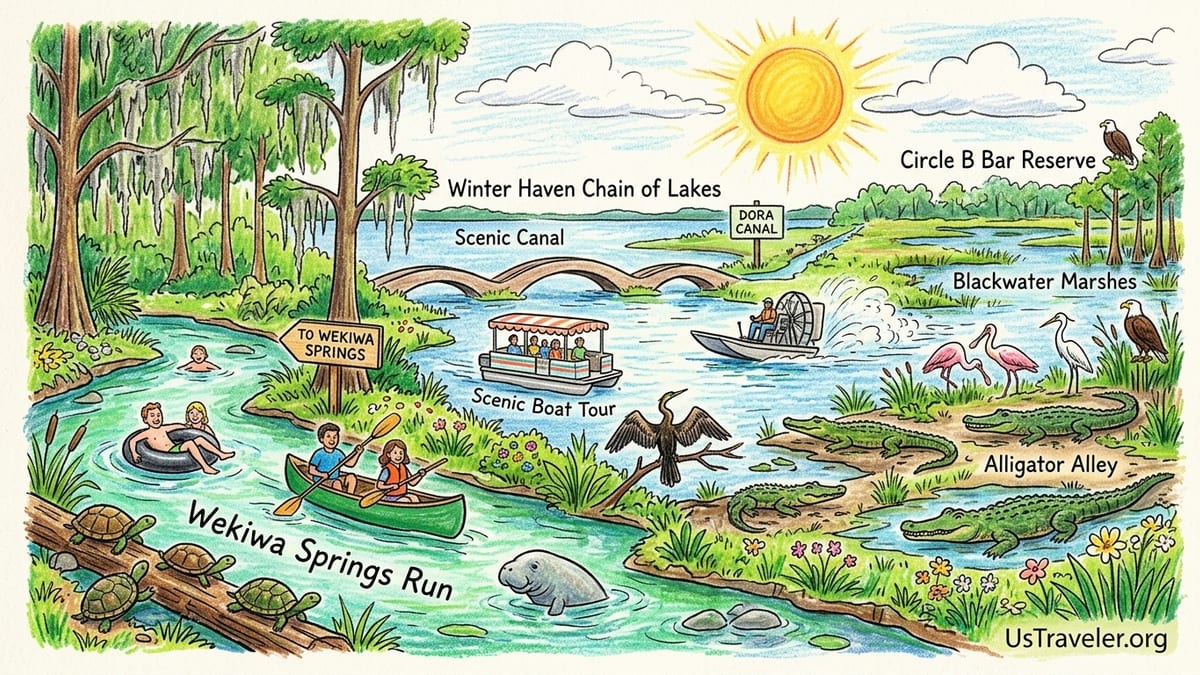
Why Central Florida’s Wild Side Belongs in Your Trip
Central Florida’s springs, lakes and nature preserves are not consolation prizes for travelers who have “done” the theme parks. They are a different kind of headline act. Crystal-clear spring runs stay around 72 degrees throughout the year, bald eagles nest above tannin-stained rivers, and blackwater marshes hold more alligators and wading birds than you will see in any staged animal show. For families, couples and solo travelers, these places create the quiet, unscripted moments that balance out crowded days at Disney and Universal.
Local tourism boards now lean into this contrast. Visit Orlando actively highlights natural springs within about an hour of the attractions area, while Polk County’s tourism office markets its Chain of Lakes, airboat rides and paddling routes as core experiences rather than fringe extras. In practical terms, that means you will find more guided boat tours, kayak outfitters and clearly signed trailheads than even a decade ago, all designed for visitors who may never have paddled a river or seen a wild alligator before.
Think of these nature experiences the way you would a well-planned dining strategy. Instead of eating theme park food for every meal, you probably plan at least a few dinners in local neighborhoods. In the same way, dropping in even one spring, lake town or wildlife reserve for a half-day, full day or overnight can radically change how a Central Florida vacation feels.
The following sections group ideas by experience, not by county line. You will see how Wekiwa Springs connects with Rock Springs Run and Kelly Park, how Winter Park’s boat tours complement nearby museums, and how places like Mount Dora, Winter Haven, Circle B Bar Reserve and Safari Wilderness can be mixed and matched into an itinerary that suits your schedule and comfort level with the outdoors.
Spring-fed Escapes: Wekiwa Springs and Rock Springs / Kelly Park
If there is one category of experience to prioritize beyond the parks, it is the springs. Wekiwa Springs State Park sits roughly 20 to 30 minutes north of downtown Orlando, close enough that locals treat it like an after-work swim spot. The main spring basin is an emerald pool that stays around 72 degrees year-round, with a large grassy slope where families spread towels, coolers and shade tents. The park now runs a day-use reservation system most of the year, especially on busy weekends and holidays, so it is worth securing a parking reservation in advance rather than gambling on same-day entry when gates often close by late morning in summer.
Wekiwa works well as a half-day or full-day escape. A common pattern is to arrive by 8 or 9 a.m., swim for an hour, then rent a canoe or kayak from the on-site concession and paddle down the Wekiva River or Wekiwa Springs Run for another two to three hours. Along the way you are likely to spot turtles stacked on logs, anhingas drying their wings and, if you are lucky, manatees in cooler months. Many visitors head back to Orlando by midafternoon to freshen up for an evening at the parks or in Winter Park. Others bring a picnic and stay until late afternoon, then catch sunset colors filtering through the live oaks.
About 30 to 40 minutes northwest of Orlando, Rock Springs at Dr. Howard A. Kelly Park offers a different spring experience. Here, a clear, shallow spring run spills from a rocky vent into what locals call a natural lazy river. Visitors rent or bring inner tubes and float roughly three-quarters of a mile through shaded hammocks, taking 20 to 30 minutes per run. Orange County Parks and Recreation manages Kelly Park, and it is known to fill to capacity early on summer weekends, often with cars turned away by midmorning. For that reason, many travelers plan Rock Springs as a weekday half-day, pairing it with a late lunch in Apopka or a relaxed evening back in Orlando.
In practice, you do not have to choose between Wekiwa and Rock Springs if you have more than one free day. One itinerary that works well for families is to spend a Friday morning floating Rock Springs, then check into a rental or small hotel in nearby Mount Dora for the night before exploring town on Saturday. Another option for active travelers is to paddle Rock Springs Run, the 10-mile tributary linking Kelly Park and the Wekiva River, on a guided kayak trip. This is a full-day experience for confident paddlers and showcases the darker, quieter side channels and wildlife corridors that most tubers never see.
Lakeside Culture and Canals: Winter Park by Boat and on Foot
Just north of Orlando’s theme park belt, Winter Park feels surprisingly different. Brick streets, lakeside cypress trees hung with Spanish moss, and a compact downtown lined with galleries and restaurants create a slower rhythm. The best first look at the area is the Winter Park Scenic Boat Tour, which has been running since the 1930s. It departs several times a day from a dock on Lake Osceola, guiding 18-passenger pontoon-style boats through narrow canals that link several city lakes. Tickets are typically priced so that a family of four can ride for considerably less than a single theme park admission, and the one-hour tour fits easily into a half-day schedule.
On the water, guides point out everything from osprey nests to the architecture of lakefront homes, from Mediterranean Revival mansions to sleek midcentury lines. You glide beneath low arched bridges and past lush backyards where residents launch kayaks or simply watch the boats go by. Because the lakes are relatively sheltered, this is a low-adrenaline outing that works well for multigenerational groups and visitors who might be nervous about airboats or open-water kayaking.
Once back on land, you can walk ten minutes to the Charles Hosmer Morse Museum of American Art, home to one of the world’s most comprehensive collections of works by Louis Comfort Tiffany, including stained glass windows and lamps. Art fans often pair the boat tour and museum visit with lunch along Park Avenue’s sidewalk cafes, turning Winter Park into a classic half-day culture-and-water combo. If you have a full day to spare, you can add the Rollins Museum of Art or simply linger under the oak trees in Central Park, watching local families and students go about their day.
Winter Park can also serve as a softer landing day after back-to-back theme park visits. Travelers staying near International Drive or Lake Buena Vista frequently drive up in the late morning, take the midday boat tour, browse bookstores and boutiques in the afternoon and finish with dinner on Park Avenue before returning to their resort. You will feel that you have stepped into a real Central Florida community rather than another tourism district, which can be a welcome reset in the middle of a long vacation.
Small-Town Charm on the Water: Mount Dora and Bok Tower Gardens
Mount Dora sits on the edge of Lake Dora, about 45 minutes to an hour northwest of Orlando, and feels like the sort of small town that stars in travel magazines. The historic downtown is built on a slight rise, unusual in mostly flat Central Florida, which gives side streets glimpses of the water. Antique shops, independent bookstores, cafes and bed-and-breakfast inns fill restored early 20th-century buildings. It is easy to spend a relaxed half-day here, but many travelers choose Mount Dora as an overnight base when they want to feel totally removed from the resort corridor.
On the water, several local operators run pontoon cruises and guided eco-tours along the Dora Canal, a cypress-lined waterway often described as an “Old Florida” jungle. Trips usually last around two hours and highlight herons, ibises and the occasional alligator basking on muddy banks. Late-afternoon departures can roll directly into sunset, when the sky reflects off the lake and the town’s lights begin to glow. Back on land, you can choose from small bistros and taverns before turning in at a lakeside inn or downtown guesthouse.
About an hour and 15 minutes south of Orlando, near Lake Wales, Bok Tower Gardens feels more like a sanctuary than a traditional attraction. The 250-acre site centers on a 205-foot art deco and neo-Gothic “Singing Tower” carillon surrounded by landscaped gardens designed in the 1920s. General admission for adults is typically around twenty dollars, with reduced pricing for children, and the grounds are open daily from morning into late afternoon, with carillon concerts scheduled most days. Staff recommend planning three to four hours to walk the trails, tour the historic El Retiro estate if you choose to add that option, and linger at overlooks with views across citrus groves.
Bok Tower Gardens lends itself to a thoughtful full day when combined with nearby small towns. One sample itinerary is to drive from Orlando in the morning, tour the gardens through early afternoon, then continue on to Winter Haven or Lake Wales for an early dinner and overnight stay. That way, you avoid driving back on busy highways in the dark and wake up already positioned to explore Polk County’s Chain of Lakes the next day.
Lakes, Airboats and Paddles: Winter Haven’s Chain of Lakes and Beyond
Polk County markets itself as the heart of Florida’s freshwater playground, and nowhere is that more obvious than in Winter Haven. Here, a series of natural lakes connected by man-made canals create the Winter Haven Chain of Lakes, a network that boaters can treat almost like a watery highway. The South Chain alone includes prominent lakes such as Howard, Cannon, Shipp, Eloise and Summit, each ringed by docks, small parks and residential neighborhoods. For visitors, the easiest way to experience the Chain is to book a guided cruise, rent a pontoon or join a paddle tour run by local outfitters.
Several companies operate scenic pontoon-style tours that leave from restaurant docks or marinas around town. A typical two-hour narrated cruise might pass former Cypress Gardens ski show sites on Lake Eloise, glide through narrow canals shaded by cypress trees and pause near active osprey nests. Prices generally sit well below theme park levels, often in the range a couple might comfortably pay for a nice dinner out. These outings work well as half-day excursions, especially when paired with lunch at a lakeside restaurant before or after your time on the water.
For more active travelers, kayak and paddleboard rentals are available on multiple lakes. Some operators specialize in guided sunrise or sunset paddles, where you launch in soft light, move quietly along the shoreline and often encounter herons, egrets and jumping fish with almost no engine noise in the background. The Florida Fish and Wildlife Conservation Commission highlights the Winter Haven Chain as a productive bass fishery, and visiting anglers commonly book four- or six-hour guided trips targeting largemouth bass from small bass boats.
Airboat tours represent another side of Polk County’s lake country. Operators based on nearby lakes and rivers run shallow-draft airboats that skim over marshes and backwaters in search of alligators, wading birds and wide-open horizons. Rides usually last 60 to 90 minutes, with ear protection provided, and are especially popular at sunset when temperatures drop. Because airboats are loud and conditions can be windy, many families treat them as a one-time adrenaline experience, then turn to quieter pontoon cruises or paddling on other days.
Wildlife Safaris and Trail Time: Circle B Bar Reserve and Safari Wilderness
Not all Central Florida wildlife experiences involve engines or even water. Circle B Bar Reserve, on the shores of Lake Hancock near Lakeland, is one of the region’s premier birding and hiking spots. Formerly a cattle ranch, the 1,200-plus-acre property has been restored to marsh, cypress swamp and oak hammock, with more than three miles of unpaved trails and additional connections to paved greenways. Admission is free, though parking areas can fill on prime weekend mornings in winter and early spring when migratory birds are abundant.
The star trails at Circle B Bar include Alligator Alley and Marsh Rabbit Run, both known for close-up views of alligators, roseate spoonbills, egrets and occasionally bobcats. Visitors regularly report seeing dozens of gators sunning along the banks on cooler, sunny days. Because wildlife is truly wild here, dogs are not allowed, and families with young children should be comfortable keeping kids close and respecting posted signs. A typical visit runs two to four hours, which makes Circle B an ideal half-day complement to an afternoon in downtown Lakeland or nearby lakes.
A few miles away, Safari Wilderness offers a very different but still nature-focused experience. Set on roughly 260 acres of private ranchland between Lakeland and Zephyrhills, the operation runs African-style safaris where visitors view exotic species such as antelope, water buffalo and lemurs from open-air trucks, drive-through routes or guided kayak trips. Standard tours usually last one to one and a half hours, with pricing per person that can be comparable to a single-day theme park ticket once you factor in optional feeding experiences, though frequent discounts and seasonal specials are available.
Safari Wilderness works well as a half-day or anchor outing on a day built around Polk County nature. One realistic plan is to hike Circle B Bar Reserve in the cool of the morning, stop for lunch in Lakeland’s downtown, then drive to Safari Wilderness for an afternoon safari truck tour. Travelers staying in Winter Haven, Lake Wales or Davenport can easily fold both experiences into a full-day loop that still ends within an hour or so of the main resort areas.
Kayaking and Freshwater Fishing Across Central Florida
Beyond the specific hubs mentioned above, Central Florida’s wider landscape is stitched together by rivers, creeks and lakes that lend themselves to low-key adventures. For first-time paddlers, spring runs such as Wekiwa Springs Run and Rock Springs Run are ideal. The clear water makes it easy to gauge depth, currents are generally manageable, and multiple outfitters offer half-day rentals that include basic instructions. A three-hour downstream paddle followed by shuttle back to your car is a common setup, giving you time to stop on sandy banks, swim and photograph turtles along the way.
More experienced kayakers might look toward the open water of larger lakes or less-developed rivers west of Orlando, often accessed through guided eco-tours marketed by local tourism boards. Trips may include night paddles timed with full moons or bioluminescent seasons on the Space Coast for those willing to drive farther afield. In every case, you will want to ask outfitters about expected wildlife, difficulty level and what is included in the rate, since some provide dry bags and coolers while others only supply the boat and paddle.
Freshwater fishing is another way to connect with the landscape, especially in Polk County and the broader Central Florida region, which is known for largemouth bass and panfish. The Winter Haven Chain of Lakes, Lake Tohopekaliga near Kissimmee and smaller neighborhood lakes throughout the area all produce fish year-round. Visiting anglers who are new to Florida often book a half-day guided trip with a local captain who provides rods, tackle and local knowledge, leaving clients responsible mainly for purchasing a state freshwater fishing license and bringing sun protection.
For families already planning a day off from the parks, pairing a morning fishing charter or kayak trip with a low-key afternoon in a small town can be especially rewarding. A sample itinerary might involve a sunrise bass charter on one of the Winter Haven lakes, brunch at a downtown cafe, and a lazy afternoon walking a lakeside trail or dipping into a local history museum before heading back to a resort. Compared with the intensity of a full theme park schedule, these days often become the memories travelers talk about most once they return home.
Planning Your Nature Breaks: Half-Day, Full-Day and Overnight Ideas
When you look at a Central Florida map covered in springs, lakes and preserves, it can feel overwhelming. The key is to think in modular blocks of time rather than trying to “collect” attractions. Half-day experiences fit neatly into rest days or travel days. Wekiwa Springs swimming and short paddles, the Winter Park Scenic Boat Tour plus a museum visit, a hike at Circle B Bar Reserve or a two-hour Winter Haven chain cruise all work well as three- to four-hour segments that can bookend a travel day or slot between heavier park days.
Full-day adventures make sense when you are willing to drive a bit farther or combine multiple experiences. A day built around Bok Tower Gardens and a nearby town, or a Polk County loop that strings together a sunrise paddle, downtown lunch and an afternoon safari truck tour at Safari Wilderness, gives you variety without the sensory overload of a mega park. Similarly, pairing Rock Springs tubing with an afternoon in Mount Dora or coordinating a morning Circle B hike with an evening in Lakeland’s restaurant districts turns a simple outing into a rounded travel day.
Overnight escapes come into play when you want to truly step outside the Orlando tourism bubble. Staying in Mount Dora, Winter Haven, Lake Wales or downtown Lakeland for a night or two allows you to see local life unfold during early mornings and evenings, when day-trippers have gone home. Bed-and-breakfast inns, lakeside motels and small hotels around the Chain of Lakes or Lake Dora are generally priced below major resort properties, particularly midweek, and many include free parking and breakfast. From these bases, you can reach springs, gardens and reserves within 30 to 45 minutes, then return to quiet streets rather than crowded hotel corridors.
Whatever structure you choose, it helps to treat Central Florida’s nature experiences with the same respect you give to theme park logistics. Check whether springs require day-use reservations, aim to arrive at trailheads early in the day for cooler temperatures, and pack water, hats and reef-safe sunscreen even in winter. Building in buffers for weather and traffic will make it easier to enjoy the moments when wild sandhill cranes stroll across a parking lot or a manatee surfaces beside your kayak, the kinds of unscripted encounters that no ride queue can guarantee.
FAQ
Q1. How far are Wekiwa Springs and Rock Springs / Kelly Park from the main Orlando theme parks?
Driving time is typically 30 to 45 minutes from the International Drive or Lake Buena Vista areas in light traffic, but you should allow up to an hour during busy periods.
Q2. Do I need reservations to visit Central Florida springs like Wekiwa and Rock Springs?
Wekiwa Springs State Park uses a day-use reservation system during busy seasons, and Kelly Park often reaches capacity early on weekends, so advance reservations or very early arrivals are strongly recommended when available.
Q3. Are these nature spots suitable for young children who are more used to theme parks?
Yes, with some planning. Winter Park’s boat tour, Winter Haven chain cruises and shallow areas of Wekiwa Springs are gentle introductions, but parents should closely supervise kids near any natural water or wildlife.
Q4. What is the best time of year to explore Central Florida’s springs and lakes?
Late fall through early spring usually offers milder temperatures and fewer afternoon thunderstorms, though summer is popular for swimming and tubing despite higher heat and humidity.
Q5. Can I see manatees or alligators on these trips?
Alligators are commonly seen in rivers, marshes and lakes such as those at Circle B Bar Reserve and along the Chain of Lakes, while manatee sightings are more seasonal and depend on water temperatures and specific locations.
Q6. How should I budget compared with a theme park day?
Most springs, gardens and boat tours cost significantly less than a single-day theme park ticket, especially for families, though experiences like Safari Wilderness safaris can approach premium attraction pricing.
Q7. Do I need a car to reach places like Mount Dora, Bok Tower Gardens and Winter Haven?
In most cases a car is the most practical option, as public transit links between Orlando’s resort corridor and these towns are limited and rideshare costs can add up over longer distances.
Q8. Are guided tours necessary for kayaking and fishing, or can I go on my own?
Confident paddlers and anglers can often rent gear and explore on their own, but first-time visitors usually find guided kayak trips and fishing charters helpful for safety, navigation and local knowledge.
Q9. What should I pack for a full day of nature activities in Central Florida?
Plan on quick-dry clothing, water shoes or sandals, hats, polarized sunglasses, plenty of drinking water, snacks, sunscreen, insect repellent and a dry bag for phones and cameras.
Q10. How many non-theme-park days should I include in a weeklong Orlando vacation?
Many travelers find that dedicating one or two full days, or several half-days, to springs, lakes and small towns creates a healthier balance and makes the entire trip feel less exhausting.