


First-time visitors often picture Central Florida as a blur of roller coasters, castle spires and hotel shuttles looping around the same few exits off Interstate 4. That entertainment corridor is a huge part of the story, but it is not the whole region. Central Florida is also lakes and citrus country, historic small towns, natural springs, and college neighborhoods where locals linger over coffee instead of lining up for rides. With a bit of planning, you can see several sides of Central Florida in one trip without spending every day inside the Disney and Universal bubble.
What Counts as Central Florida, Really?
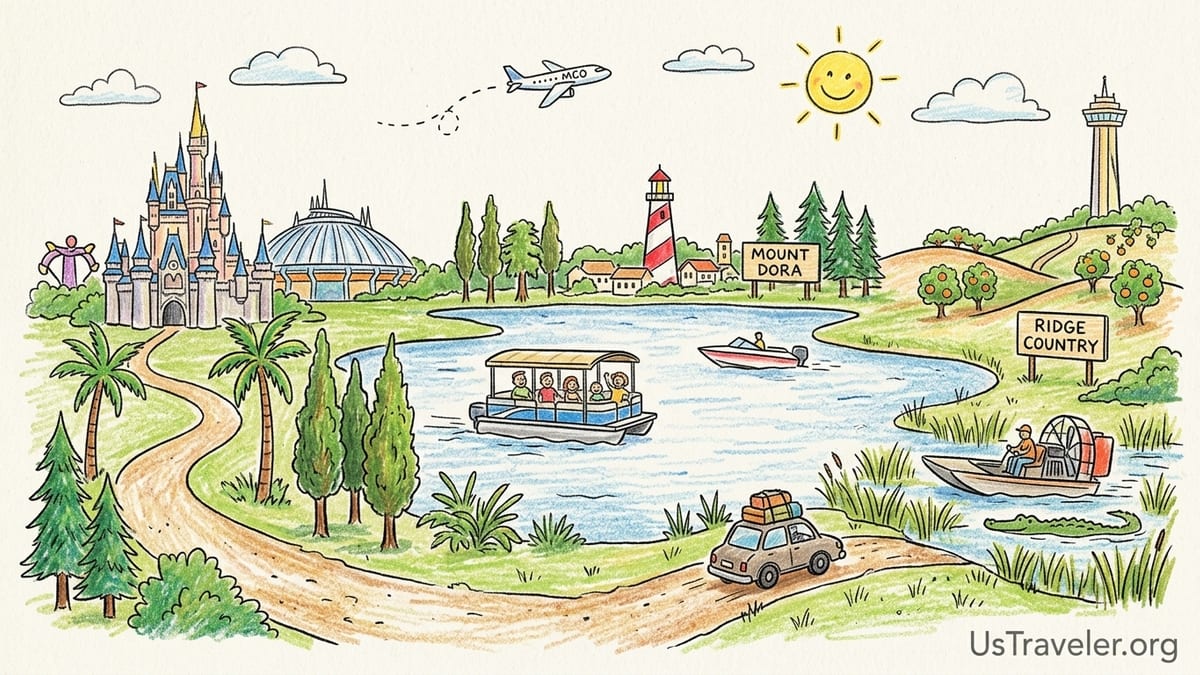
Central Florida does not have a single official boundary, but for travelers it usually means the cluster of inland counties anchored by Orlando and stretching west and south into lake and ridge country. Orlando, Lake Buena Vista and Kissimmee sit in Orange and Osceola counties, while Winter Park and the small-town lakes of Mount Dora are in neighboring Lake and Orange counties. Farther southwest, Clermont, Davenport, Winter Haven, Lakeland and Lake Wales fall in Polk County, an area locals often describe as the geographic center of the peninsula with rolling ridges and hundreds of lakes. In practical terms, if you are flying into Orlando International Airport and driving less than about 90 minutes in any direction without reaching the Atlantic or Gulf coasts, you are very likely still in Central Florida.
This guide focuses on the inland heart of the region that first-time visitors can realistically combine in one trip of five to ten days. That includes the major theme parks of Walt Disney World, Universal Orlando and SeaWorld, but also day-trip destinations like Winter Park’s brick-lined Park Avenue, Mount Dora’s lakefront historic district, and the chain-of-lakes cities around Winter Haven and Lakeland. Tampa and the Gulf beaches, Daytona Beach on the Atlantic, and South Florida cities such as Miami and Fort Lauderdale are separate regions that require more driving and usually deserve their own dedicated itineraries.
Because the distances are shorter than many visitors expect, you can use one base for most of this region. Orlando’s attractions area sits roughly an hour or less from Mount Dora to the north, Clermont to the west and Winter Haven and Lakeland to the southwest in normal traffic. That makes it possible to pair a few theme park days with quieter small-town or lake days, rather than spending your entire vacation within the Disney and Universal exits.
The climate and landscape tie these places together. This is warm, humid, subtropical Florida, with summer highs typically in the 90s Fahrenheit, brief afternoon thunderstorms and mild, drier winters. The interior lakes and natural springs create opportunities for boating and swimming, while the slight elevation of the central ridge around Clermont and Lake Wales provides rolling hills that surprise visitors expecting a flat state.
Orlando & Lake Buena Vista: Theme Parks and Beyond
Orlando and adjacent Lake Buena Vista are the names you see on airline search screens when you plan a theme park trip, and the major draws remain Walt Disney World, Universal Orlando Resort and SeaWorld Orlando. Each of these complexes operates multiple parks and water parks, and visiting them properly can easily fill four to seven days. It is realistic, for example, to devote one full day each to Magic Kingdom and EPCOT, plus a combined day for Disney’s Hollywood Studios and Disney’s Animal Kingdom, especially if you purchase line-skipping services that can add roughly the cost of a nice dinner per person to each day’s budget. Universal’s side, anchored by Universal Studios Florida and Islands of Adventure, will soon be joined by a major new gate, Epic Universe, drawing even more visitors to the south of downtown.
First-time visitors, however, should know that you can dip into this world without being consumed by it. Many families now book three or four park days within a ten-day Central Florida stay and spend the rest of the time exploring smaller attractions and towns. Staying in a Lake Buena Vista or International Drive hotel that offers free shuttles gives you straightforward access to the parks on certain days while still allowing you to rent a car or rideshare elsewhere. A typical pattern might be: two back-to-back park days, then a recovery day at a resort pool or a lakefront town like Winter Park or Mount Dora, then another park day.
Beyond the big three resort companies, Orlando offers attractions that feel more grounded in the region. The Orlando Science Center northeast of downtown, near Loch Haven Park, is a hands-on museum with exhibits on Florida ecosystems alongside planetarium shows, making it a good non-park day activity, especially in summer thunderstorms. Icon Park on International Drive houses an observation wheel and several mid-size attractions, but it is also simply a place to stretch your legs, grab a casual meal and remember that Orlando residents come here for a night out too.
Dining and shopping have also diversified beyond theme park restaurants and outlet malls. Neighborhoods like Mills 50 and the Milk District offer independent eateries where a main course often costs less than a theme park quick-service meal. A family might spend around the price of one character breakfast at a Disney hotel on an entire evening of tacos or Vietnamese food in town. This side of Orlando makes a strong case for renting a car or budgeting for a few Lyft or Uber rides so you are not captive to the most expensive dining corridors.
Kissimmee & the South I-4 Corridor: Gateway to Attractions
Kissimmee and the built-up corridor of U.S. Highway 192 south of the main gates of Walt Disney World are where many value-conscious visitors stay. You will find a broad mix of accommodations here, from older motels advertising nightly rates under what one on-site Disney meal might cost, to newly built vacation home communities where four-bedroom pool homes are rented to two or three families traveling together. These communities often sit in the Kissimmee and Davenport area just south and southwest of the theme parks.
For a first-time visitor, the U.S. 192 corridor can feel like an endless strip of neon signs, souvenir shops and chain restaurants. The advantage is choice. You can have breakfast at a diner frequented by hospitality workers one morning, then splurge on a themed character meal inside Disney Springs another evening. Many Kissimmee-area hotels run scheduled shuttles to the major parks, but the schedules can be limited, so it is worth verifying whether the timetable matches early entry hours or nighttime shows.
Kissimmee also offers glimpses of Central Florida’s pre-theme-park identity. Head a short drive south of the tourist strip and you reach Lakefront Park on the shores of Lake Tohopekaliga, known locally as Lake Toho, which has a broad walking path, playgrounds and boat ramps. Airboat tour operators based on Lake Toho and nearby lakes take visitors into sawgrass marshes to look for alligators and birdlife, often on hour-long trips scheduled throughout the day. Prices vary by operator, but for a family of four the total cost is often comparable to a single-day theme park ticket, giving you a sense of relative value when you plan your budget.
In practical itinerary terms, Kissimmee is firmly within the same vacation zone as Orlando and Lake Buena Vista. Driving times from U.S. 192 hotels to the Disney or Universal parking plazas range from 15 to 40 minutes depending on traffic. It is common to pair Kissimmee lodging with day trips to the parks, a morning of outlet shopping, and one or two forays up to Winter Park or west to Clermont for a change of scenery.
Winter Park & Mount Dora: College Town Charm and Lakeside Villages
North of downtown Orlando, Winter Park feels like a different world from the theme park corridor, although it is only about a 20 to 30 minute drive in normal conditions. Centered on brick-paved Park Avenue and the campus of Rollins College, Winter Park is known for sidewalk cafes, shaded Central Park, and the Scenic Boat Tour that glides through canals linking the city’s lakes. Visitors often combine a museum stop, such as the Charles Hosmer Morse Museum of American Art with its large Tiffany glass collection, with a long lunch outdoors where entrees are often priced similarly to or slightly below table-service meals in the theme parks.
Winter Park works well as a half-day or full-day excursion from an Orlando base. Families with school-age children often appreciate the slower tempo: you might start with pastries and coffee on Park Avenue, take a late-morning boat tour that lasts about an hour, then let kids run around Central Park or visit a playground before an early dinner. SunRail commuter trains link Winter Park to downtown Orlando on weekdays, but because schedules can be limited on evenings and weekends, most first-time visitors find a rental car or rideshare more flexible.
Continue about 40 minutes northwest of Orlando and you reach Mount Dora, a small city perched above Lake Dora that travel and tourism boards promote as a classic Central Florida lakeside town. Its compact downtown has independent boutiques, antique shops, wine bars and cafes, with many buildings dating to the early 1900s. The lakefront hosts boat tours that run from roughly 30 minutes to two hours, some focusing on the wildlife of nearby canals and coves, others timed to sunset. A typical sunset cruise often costs less per person than a full-service dinner back at the attractions corridor, and gives you wide-open views of the lake, a lighthouse and the historic Lakeside Inn along the shore.
Mount Dora is ideal for visitors who want at least one day that feels nothing like a theme park. You can browse local art, grab ice cream on a shaded bench, then wander down to Grantham Point Park to see the small, red-and-white lighthouse that has become one of the town’s signature photo spots. Many travelers visit as a day trip from an Orlando or Kissimmee base, but the town also has bed-and-breakfast inns and small lakeside hotels for those who prefer a quieter overnight. Realistically, Winter Park and Mount Dora pair better with Orlando and Lake Buena Vista than with the Polk County lake towns, simply because of their location north of the metro core.
Clermont, Davenport & the Ridge Country: Rolling Hills and Vacation Homes
Head west from Disney’s western entrance and you will quickly notice the land begin to roll into gentle hills around Clermont. This area sits on the Lake Wales Ridge, a spine of higher ground that runs north-south through Central Florida. For visitors using a smartphone fitness app, bike rides here might record more elevation change than in many other parts of the state. Clermont has grown rapidly as a residential suburb and triathlon training hub, with Lake Minneola’s waterfront trail and the 250-foot Florida Citrus Tower, a mid-20th-century attraction that still offers elevated views of lakes and distant theme park skylines on clear days.
Clermont and nearby Davenport also form the heart of Central Florida’s vacation home market. Gated communities with names referencing lakes and resorts line the roads west and south of the parks, offering houses with private pools, game rooms and garages converted into media spaces. Nightly rates vary widely by season, but extended families often find that sharing a four- or five-bedroom home with a kitchen and laundry can cost less per person than multiple hotel rooms. The trade-off is that you will drive yourself to the parks, usually 20 to 45 minutes each way, and you may feel somewhat removed from walkable dining districts unless you deliberately head into historic downtown Clermont or neighboring towns.
Davenport itself has a relatively small traditional downtown, but its location along major roads such as U.S. Highway 27 and Interstate 4 makes it convenient for visitors who want to split time between Orlando’s parks and the Polk County lake towns further south. Grocery stores and big-box retailers have clustered around many of the vacation home communities, so stocking a rental kitchen is straightforward. This is one area where a rental car is extremely helpful; while you can use rideshare services, the cost of repeated long trips can add up over a week.
For itineraries, Clermont and Davenport work best as bases if you plan to divide your vacation between theme park days and low-key time at your rental home, perhaps adding one or two day trips to places like Winter Garden’s historic downtown or Lake Louisa State Park for hiking and kayaking. Because these communities are already 30 to 45 minutes from the main gates of the parks, tacking on lengthy drives to more distant destinations like the Atlantic or Gulf coasts can lead to long days in the car that are less appealing for first-time visitors.
Winter Haven, Lakeland & Lake Wales: Lakes, Gardens and Family Attractions
Southwest of the Disney and Universal area, roughly an hour to 90 minutes by car, the Polk County triad of Winter Haven, Lakeland and Lake Wales shows visitors another side of Central Florida. Winter Haven brands itself as the Chain of Lakes City. It is also home to the Florida location of Legoland, a theme park built on the site of the former Cypress Gardens botanical attraction. Legoland is smaller and more focused on younger children than the Orlando parks, making it especially appealing to families with kids roughly ages 2 to 12 who may be overwhelmed by the size and intensity of Disney and Universal. Many families treat it as a one- or two-day add-on, staying in the brightly themed Legoland Hotel or nearby mid-range properties.
Lakeland, between Orlando and Tampa, mixes a lively downtown with lakeside walking paths and a concentration of buildings designed by architect Frank Lloyd Wright on the campus of Florida Southern College. The city often hosts weekend markets and minor league baseball games in season, giving visitors a glimpse of everyday Central Florida life. Dining skews toward independent restaurants and craft breweries alongside national chains, and nightly hotel rates often run lower than in Orlando at similar quality levels, especially outside major event weekends.
Lake Wales, farther south along U.S. Highway 27, is known for Bok Tower Gardens, a historic landscaped sanctuary centered on a pink and gray marble and coquina bell tower. Visitors pay an admission fee that is roughly comparable to a mid-level museum ticket in a major city and gain access to walking trails, seasonal flowers and one of the quietest large green spaces in Central Florida. The gardens pair well with nearby state parks and lakes for a full day of low-key exploration, especially in the cooler months from roughly November through March.
From a planning perspective, Winter Haven, Lakeland and Lake Wales belong to the same realistic vacation cluster as Orlando and the attractions corridor, but they are most convenient if you are willing to drive at least an hour each way. First-time visitors who devote most of their time to Walt Disney World and Universal sometimes underestimate how tiring multiple park days can be. It is worth building in one or two slower days in Polk County, perhaps staying overnight in Lakeland or near Legoland, rather than attempting long roundtrips from a Kissimmee or Lake Buena Vista hotel on top of full park days.
Lakes, Springs, Small Towns and Outdoor Experiences
While roller coasters grab the headlines, much of Central Florida’s character lies in its water and green spaces. The region is dotted with freshwater lakes where locals boat, fish and watch sunsets. In Winter Park, the Scenic Boat Tour passes lakefront homes and cypress-lined canals. In Mount Dora, small tour companies run pontoon and covered-boat trips across Lake Dora and into narrow waterways where you might spot herons, ospreys and, at certain times of year, alligators lounging on the banks. Rental kayaks and paddleboards are available at many public lakes, typically for hourly rates similar to or below the cost of a theme park locker rental, making them accessible even to budget-conscious travelers.
Natural springs form another uniquely Floridian experience within day-trip range. While many of the most famous springs, like Wekiwa Springs State Park and Kelly Park/Rock Springs, sit slightly outside the specific towns highlighted in this guide, they are still part of the broader Central Florida experience. Visitors drive approximately 30 to 45 minutes from north Orlando or Apopka to reach swimming areas where clear, 70-something-degree water flows year-round. Because parking lots at popular springs often reach capacity on summer weekends and holidays, arriving early in the morning is wise, especially if you are combining the outing with an afternoon or evening in a nearby town.
On land, trails and parks break up days otherwise spent on pavement. Lake Louisa State Park near Clermont offers hiking and biking on rolling terrain with views of lakes and scrub habitat that feels wilder than its proximity to U.S. Highway 27 suggests. In Lakeland, Lake Hollingsworth’s paved path draws walkers, runners and cyclists for a loop of just under three miles around the water. Even in the denser tourist corridor, resorts increasingly market walking paths, splash pads and nature-themed play areas as a way for families to wind down between park visits.
For small town strollers, downtown Winter Park, Mount Dora, Lakeland and Winter Haven all reward unstructured wandering. You may come across a Saturday farmers market in Winter Park, an art festival in Mount Dora, or a food truck rally in Lakeland. These events often feature local produce and crafts at prices lower than theme park souvenirs, and they create opportunities to interact with residents rather than only fellow tourists. Checking local tourism board calendars shortly before your trip can help you align your visit with a festival or market without overplanning every hour.
Getting In, Getting Around and Combining Destinations
Most first-time visitors arrive at Orlando International Airport, located southeast of downtown. It is the primary gateway for both the attractions corridor and the towns described in this guide. Some low-cost and charter carriers also use Orlando Sanford International Airport to the north, which can be convenient if you plan to focus on destinations like Winter Park, Mount Dora or the springs. Lakeland and Winter Haven have smaller regional airports that primarily serve general aviation and some limited commercial or charter services, but they are not typical entry points for first-time leisure travelers from out of state.
Once you land, you face a choice: rely on resort transportation and rideshares, or rent a car. If your entire trip will be spent on Disney and Universal property with only occasional forays to Disney Springs or nearby outlet malls, you can manage without a car using airport shuttles, hotel buses, and app-based rides. However, if you plan to explore Winter Park, Mount Dora, Clermont, Davenport, Winter Haven, Lakeland or Lake Wales, having your own vehicle offers far more flexibility and often ends up cheaper than multiple long rideshare trips. Daily rental rates fluctuate widely by season and demand, but when you factor in the cost of moving a family across the region several times, a compact or midsize rental frequently pays for itself.
Driving in Central Florida is straightforward but can be busy, particularly along Interstate 4 between Orlando and Lakeland and on toll roads like State Road 417 and the Florida Turnpike. Many visitors opt to use a rental car’s built-in toll transponder or a rental agency’s toll program to avoid manual payments. Distances between the places in this guide are typically under 90 minutes one-way. For example, the drive from a Lake Buena Vista resort to Mount Dora is often around 50 to 70 minutes outside of rush hour, while Lake Buena Vista to Winter Haven or Lakeland can range from about one hour to just over that, depending on traffic and route.
When deciding which destinations to combine in one vacation, think in clusters. Orlando, Lake Buena Vista and Kissimmee form the primary attractions cluster. Winter Park and Mount Dora are natural northern add-ons that fit into day trips or one- or two-night stays. To the west and southwest, Clermont, Davenport, Winter Haven, Lakeland and Lake Wales form a second cluster where lake activities, Legoland and Bok Tower Gardens come to the fore. It is realistic on a week-long first visit to base yourself in the Orlando area for five or six nights, then spend one or two nights in Polk County or Mount Dora for a slower-paced finale.
What usually does not belong on the same tightly scheduled first-time Central Florida vacation is a full-blown beach escape. While it is possible to do a single-day side trip to the Atlantic coast from Orlando, or to the Gulf beaches from Lakeland, the drives often take 90 minutes to two hours each way without heavy traffic. For many travelers, saving coastal regions like Clearwater, St. Pete, Cocoa Beach or the Space Coast for a future trip allows you to focus on Central Florida’s inland mix of attractions, towns and landscapes without feeling rushed.
The Takeaway
Central Florida is far more than the view from a hotel shuttle window between castles and coasters. Defined loosely by the Orlando metro area and the inland lakes and ridge country of Lake and Polk counties, the region rewards visitors who step beyond the familiar entertainment corridor. First-time travelers can comfortably combine a few highlight days at Walt Disney World, Universal Orlando or SeaWorld with excursions to Winter Park’s college-town streets, Mount Dora’s lakeside historic district, Clermont’s rolling hills, and the family-oriented attractions and gardens of Winter Haven, Lakeland and Lake Wales.
Structuring your trip around realistic clusters and driving times helps keep the experience enjoyable rather than exhausting. Use Orlando or Lake Buena Vista as a base for the theme parks and northern day trips, then consider a short stay in Clermont, Davenport or Polk County’s lake towns if you want easier access to Legoland, Bok Tower Gardens and quieter waterfronts. Factor in at least one day for a natural spring or state park, especially if you visit in the cooler months. With this approach, you will return home with memories of both iconic attractions and small, grounded moments: a sunset over Lake Dora, live oaks shading a Winter Park sidewalk, children splashing in a hotel pool after a day on the rides.
Most importantly, remember that you do not need to spend every day of a Central Florida vacation inside a gated resort. The region’s character emerges when you give yourself permission to slow down between thrill rides, explore neighboring towns, and see how locals live between the lakes and rolling ridges that make this part of Florida distinct.
FAQ
Q1. How many days do I need for a first Central Florida trip? Most first-time visitors find that seven to ten days works well, allowing three to five theme park days plus time for Winter Park, Mount Dora or Polk County lake towns without feeling rushed.
Q2. Is it realistic to visit Disney, Universal and Legoland in one vacation? Yes, but only if you prioritize. Many families choose two or three Disney days, one or two Universal days and one Legoland day, with rest days between to avoid burnout.
Q3. Do I need a rental car, or can I rely on shuttles and rideshares? You can manage with shuttles and rideshares if you stay inside the attractions corridor, but a rental car makes it much easier and often cheaper to visit Winter Park, Mount Dora, Clermont, Winter Haven, Lakeland and Lake Wales.
Q4. Which Central Florida towns are best for a quieter day away from the parks? Winter Park and Mount Dora to the north and Lakeland and Lake Wales to the southwest are excellent choices for walkable streets, lakeside views and more relaxed dining.
Q5. Is it worth staying in Kissimmee or Davenport instead of on-site at a theme park hotel? For many visitors, yes. Off-site lodging in Kissimmee or Davenport often offers more space and lower nightly rates, especially in vacation homes, though you will trade some convenience and rely more on driving.
Q6. Can I visit natural springs or state parks without leaving Central Florida? Yes. Springs such as Wekiwa Springs and Rock Springs, and parks like Lake Louisa State Park near Clermont, are within typical day-trip driving distance of Orlando and the attractions corridor.
Q7. Is Central Florida a good destination outside school holidays? Absolutely. Late winter and early spring often bring milder temperatures and lower humidity, and while the parks can still be busy, crowds in small towns and outdoor areas are usually lighter than peak holiday periods.
Q8. How far is Mount Dora from the main Orlando theme park area? In normal traffic, the drive from the Lake Buena Vista or International Drive area to Mount Dora typically takes around 50 to 70 minutes by car, making it a comfortable day trip.
Q9. Should I include the beach on my first Central Florida visit? You can, but it is not essential. Beach towns typically sit 90 minutes to two hours from Orlando by car, so many first-timers save coastal destinations for a separate trip and focus on inland attractions instead.
Q10. Are Central Florida’s small towns and lakes suitable for families with young children? Yes. Places like Winter Park, Mount Dora, Winter Haven and Lakeland offer playgrounds, easy walking routes, boat tours and family-friendly dining that work well alongside or instead of intense theme park days.