


Northwest Florida’s Panhandle is one of the easiest places in the state to turn into a genuine road trip. Instead of racing between big cities, you follow a mostly low-rise coastline of white sand, fishing piers and pastel beach towns. The core stretch from Pensacola Beach to Panama City Beach is roughly 100 miles, which makes it ideal for a long weekend or a relaxed week, with an optional extension east toward Port St. Joe, Cape San Blas and Apalachicola on the so-called Forgotten Coast.
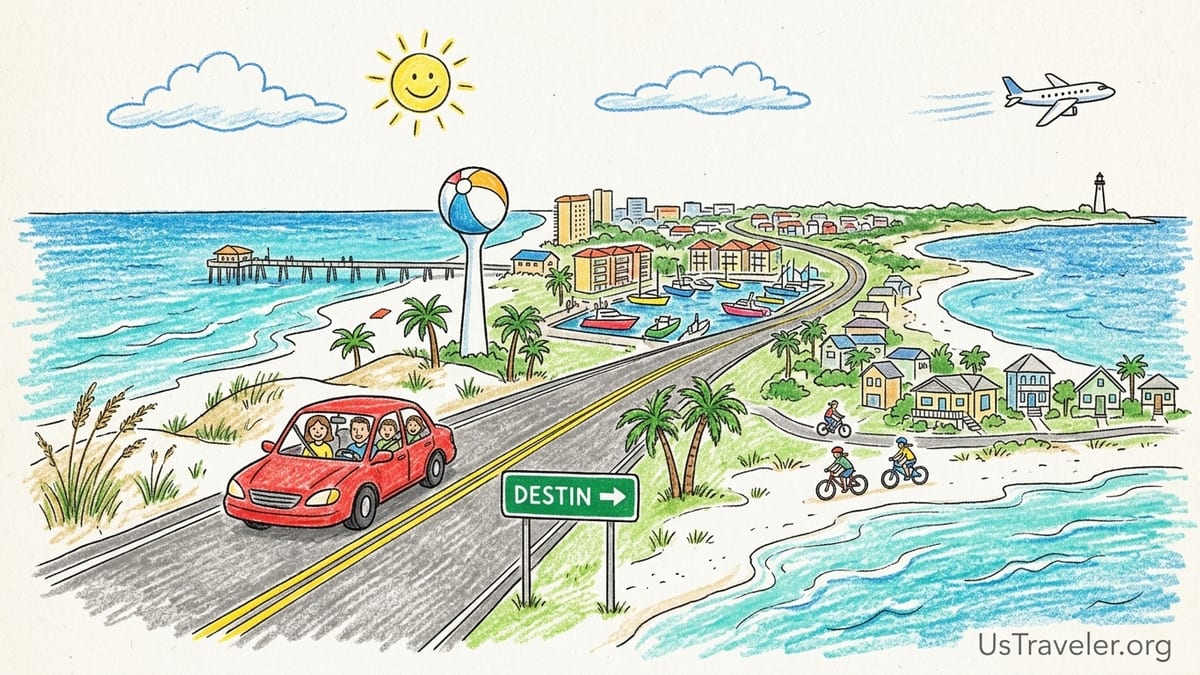
How This Panhandle Road Trip Works
This route assumes you pick up a rental car in Pensacola, follow the Gulf along Highway 98 with detours to Pensacola Beach and Navarre Beach, then continue through Fort Walton Beach and Destin before dropping onto Scenic Highway 30A. From there you rejoin Highway 98 near Panama City Beach. Travelers with more time can continue along 98 toward Port St. Joe, Cape San Blas and Apalachicola for a quieter, less developed finale.
The main Pensacola to Panama City Beach section is short in pure distance, roughly 100 miles depending on where you start and finish in each town. Spacing your nights so you are only driving 30 to 60 minutes per day keeps this from turning into a commute. Many travelers overnight in two or three bases, for example Pensacola Beach, Destin or 30A, and Panama City Beach, then use those hubs for day trips.
Because this is a coastal corridor rather than a cross-state marathon, it works well as a standalone trip instead of a bolt-on to an Orlando or Miami vacation. Pensacola has its own commercial airport and rental car desks inside the terminal, and small airports at Destin–Fort Walton Beach and Panama City Beach make it easy to start in one city and fly home from another if you choose a one-way road trip.
Most of the drive follows U.S. Highway 98, a four-lane road that acts as the Panhandle’s main street. Summer weekends and holiday weeks can mean slow-going through bottlenecks like Destin and Panama City Beach, so what looks like a 25-minute hop on a map can double in practice. Planning your movements in the morning or early afternoon, and building in beach and meal stops, helps keep the driving part of the trip enjoyable.
Starting in Pensacola: Rentals, Overnights and Beach Access
If you are flying in, Pensacola International Airport is the most logical starting point. It is compact, and the rental car counters are inside the terminal with cars in a connected garage. Major brands such as Hertz, Avis, Budget and Enterprise usually have a wide selection of midsize sedans and small SUVs; in recent seasons, basic sedans have often run in the ballpark of 50 to 80 dollars per day outside peak holidays, while SUVs and crossovers commonly range higher, especially in March, June and July. Booking early and being flexible on vehicle type can reduce costs.
Most travelers spend their first night either in downtown Pensacola or across the bay at Pensacola Beach. Downtown offers historic streets, restaurants and live music within walking distance. Pensacola Beach sits on Santa Rosa Island, reached via the toll bridge on Highway 399, and gives immediate access to wide beaches and the Gulf Islands National Seashore. Typical accommodations range from midscale chain hotels near the bridge to beachfront resorts and condo towers with direct sand access, plus smaller inns and vacation rentals along quieter stretches.
Parking is straightforward if you know where to look. Downtown Pensacola has a mix of garages and surface lots around Palafox Street that usually charge modest hourly or daily rates, with some free evening options. On Pensacola Beach, public beach access lots fill on summer weekends, and some hotel garages are reserved strictly for guests. If your budget allows, staying at a property with its own parking and beach access removes one layer of logistics for day one of the trip.
From Pensacola Beach you can set the tone of the whole journey by detouring into Gulf Islands National Seashore, where the road runs with dunes on both sides and little development. This stretch gives a preview of the lower-key scenery you will find later toward the Forgotten Coast, and it reminds you that the best parts of the Panhandle are not always in the busiest, most built-up zones.
Pensacola to Navarre and Destin: Bridges, Traffic and Beach Stops
Leaving Pensacola Beach, you can return to the mainland and pick up Highway 98 east, or, conditions permitting, follow the scenic route along Santa Rosa Island toward Navarre Beach. Either way, your first practical segment is short. Pensacola to Navarre along 98 is roughly 25 to 30 miles, often under 45 minutes outside of heavy traffic. Many travelers choose to pause at Navarre Beach, which sits just off 98 on a separate bridge, for a few hours or an overnight.
Navarre Beach tends to be quieter and more residential than some of the bigger names further east. The main beachfront road here has a handful of midrise condo buildings, a fishing pier, and limited but convenient public parking near the pier and main access points. If you prefer a calmer base with easy sand access, a night in Navarre can work well before heading on to busier Destin and Fort Walton Beach.
Continuing east on Highway 98 toward Fort Walton Beach and Destin, traffic begins to feel more urban. Fort Walton Beach has a strip of chain hotels and restaurants along 98 and a separate barrier island area on Okaloosa Island, where midrange beachfront properties give reasonably priced direct Gulf access compared with trendier spots. Families often choose Okaloosa Island for an overnight because it balances affordability and proximity to attractions like the Gulfarium and harbor cruises in Destin.
The Destin area is one of the biggest traffic pressure points on this road trip. Highway 98 narrows near the Destin Harbor and shopping centers, and weekend afternoons can see bumper-to-bumper conditions. To keep your sanity, plan to arrive in Destin earlier in the day, then park and leave the car. Many harbor-front resorts and condos offer on-site parking, but public harbor parking can be tight. If your goal is dining and a quick walk along the boardwalk, ride-share services are often easier than circling for a spot at peak times.
Sliding onto Scenic 30A: Where to Stay and How to Park
East of Destin, Highway 98 begins to feel less urban, and you reach the western access to Scenic Highway 30A in the Santa Rosa Beach area. Scenic 30A is a roughly two dozen mile coastal byway connecting a series of master-planned beach communities and older neighborhoods between Dune Allen and Inlet Beach. It is a narrow, mostly two-lane road with frequent pedestrian crossings, bicycles and golf carts, so driving here is slower and more relaxed than Highway 98.
Choosing where to overnight on 30A is one of the most important decisions of this road trip. Each community has its own personality. Places like Grayton Beach and Blue Mountain Beach lean more relaxed and old-Florida, with low-rise buildings and locally owned cafes. Seaside, WaterColor and Rosemary Beach are highly planned and walkable, with town squares, boutiques and higher nightly rates. A practical strategy is to book accommodation in a town with good public beach access and centralized services, such as Santa Rosa Beach near Gulf Place on the west end or the Seagrove and Seaside area in the middle stretch.
Parking along Scenic 30A can surprise first-time visitors. Many beach accesses are technically public but have small lots that fill quickly on sunny days. Some newer town centers have built multi-level parking, but they may be shared with retail and restaurant traffic. If your budget allows, renting a condo or cottage that includes dedicated parking and private or semi-private beach access inside the community boundaries removes much of the daily parking stress. If you rely on public access, plan to arrive at your chosen beach before mid-morning, particularly in high season.
Bicycles are a smart alternative for short hops between communities. A paved multi-use path parallels much of 30A, and bike rental shops are common. For instance, it is realistic to park once near Gulf Place or Seaside and spend the day riding between neighboring beach accesses and cafes, avoiding repeated parking hunts. Travelers who are not comfortable biking in the heat should remember that spring and fall offer milder temperatures and less traffic than peak summer.
Panama City Beach and the Optional Forgotten Coast Extension
At the eastern end of Scenic 30A, you rejoin Highway 98 near Inlet Beach and continue toward Panama City Beach. This segment is another traffic pinch point in the busiest months, as 98 effectively becomes the main commercial strip for Panama City Beach, with hotels, condo towers, miniature golf and roadside attractions. If you plan to overnight here, decide whether you want to be in the heart of that scene or slightly west around Laguna Beach and Sunnyside, where development steps down and low-rise motels and older condos sit closer to the sand.
Panama City Beach offers a wide range of lodging, from national-brand hotels with structured parking to large vacation rental towers that issue parking passes for adjacent garages or surface lots. During spring break and summer, nightly rates and parking demand both spike. Families often appreciate the combination of predictable chain hotels and nearby supermarkets, while couples may prefer smaller gulf-front inns away from the busiest intersections. For many road trippers, this is a natural endpoint: you have driven the length of the core Emerald Coast and can loop back to Pensacola or fly out of the local airport.
Travelers with extra days and an appetite for quieter shores can continue east on Highway 98 toward the Forgotten Coast. The drive from Panama City to Port St. Joe is roughly an hour, with much of it passing pine forest, bay views and the recovering town of Mexico Beach. Port St. Joe itself feels like a small working town with a few inns and vacation rentals, plus access to nearby St. Joseph Peninsula and Cape San Blas, where development is more scattered and the beaches feel wilder.
From Port St. Joe, the road bends north and then east to Apalachicola, a historic fishing town known for its waterfront, brick storefronts and slower pace. Lodging here tends to be small inns, bed and breakfasts and vacation homes rather than high-rise resorts. Parking is typically easier than in the big beach towns, with free or low-cost spaces along side streets and near the waterfront. This extension adds another 80 to 100 miles round-trip to your overall road journey, but many travelers consider it the most rewarding section if they value atmosphere over amenities.
How Many Nights, How Much Territory and When to Go
Because the Pensacola to Panama City Beach segment is only about 100 miles, the question is not whether you can drive it in a day but how long you want to linger. A minimal but workable itinerary might look like four nights: one in Pensacola Beach or downtown, one near Destin or Fort Walton Beach, one on 30A, and one in Panama City Beach. That gives you a taste of each area without excessive packing and unpacking. If you can spare a week, adding extra nights on 30A or the Forgotten Coast allows for non-driving days dedicated purely to the beach.
One efficient approach is to limit yourself to two or three hotel or rental changes. For example, you could base yourself two nights in Pensacola Beach, three nights somewhere central on 30A such as Seagrove or Santa Rosa Beach, and two nights in Panama City Beach, using those hubs for day trips to Navarre, Destin and the state parks. This keeps your total driving within comfortable daily windows while reducing the time spent checking in and out of new places.
Season matters. Summer school holidays bring the highest crowds, rates and humidity along Highway 98 and 30A. Spring break weeks, especially around March and early April, can be busy too, and some Panhandle beach towns historically attract large student groups. Late April, May, September and October often offer a sweet spot of warm water, lighter traffic and more moderate pricing. Winter can be cool and windy, with some seasonal businesses on limited hours, but it is also when you may find the lowest lodging rates and easiest parking.
Weather can change quickly along the Gulf. Afternoon thunderstorms are common in the warmer months, and tropical systems are a reality of late summer and early fall. Flexible driving days help you dodge the worst of any storms by planning indoor activities or shorter hops on wet days and longer beach sessions when the skies clear.
Practical Planning: Rental Cars, Budgeting and Parking Strategy
For most visitors, a standard sedan or small SUV is the most practical rental choice. Compact cars are fine for couples or solo travelers, but an SUV or crossover can make sense for families carrying beach gear, foldable chairs and coolers. Unless you plan to launch boats or explore unpaved forest roads inland, four-wheel drive is unnecessary. When pricing, remember to factor in one-way drop fees if you intend to pick up in Pensacola and drop in Panama City Beach or vice versa; sometimes flying in and out of the same airport and doing a loop is more economical.
The bulk of your budget will likely go to lodging rather than fuel. The total driving distance for a Pensacola to Panama City Beach trip with modest detours might be 200 to 300 miles, which is not a strain on modern gasoline or hybrid vehicles. Lodging, by contrast, can vary from simple motels under 150 dollars per night in shoulder season to premium beachfront condos well over 400 dollars on peak dates in places like 30A and Destin. Setting expectations and booking early for holiday weeks helps avoid sticker shock.
Parking costs also vary. Many public beach accesses along this route remain free or low-cost, particularly in smaller communities and state parks, although premium zones near popular piers and town centers increasingly use paid meters or kiosks. In dense areas such as Destin Harbor or Seaside, you should expect to pay for structured parking or park farther away and walk or bike in. Bringing a small soft-sided cooler, collapsible wagon or beach cart makes that walk more manageable with children.
If you are changing hotels multiple times, try to schedule arrivals in the late morning or early afternoon rather than evening. This allows you to secure parking before lots fill and gives you a usable half day at each destination. It also offers a buffer if Highway 98 traffic is heavier than expected. Travelers with mobility needs should confirm in advance whether their chosen hotel or vacation rental includes accessible parking close to elevators or boardwalks, as some older properties rely heavily on stairs.
The Takeaway
What makes this Northwest Florida road trip appealing is not the mileage but the mood. You are tracing a relatively compact stretch of coast where the scenery shifts from busy harbors and resort skylines to low-slung dune neighborhoods and finally to the slower rhythm of the Forgotten Coast. With about 100 miles between Pensacola and Panama City Beach, you can afford to slow down, stay several nights in just a few well-chosen bases and treat the drive itself as part of the vacation instead of a chore.
By understanding how Highway 98 traffic ebbs and flows, where parking is limited, and which beach towns match your style, you can turn a simple line on the map into a satisfying, commercially useful coastal-driving itinerary. Whether you end the trip sipping coffee on a balcony in Panama City Beach or watching the sunset over the Apalachicola River, this corner of Florida rewards travelers who leave enough time to explore, not just pass through.
FAQ
Q1. How many days do I need for a Pensacola to Panama City Beach road trip?
Most travelers are comfortable with four to seven days. Four nights gives you one stay each in Pensacola, Destin or 30A, and Panama City Beach, while a full week allows you to add time on 30A or extend to the Forgotten Coast without feeling rushed.
Q2. Is it better to base in one town or move every night?
It is usually better to choose two or three bases and do day trips from there. For example, staying several nights on 30A lets you visit Destin and Panama City Beach without packing and unpacking daily.
Q3. Do I need a special type of vehicle for this road trip?
No. A standard sedan or small SUV is sufficient for the paved coastal highways and town streets. Four-wheel drive is rarely necessary unless you plan inland off-pavement adventures or towing a boat.
Q4. How bad is Highway 98 traffic in summer?
In July and on holiday weekends, traffic can be slow through Destin, Fort Walton Beach and Panama City Beach, especially midday and late afternoon. Planning early morning drives and avoiding peak check-in times helps reduce delays.
Q5. When is the best time of year to drive this route?
Late spring and early fall often offer warm water, lighter crowds and more moderate prices. Summer is busier but has the most predictable beach weather, while winter is quieter and cooler with lower rates.
Q6. How easy is it to find parking at the beaches?
Outside peak holidays, you can usually find public beach parking if you arrive by mid-morning. In busy spots like Destin Harbor or the central 30A towns, lots may fill and paid garages or longer walks are common.
Q7. Should I book lodging on 30A or stay on Highway 98 nearby?
Staying directly on 30A offers walking access to the beach and town centers but typically costs more. Lodging along 98 can be more affordable, with a short drive or bike ride to 30A’s beaches.
Q8. Can I do this trip without a car using ride shares?
Ride-share services exist in larger hubs like Pensacola, Destin and Panama City Beach, but they are inconsistent between towns. A rental car provides far more flexibility for a multi-stop coastal itinerary.
Q9. Is the Forgotten Coast extension suitable for families?
Yes, but it is quieter and less commercial than Destin or Panama City Beach. Families who enjoy nature, small towns and uncrowded beaches tend to appreciate Port St. Joe, Cape San Blas and Apalachicola.
Q10. Can I make this a one-way trip instead of a loop?
Yes. Some travelers fly into Pensacola, drive east to Panama City Beach or Apalachicola, and then fly home from the closer airport. Check rental car one-way fees and flight options before committing, as round-trip to one airport is sometimes cheaper.