


Northwest Florida’s Emerald Coast is one of the most concentrated fishing and boat tour destinations in the United States. From Destin’s legendary deep-sea charters and Crab Island sandbar parties to Panama City Beach’s Shell Island dolphin cruises and Pensacola’s laid-back inshore trips, visitors can choose from a dense mix of operators, boat styles and on-the-water experiences. This guide explains how the main options compare in practice, what a realistic day on the water looks like, and how to match a charter or tour to your budget, timeframe and family or group.
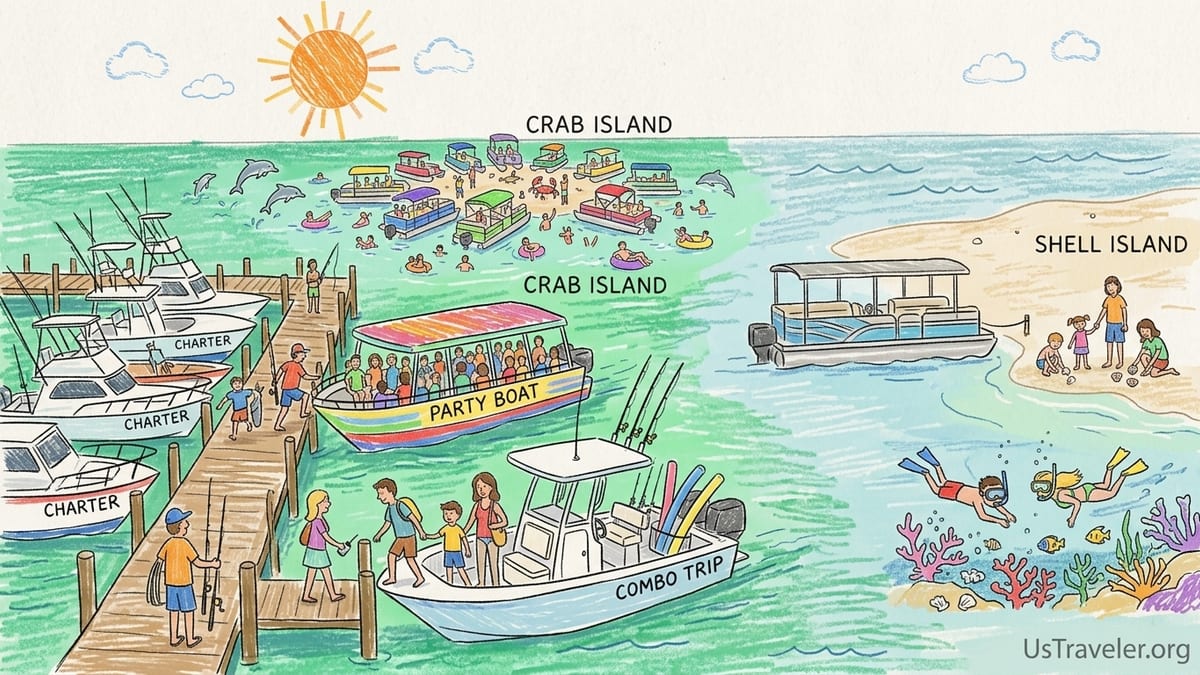
Destin: Deep-Sea Capital and Combo-Trip Specialist
Destin markets itself as the "World’s Luckiest Fishing Village" and the claim is not far from reality. Dozens of federally permitted charter boats line Destin Harbor, giving visitors more choice for offshore and inshore fishing than almost anywhere else on the Gulf. On a typical summer morning, HarborWalk Village is packed before sunrise as crews load bait and guests board everything from 25-foot center consoles that take six anglers inshore to 60-foot sportfishing boats rigged for 12-hour offshore runs.
Deep-sea trips from Destin generally fall into two categories: private charters and shared “party boats.” Private offshore charters for up to six anglers usually start around the mid hundreds of dollars for a shorter inshore-focused morning and run into the four figures for full-day offshore runs. Many operators list half-day offshore trips in the range of roughly 800 to 1,200 dollars for the boat, with larger sportfishers and longer runs climbing over 2,000 dollars. Shared head boats such as large party vessels boarding 30 to 60 passengers commonly advertise per-person pricing in the ballpark of 85 to 150 dollars for 6 to 8 hours, making them one of the most cost-effective ways to access reef species like red snapper and amberjack.
Destin captains also lean heavily into combo experiences that fold in the area’s other signature attractions. A number of inshore and nearshore operators market “Fish & Fun” or “Adventure” trips that might include an hour or two of casting for trout and redfish in Choctawhatchee Bay, a stop at Crab Island for swimming, plus a casual dolphin-watching segment on the cruise back through East Pass. For families who do not want a full day of hard fishing, these combo trips are a low-pressure way to get kids a few bites, swim in waist-deep emerald water and still see dolphins and the harbor scenery.
Crab Island, Dolphin and Sunset Cruises Around Destin
Crab Island is a submerged sandbar just inside Destin’s East Pass, and in peak season it functions as a floating playground for pontoon rentals, small excursion boats and privately owned vessels. Commercial shuttles and charter pontoons typically run 3 to 4 hour excursions that include transport from the harbor, a slow cruise through the pass that often doubles as an impromptu dolphin tour, and 2 or so hours anchored in the sandbar’s waist-deep water. Pricing for these trips often ranges from around 60 to 100 dollars per adult on shared boats, with private pontoon charters for small groups landing in the low to mid hundreds of dollars for a half day.
A growing number of Destin fishing operators advertise blended itineraries where guests may bottom fish the bay or nearshore reefs for the first part of the outing, then anchor at Crab Island to swim and relax, and finally time their return so the ride home doubles as a sunset or dolphin cruise. For example, a 5-hour “Fish & Fun” charter on a 30-foot center console might run a family several hundred dollars plus crew tip, but that one fee replaces booking a separate Crab Island shuttle and separate dolphin cruise.
Dedicated dolphin and sunset cruises from Destin Harbor vary from small, quiet catamarans carrying a few dozen passengers to large double-decker power catamarans that can host over 100 guests. Standard pricing often falls between 30 and 60 dollars per adult for a 1.5 to 2 hour cruise, with sunset departures at a small premium during peak summer. These trips rarely include fishing but provide a low-commitment way to be on the water, watch dolphins surfing boat wakes and photograph the sun dropping behind Okaloosa Island.
Panama City Beach: Shell Island, Dolphin Tours and Snorkeling
About an hour east of Destin, Panama City Beach focuses its marketing heavily on Shell Island and dolphin tours. Shell Island is an undeveloped barrier island near St. Andrews State Park, prized for clear water, sand flats and shelling. Many boat tour companies run 3 to 4 hour excursions that combine a narrated dolphin cruise in St. Andrews Bay with a stop for beach time and snorkeling around Shell Island’s shallows. Typical shared-boat prices for these tours often fall in the 40 to 80 dollar per adult range depending on boat size and whether snorkeling gear and drinks are included.
Snorkeling-focused trips usually operate on smaller boats with capped capacities, offering a more intimate feel than the larger dolphin tour catamarans. Operators frequently include masks, snorkels and vests in the fare, though guests are encouraged to bring their own if they prefer. For families, these half-day Shell Island and dolphin outings are one of the easiest introductions to Gulf waters because they stay in relatively protected bay conditions and the water depth around the island often allows kids to stand.
PCB also supports a growing fleet of fishing charters operating out of marinas such as Captain Anderson’s and Treasure Island Marina. Pricing is broadly similar to Destin for comparably sized boats and trip lengths. Visitors can choose inshore bay trips for seatrout and redfish, nearshore reef runs for snapper and mackerel, or long-range offshore charters targeting grouper, amberjack and pelagic species. Many captains and tour companies in PCB will package fishing with Shell Island time on custom itineraries if you book privately, which can be attractive to mixed-interest groups where only part of the party wants to fish hard.
Pensacola and the Western Panhandle: Laid-Back Alternatives
Pensacola and nearby communities like Perdido Key and Navarre offer a quieter spin on the same Gulf fishing and dolphin-watching product. Offshore charter boats based around Pensacola Beach and downtown marinas routinely run 6 to 12 hour trips into the Gulf for snapper, grouper, amberjack and king mackerel, with full-boat prices broadly comparable to Destin. Inshore guides focus on the fertile bays, grass flats and bridges where speckled trout, redfish and flounder are common targets, often at slightly lower price points than the biggest-name Destin vessels.
Several Pensacola-area operators emphasize flexibility, marketing the same boat for hardcore offshore trips one day and relaxed sightseeing or dolphin cruises the next. This is particularly useful for multi-day visitors who may want to fish one morning and then book the same captain for an easy-going sunset bay cruise later in the week. Compared with Destin and PCB, Pensacola’s tour scene feels less crowded at the dock, and some anglers prefer that slower pace even if it means a longer drive from major condo clusters along Highway 98.
Pensacola’s proximity to Alabama waters also gives certain offshore trips more route options, though visitors should remember that charter captains will handle all permitting issues. For many travelers staying in Navarre or Fort Walton Beach, Pensacola charters represent a viable alternative to Destin, especially if preferred dates in Destin Harbor are fully booked during peak summer or red snapper season.
Private vs Shared Trips, Half-Day vs Full-Day
The first major decision for most visitors is whether to book a private charter or join a shared trip. On a private charter, one group reserves the entire boat and pays a single rate regardless of how many people they bring, up to the vessel’s maximum capacity. A typical six-passenger center console running a 4 to 6 hour inshore or nearshore trip might charge somewhere between the high hundreds and low thousands of dollars per outing, which works out well when four to six adults split the cost. Larger sportfishing boats that carry 10 or more anglers will cost more in total but may feel spacious for multi-generational families.
Shared trips include large party-style head boats and smaller “shared charters” where operators match several unrelated groups. In Destin, party boats boarding 30 to 60 anglers often advertise per-person tickets under 150 dollars for 6 to 8 hours of bottom fishing, including basic tackle and bait. These trips are ideal for solo travelers or small groups who want the offshore experience at a lower price, but you share rail space and the captain cannot tailor the day to any one group’s preferences. Smaller shared trips, marketed as semi-private, may cost more per person but provide more elbow room and often better catch rates.
Half-day versus full-day is the next trade-off. Half-day trips, usually 4 to 6 hours, are best suited to inshore targets like speckled trout and redfish, close-in reef fishing for smaller snapper and mackerel, and family groups testing the waters. Full-day offshore trips of 8 to 10 hours allow captains to run farther to less-pressured reefs, spend more time on productive spots and change tactics if the bite is slow. In practice, if you want a chance at larger reef species or pelagic fish and can tolerate a long day and the cost, a full-day often provides a better value per hour of actual fishing.
Licenses, Gear, Seasickness and Family Suitability
One of the biggest advantages of booking a licensed charter or commercial dolphin tour in Florida is that fishing licenses for guests are typically covered by the boat’s permit. On standard offshore, inshore and nearshore trips around Destin, PCB and Pensacola, adults and children do not need to purchase individual saltwater licenses when fishing under the charter’s umbrella. Exceptions may apply if you plan to fish independently from shore or a kayak on other days, in which case a short-term recreational license from the state is straightforward to obtain online or at local tackle shops.
Most reputable charters and boat tour operators provide all essential gear. For fishing trips this usually includes rods, reels, tackle, bait and ice for the fish box. Visitors are typically asked to bring sun protection, appropriate clothing, any preferred snacks and drinks, and soft-sided coolers. On PCB Shell Island and snorkeling tours, masks, snorkels and flotation vests are commonly included, while some companies rent or sell premium gear separately. Nearly all operators supply U.S. Coast Guard approved life jackets sized for both adults and children.
Seasickness is a key consideration, especially on longer offshore runs. Even on calm summer days, swells in the open Gulf can be enough to upset first-time passengers. A practical rule is that inshore and bay trips in Destin, PCB and Pensacola are generally gentler for young children, older travelers and anyone prone to motion sickness. Guests concerned about nausea often choose 4 to 5 hour bay or nearshore trips, take over-the-counter motion sickness medication as directed the night before and morning of their trip, and avoid heavy or greasy breakfasts. Captains may suggest rescheduling in the event of unusually rough forecast conditions, especially for family groups.
Seasonal Catches and What Is Typically Included
Fishing seasons and species availability in Northwest Florida shift month by month, and harvest rules for popular targets such as red snapper and gag grouper change regularly based on state and federal management. As a general pattern, late spring through early fall sees the heaviest demand for offshore reef trips that target red snapper, amberjack, triggerfish and grouper, while fall and winter are prime for bull redfish in the surf and bays, sheepshead around bridges and docks, and speckled trout on grass flats and in back-bay creeks.
Captains in Destin, PCB and Pensacola typically list target species by season in their marketing but emphasize that exact catches can never be guaranteed. In practice, a mid-summer full-day Destin offshore charter might focus first on bottom fishing reefs for legal-size red snapper and grouper, then switch to trolling for king mackerel, mahi-mahi or wahoo on the ride back if conditions allow. An April inshore trip in Pensacola Bay may split time between sight-fishing for slot redfish on the flats and drifting for speckled trout near deeper channels. Shell Island and Crab Island tours, by contrast, are built around scenery, swimming and dolphin watching rather than specific fish species.
Standard inclusions on fishing charters usually cover fuel, bait, tackle, rods and reels, ice and a basic level of fish cleaning at the dock. Some operations clean a reasonable number of fish per person at no extra charge while charging a small fee beyond that. Guests should budget for crew gratuities, which often run between 15 and 20 percent of the trip cost for private charters when service is good. On dolphin, Shell Island and sunset cruises, inclusions might be limited to the boat ride and safety gear, with drinks and snacks either sold on board or brought by guests. A few higher-end sunset and fireworks cruises include soft drinks or simple appetizers in the ticket price, something operators will note clearly when you book.
How Destin and PCB Tour Styles Compare in Practice
While Destin, Panama City Beach and Pensacola share the same stretch of Gulf, the way tourism is presented to visitors differs in subtle ways. Destin’s harbor is visually dominated by fishing vessels and combination fishing-and-fun boats, signaling that the town’s identity is built around charter fishing first and foremost. Many Destin operators emphasize multi-activity trips, such as a 6 hour outing that starts with trolling East Pass for Spanish mackerel, pauses at Crab Island for lunch and swimming, and finishes with a slow dolphin-watching loop past the jetties at sunset.
Panama City Beach, on the other hand, leans harder into Shell Island and dolphin imagery in its advertising, with brochures and hotel lobby racks full of photos showing families on the undeveloped barrier island and kids snorkeling in clear shallows. Fishing is still important, but many casual visitors encounter PCB initially as a place for dolphin tours, glass-bottom boats and shelling excursions. As a result, families whose primary interest is snorkeling and beach time may find PCB’s offerings slightly more focused in that direction, while serious offshore anglers often gravitate to Destin’s dense charter fleet or to Pensacola’s quieter marinas.
In practical terms, travelers staying anywhere along the stretch from Pensacola to Panama City Beach can mix and match. A family might book a full-day offshore trip in Destin during the peak of red snapper season, then drive to PCB another day for a calmer afternoon Shell Island dolphin and snorkel tour, and end the week in Pensacola with a relaxed inshore charter aimed at putting kids on steady action from trout and redfish. The distances are short enough that cross-booking between these hubs is realistic for a weeklong vacation.
The Takeaway
Choosing between Destin, Crab Island excursions, PCB Shell Island tours, dolphin and sunset cruises, and Pensacola fishing options is less about which destination is best and more about which mix of time, budget and comfort level fits your group. Destin excels for serious fishing and flexible combo trips that fold in Crab Island and sunset cruising, backed by one of the largest charter fleets on the Gulf. PCB’s strength lies in family-friendly Shell Island and dolphin experiences with convenient snorkeling in protected water, while Pensacola offers a quieter, slightly less commercial blend of inshore and offshore charters and relaxed bay cruises.
For most visitors, the smartest approach is to start with the people in your party. If you are traveling with young kids or anyone prone to seasickness, prioritize shorter inshore or bay trips and consider Shell Island or Crab Island excursions that allow for breaks on sandbars and beaches. If your group is made up of anglers willing to invest in a longer day and higher budget, a full-day private offshore charter from Destin or Pensacola timed around peak reef-fish seasons can be a highlight of the entire vacation. Either way, booking with reputable, licensed operators, asking detailed questions about what is included and being realistic about weather and sea conditions will go a long way toward ensuring your day on the Gulf feels memorable for the right reasons.
FAQ
Q1. Do I need a Florida fishing license for a Destin or PCB charter?
On licensed charter boats and commercial guide trips in Destin, Panama City Beach and Pensacola, guests are almost always covered under the captain’s permit, so separate recreational licenses are typically not required for those charter days. Independent shore or pier fishing outside of charters usually does require a personal license.
Q2. What is a realistic budget for a family of four on a Destin fishing trip?
For a shared party boat, four tickets might total a few hundred dollars for a 6 to 8 hour trip, plus gratuity and optional fish cleaning. A private six-passenger charter suitable for a family of four commonly runs somewhere in the mid hundreds to low thousands of dollars for a half-day, with the cost effectively divided among the group.
Q3. Are Crab Island and Shell Island trips suitable for small children?
Yes, most Crab Island shuttles and Shell Island dolphin and snorkel tours are designed for families, with shallow water stops, life jackets and shaded areas on board. Parents should still consider sun exposure, nap schedules and the fact that kids must remain supervised on the sandbar or beaches.
Q4. How far in advance should I book a charter during summer?
During peak months such as June and July, especially when red snapper seasons are open, many popular captains and tour operators sell out several weeks in advance. Booking 4 to 8 weeks ahead is prudent for prime dates, while shoulder-season trips can sometimes be arranged with shorter notice.
Q5. What happens if the weather is bad on the day of my trip?
Captains monitor marine forecasts closely and will usually cancel or reschedule if wind and seas are unsafe, with deposits either refunded or applied to a new date according to the operator’s policy. Light rain alone often does not cancel a trip, but strong storms or high seas typically will.
Q6. Can we keep the fish we catch on a charter?
In most cases you can keep legal-size fish within current bag limits, and crews will clean and fillet a reasonable amount of your catch back at the dock. Certain species have strict open seasons, size restrictions or are catch-and-release only, and captains are responsible for enforcing those regulations on board.
Q7. What should I bring on a dolphin or sunset cruise?
Most guests bring sunblock, sunglasses, a light jacket for evening trips, and a camera or phone for photos. Operators may allow small coolers with non-glass beverages and snacks, though some boats sell drinks on board, so it is worth confirming rules when you book.
Q8. Is a full-day offshore trip too long for first-time anglers?
It depends on the individual, but many first-timers find 4 to 6 hour trips more comfortable, particularly if they are unsure about seasickness or have children in the group. Full-day offshore trips are best for guests who are committed to fishing, comfortable with longer boat rides and prepared for a full day in the sun.
Q9. How much should we tip the crew on a fishing charter?
Industry custom in Northwest Florida is to tip crew members about 15 to 20 percent of the trip price when service is good, similar to restaurant tipping. On shared party boats, some guests tip a flat amount per person, while on private charters the group typically pools a gratuity for the mate at the end.
Q10. Are there options for non-anglers in a mixed group?
Yes, many operators in Destin, PCB and Pensacola offer custom itineraries where some of the group fishes while others relax, swim at Crab Island or Shell Island, or focus on dolphin watching and sightseeing. Communicating your group’s mix of interests when booking helps the captain design a day that works for everyone.