


Northwest Florida stretches along the upper curve of the Gulf of Mexico, a long sweep of sugar-white sand and emerald water that many travelers know only as “the Panhandle.” For first-time visitors, it can be surprisingly vast and confusing, with dozens of small towns, multiple airports, and more than 150 miles of shoreline. This guide breaks the region into manageable sections so you can choose the right base, understand how the Emerald Coast fits together, and avoid trying to drive the entire Panhandle in one rushed week.
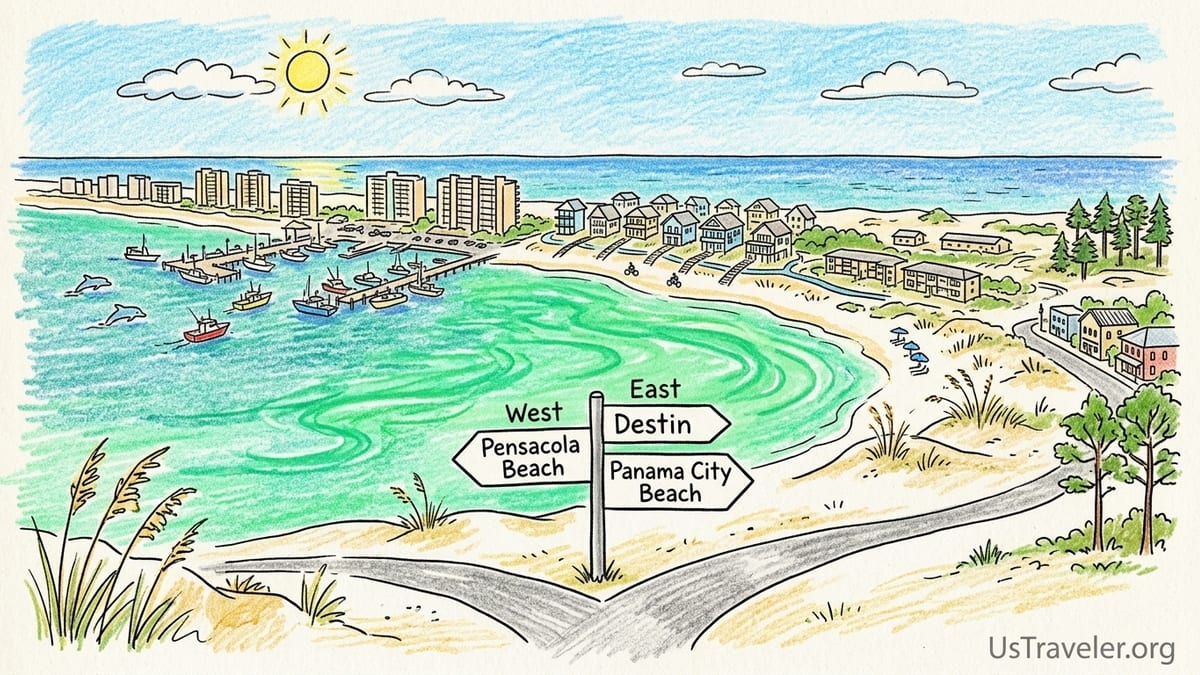
Where Exactly Is Northwest Florida, the Panhandle, and the Emerald Coast
On a map, Northwest Florida runs from the Alabama state line near Pensacola east toward Apalachicola and Mexico Beach. The term “Florida Panhandle” usually refers to this whole top bar of the state, stretching roughly from Pensacola to Tallahassee, but most beach-focused trips concentrate on the coastal section between Pensacola and Apalachicola. You can drive this shoreline in about 4 to 5 hours without stops, but in practice traffic, bridge bottlenecks, and beach-town speed limits make it feel longer.
The Emerald Coast is a nickname for the most developed beach corridor in the central Panhandle, where the water often turns a vivid green on sunny, calm days. In tourism and local usage it typically runs for about 100 miles across Escambia, Santa Rosa, Okaloosa, Walton and Bay counties, tying together Pensacola Beach, Navarre Beach, Fort Walton Beach, Destin, the South Walton and 30A communities, and Panama City Beach. Travelers will see the “Emerald Coast” label on everything from airport marketing to fishing charters and beach rentals.
When you zoom in further, the shoreline breaks into distinct subregions that each have their own personality. Pensacola and Perdido Key mix historic city with wide beaches and Navy heritage. Navarre is a quieter, mostly residential beach escape. Destin and Fort Walton Beach are classic family-resort hubs with high-rise condos, harbors, and attractions. South Walton and 30A are a string of design-conscious beach villages. Panama City Beach offers a broad, lively resort strip. East of there, around Port St. Joe, Cape San Blas and Apalachicola, the coast softens into small-town Old Florida with more state parks and fewer crowds.
Because distances are longer than they look, first-time visitors are usually happiest if they pick one main base, or at most two neighboring bases, rather than waking up in a different Panhandle town every day. A typical one-week trip might focus only on Destin and 30A, or only on Panama City Beach and Cape San Blas, with a day trip or two to neighboring areas.
Pensacola & Perdido Key: History, Navy Heritage, and Wide Beaches
Pensacola anchors the western end of the Emerald Coast and is the only sizeable city on this stretch of shoreline. Pensacola International Airport sits about 10 minutes from downtown and roughly 25 minutes from Pensacola Beach by car, which makes it one of the easiest gateways for travelers who want both city comforts and beach time. Many major U.S. airlines serve the airport with connections through Atlanta, Dallas, Houston, Charlotte, and other hubs, so it often works well for long-haul and international itineraries that connect within the United States.
The region splits into three main zones for visitors. Downtown Pensacola is a walkable historic district with brick streets, 19th-century storefronts, and restaurants and bars along Palafox Street and nearby side streets. Pensacola Beach sits out on Santa Rosa Island, a barrier island lined with hotels, condos, and long public stretches managed by Gulf Islands National Seashore. Farther southwest, Perdido Key feels more relaxed, with low-rise condos and protected dunes at Perdido Key State Park. Many visitors base themselves in a high-rise condo overlooking the Gulf on Pensacola Beach and plan an afternoon or evening downtown for dining and museums.
Outdoor and family activities lean heavily on the area’s military and coastal heritage. Families often pair beach days with a visit to the National Naval Aviation Museum on the grounds of Naval Air Station Pensacola, where admission has historically been free and exhibits include historic aircraft suspended from the ceilings. On some days in season, the Blue Angels flight demonstration squadron practices in the skies nearby, which can turn a beach morning into an impromptu air show. West of Pensacola Beach, Fort Pickens preserves the brick Civil War–era fort at the tip of Santa Rosa Island, with hiking trails, camping loops, and calm sound-side shores that work well for younger children.
Who should base here: Travelers who want a mix of culture and coast, or who are flying in from farther afield and value an airport close to both town and beach. A long weekend could split nights between a boutique hotel downtown and a condo or hotel on Pensacola Beach or Perdido Key, with one day dedicated to museums and historic sites and another to pure beach time.
Navarre: Quiet Beach Retreat Between Pensacola and Destin
Navarre and Navarre Beach sit east of Pensacola Beach along the same barrier island, but the mood shifts to low-key residential. The main beach strip is dominated by a few condo towers, small hotels, and houses on stilts, and it generally feels less commercial than either Pensacola Beach or Destin. Families who prefer to walk straight from a condo to a quiet stretch of sand often look closely at Navarre, especially in summer when Destin’s harbor can be extremely busy.
The Navarre Beach Fishing Pier is one of the area’s signature landmarks and offers sweeping views up and down the coast. Anglers pay a modest daily pier fee per person and can rent basic gear, so it is easy for first-timers to try Gulf fishing without chartering a boat. On a typical warm morning, you might see visitors catching Spanish mackerel or pompano while dolphins surface in the distance. Behind the dunes, the Navarre Beach Marine Park includes small facilities that promote sea turtle conservation and local marine life, and nearby sound-side access points create protected, shallow water play areas for younger kids.
Navarre works well as a base for people who are happy to drive for attractions but want a laid-back home beach. It is roughly 45 minutes by car to downtown Pensacola in light traffic and a similar drive to Destin. Many visitors rent a condo with a full kitchen and stock up at supermarkets on the mainland, using Navarre as a quiet home base while they day-trip once each way along the coast. This pattern is especially popular for multi-generational family groups traveling from nearby states such as Alabama or Georgia by car.
Who should base here: Visitors who prioritize a calm, mostly residential beach and are comfortable doing more driving for dining, shopping, and entertainment. Navarre is also a good fit for shoulder-season trips in early May or late September, when the weather is warm but crowds are lighter than midsummer.
Destin & Fort Walton Beach: Classic Emerald Coast Family Playground
Destin and neighboring Fort Walton Beach sit at the heart of the Emerald Coast and are among the most popular destinations for first-timers. The Destin-Fort Walton Beach Airport, sometimes marketed as VPS, lies inland but within about a 20- to 30-minute drive of the main beach areas, depending on traffic. Many visitors from the Midwest and South connect through hubs like Atlanta and Dallas directly into this airport, then pick up a rental car on arrival. Driving in from Atlanta takes roughly 5 to 6 hours, which is why the region is also packed with families who road-trip from Georgia, Alabama, Tennessee, and Mississippi.
Destin itself grew from a fishing village into a busy resort town centered on Destin Harbor. Today the harbor is lined with charter boats and dolphin cruises, seafood restaurants, and small attractions. Families commonly book a half-day party-boat fishing excursion where gear and licenses are included in the price per person, or a dolphin cruise timed for sunset. Just offshore, a shallow sandbar nicknamed Crab Island fills with anchored boats and rental pontoons on warm days, while on land Big Kahuna’s Water and Adventure Park and similar attractions in town offer water slides and go-karts when children want a break from the beach.
Fort Walton Beach and Okaloosa Island, just west of Destin, share the same emerald water and white sand but feel slightly less hectic while still offering plenty of lodging. Gulfarium Marine Adventure Park on Okaloosa Island is a long-running family attraction featuring dolphin and sea lion shows and touch pools where children can learn about local marine life. Nearby, The Boardwalk on Okaloosa Island mixes beachfront dining and casual shopping with beach access, so many visitors plan an afternoon there followed by an evening stroll along the pier.
Who should base here: First-time Emerald Coast visitors with children who want a classic beach vacation with lots of built-in activities. A typical one-week stay might involve renting a two-bedroom condo near Destin Harbor or on Okaloosa Island, spending most days between the beach and the pool, with two or three outings to Gulfarium Marine Adventure Park, a water park, and a dolphin cruise or fishing charter.
South Walton & Scenic 30A: Design-Forward Beach Towns
East of Destin, the shoreline narrows into South Walton, stitched together by County Road 30A, a scenic coastal route lined with master-planned beach towns and state parks. Here you will find communities like Seaside, Rosemary Beach, Alys Beach, Grayton Beach and Santa Rosa Beach, each with its own architectural style and village center. Many accommodations are vacation rentals rather than traditional hotels, ranging from small one-bedroom carriage houses over garages to large multi-story homes rented by the week.
The beaches along 30A are some of the most photographed in Northwest Florida, with tall dunes and clear, gentle water in calm conditions. Several protected areas, such as Grayton Beach State Park and Topsail Hill Preserve, preserve long stretches of undeveloped dunes and lakes. Visitors often rent bicycles to move between neighborhoods, and some communities have boardwalk promenades, small amphitheaters, farmers markets, and gourmet food trucks. Prices in these towns can be higher than in neighboring areas, particularly in peak summer and around school holidays when homes book out months in advance.
Because 30A is both popular and relatively narrow, parking and traffic can be tight in high season. Many repeat visitors avoid peak weekends and instead plan trips in late April, early May, or late September, when water temperatures are pleasant but crowds are slightly lighter. For day trips, Destin is usually about a 20- to 40-minute drive from different 30A towns, and Panama City Beach lies another 20 to 30 minutes east, which makes 30A a good central base if you want to sample both neighboring areas without changing hotels.
Who should base here: Travelers who like walkable, design-focused beach communities, enjoy vacation rentals, and are comfortable paying a premium for aesthetics and atmosphere. Couples, friend groups, and families who want to park the car for the week and move mostly on foot or by bike usually find 30A especially appealing.
Panama City Beach: Big-Strip Energy and Easy Air Access
Panama City Beach, often shortened to PCB, extends for miles along the Gulf with a continuous run of condos, hotels, restaurants, and attractions. It tends to attract a slightly younger crowd alongside families, especially in summer and around college break periods, though regulations and an evolving lodging base have gradually shifted the focus more toward families than in past decades. The shoreline itself is broad, with deep, soft sand and a long pier that offers fishing and views up and down the beach.
Just inland, Northwest Florida Beaches International Airport, known by its code ECP, serves Panama City Beach and the surrounding region. The airport sits north of town, roughly a 20- to 30-minute drive from most beach resorts, and is marketed as a central gateway for the Emerald Coast, especially for visitors heading to PCB, 30A, or the quieter eastern Panhandle. Major U.S. carriers typically offer a mix of year-round service and seasonal additions, which means that in peak months travelers from cities such as Atlanta, Dallas, Houston, Nashville, and others can often fly directly in with one connection or less.
Family attractions in and around Panama City Beach include water parks, mini-golf and go-kart complexes, small aquariums and animal encounters, and a large open-air shopping and entertainment district with restaurants, boutiques, and seasonal events. To balance the commercial side, many travelers set aside at least one day for nearby state parks. St. Andrews State Park, at the eastern end of the beach strip, offers protected swimming areas, jetties popular with snorkelers, and boat shuttles in season to undeveloped Shell Island, which is known for its quieter, wild-feeling beaches and frequent dolphin sightings.
Who should base here: Travelers who want easy air access, a wide range of condo and hotel options at varying price points, and a classic resort-strip experience. For a realistic one-week trip, many visitors rent a condo on the west end of PCB, spend most days on the beach or at the pool, then plan two or three excursions such as a Shell Island trip, an afternoon at a water park, and a day exploring the historic town of St. Andrews or heading east toward Mexico Beach.
Quieter Eastern Panhandle: Port St. Joe, Cape San Blas & Apalachicola
East of Panama City Beach, the character of the coast changes noticeably. High-rises thin out, road speeds slow, and small towns and state parks take over from large attractions. This quieter section runs roughly from Mexico Beach through Port St. Joe and Cape San Blas to Apalachicola and neighboring communities. Many visitors describe it as feeling more like “Old Florida,” with mom-and-pop motels, low-rise beach houses, and downtown streets lined with locally owned restaurants and shops.
Port St. Joe sits on St. Joseph Bay and serves as a practical base for exploring beaches and parks in both directions. Cape San Blas, a narrow peninsula that curls around St. Joseph Bay, mixes rental homes on stilts with long stretches of wild dunes and dog-friendly beaches. T.H. Stone Memorial St. Joseph Peninsula State Park at the end of the cape has camping loops and day-use areas with boardwalks over the dunes and expansive views. Many visitors spend mornings fishing or kayaking on the bay, where the water is often calm and shallow, and afternoons collecting shells on the Gulf side.
Farther east, Apalachicola sits at the mouth of the Apalachicola River and has long been known for its seafood industry. Today its walkable historic district remains a draw, with restored brick warehouses converted into inns, galleries, and restaurants that highlight local oysters, shrimp, and seasonal Gulf fish. Nearby barrier islands and coastal preserves provide quiet beaches and birding opportunities. Gulf County and Franklin County tourism offices often promote this stretch as a place to unplug, with spotty mobile service in some areas and wide stretches of night sky once you leave town lights behind.
Who should base here: Travelers who prefer low-key towns, nature, and local seafood to shopping malls and large attractions. This area pairs well with Panama City Beach or 30A for travelers willing to shift bases once. A typical split itinerary might use three or four nights in PCB for convenient flights and family attractions, followed by three or four nights in a beach house on Cape San Blas or an inn in Apalachicola for a slower, more nature-focused conclusion to the trip.
Airports, Driving Distances, and How to Divide a First Trip
For most first-time visitors, choosing the right airport and limiting how many bases you use will shape the entire trip. The main commercial gateways to Northwest Florida’s beaches are Pensacola International Airport near Pensacola, Destin-Fort Walton Beach Airport near Destin and Fort Walton Beach, and Northwest Florida Beaches International Airport north of Panama City Beach. All three typically offer rental cars on site, and ride-hailing services may be available for travelers staying close to the more urbanized beach areas, though costs for long-distance rides between towns can quickly exceed the price difference between two competing airfares.
Driving times can be deceptive because much of the coastal route runs along U.S. Highway 98 and two-lane local roads. As a rough guide in normal conditions, Pensacola to Destin takes about 1.5 hours, Destin to Panama City Beach about 1.5 hours, and Panama City Beach to Port St. Joe about 1.5 hours, with additional time needed at busy times of year or when crossing bridges. That means a “quick day trip” from Pensacola Beach to Panama City Beach, or from Destin to Cape San Blas and back, can turn into more than 5 hours of driving.
For a first trip of 5 to 7 days, it is usually best to choose one zone and explore it deeply. For example, you might fly into VPS, stay in Destin or Okaloosa Island for the whole week, and spend one day driving scenic 30A and another doing a half-day trip to Pensacola. Alternatively, you could fly into ECP, stay three or four nights in Panama City Beach for its attractions and state parks, then drive about 90 minutes east for three or four quieter nights in Port St. Joe or Cape San Blas before flying home. Travelers interested in history and food might fly into Pensacola, spend two nights downtown for museums and dining, then move to a condo on Pensacola Beach or Perdido Key for four or five nights of swimming and beach walks.
If you have 10 to 14 days and genuinely enjoy road trips, you can stitch together two or three bases along the coast, such as Pensacola Beach, Destin, and 30A, or Destin, 30A, and PCB plus the Cape San Blas area. Even then, try to organize your route logically from west to east or east to west and avoid constant backtracking. When comparing flights, factor in the cost and time of any long airport-to-resort transfers. In many cases, paying a bit more for a ticket into the closest airport to your chosen base will save several hours of driving and possibly a night of lodging.
Beaches, Outdoor Activities, and Family Attractions
Across Northwest Florida, the main draw is the Gulf of Mexico itself, with its fine, pale sand that squeaks underfoot and water that can appear emerald green on sunny days. Most beach communities provide public access points with parking, boardwalks over the dunes, and basic facilities such as restrooms and outdoor showers. Local regulations vary, so visitors should always check posted signs about beach flags, surf conditions, and any rules about tents, chairs, dogs, and bonfires. Many travelers reserve beach chair and umbrella setups from local vendors for a daily fee, particularly in busier areas where personal tents and large setups may be restricted.
Outdoor activities extend beyond simple swimming and sunbathing. State parks like Grayton Beach, Topsail Hill Preserve, St. Andrews, and St. Joseph Peninsula offer nature trails, dune overlooks, and sometimes rental kayaks or canoes for exploring rare coastal dune lakes and calm bays. Inland, rivers and springs in the broader Northwest Florida region provide opportunities for tubing, paddling, and day trips away from the salt air. Anglers can choose from pier fishing, inshore trips targeting redfish and speckled trout, and deep-sea charters that seek out snapper, grouper, and other offshore species.
Families with children will find a wide array of non-beach attractions in the more developed zones. In Destin and Fort Walton Beach, Gulfarium Marine Adventure Park offers marine life shows and interactive experiences, while water parks, mini-golf courses, go-kart tracks, and indoor arcades cluster along the main highway. In Panama City Beach, a similar mix of water parks, small animal parks, and indoor attractions provides rainy-day options. Even quieter areas like Port St. Joe and Apalachicola typically have modest playgrounds, small local history museums, and outfitters who run shelling, dolphin, or eco-tour boat trips suited to families.
For couples and adult groups, sunset cruises from harbors in Destin, Panama City Beach, or Apalachicola can be a highlight, especially when combined with dinner at a waterfront restaurant that serves local Gulf shrimp and seasonal fish. Birders and photographers often schedule early-morning outings in state parks or wildlife refuges, while paddlers may plan half-day excursions on coastal dune lakes or through bayous and marshes, where it is common to spot ospreys, herons, and occasionally dolphins or rays in the shallows.
Where to Stay and How to Match Towns to Travel Styles
Accommodation across Northwest Florida ranges from basic roadside motels and older beachfront hotels to luxury high-rise condos and large vacation homes. In Pensacola and Panama City proper, you will find familiar chain hotels near interstates and airports, which can work well for late arrivals or early departures. Out on the islands and beach strips, condo resorts and vacation rentals dominate, especially in Destin, 30A, Panama City Beach, and Cape San Blas, where weeklong stays from Saturday to Saturday are common in peak season.
Travelers seeking full-service hotels with on-site restaurants and pools might gravitate toward Pensacola Beach, parts of Destin and Okaloosa Island, central Panama City Beach, and some nodes along 30A, where recognizable brands maintain beachfront properties. Those who prefer more independence and space often rent condos with kitchens, washers and dryers, and separate bedrooms, which are widely available through local agencies and national booking platforms. In quieter eastern towns like Apalachicola and Port St. Joe, restored inns, small lodges, and low-rise motels provide alternatives to large towers, often within walking distance of local restaurants and marinas.
To match specific towns to travel styles, it helps to be honest about your priorities. If your ideal week is mostly pool and beach time with occasional structured outings, Destin, Okaloosa Island, and central Panama City Beach offer the most built-in attractions. If you picture bike rides between cafes and architect-designed vacation homes, focus on 30A communities like Seaside and Rosemary Beach. For an emphasis on local seafood and historic charm, Apalachicola or downtown Pensacola pair nicely with a beach base nearby. Dog-owning travelers should research local rules carefully, since some stretches of sand are strictly off-limits to pets while others, particularly around Cape San Blas and parts of the eastern Panhandle, are more dog-friendly.
Seasonality plays a major role in pricing and availability. School holidays, especially March and April spring break periods and mid-June to early August, drive up demand. During those weeks, rates in hotspots like Destin and 30A can be significantly higher, and many properties enforce minimum stays. Shoulder seasons such as late April to early May and late September to October often deliver a sweet spot of warm water, thinner crowds, and more reasonable rates, though travelers should be aware that the broader Atlantic hurricane season runs from June through November and stay flexible with cancellation policies and travel insurance.
FAQ
Q1: What is the best airport to fly into for the Emerald Coast?
Pensacola International Airport works well for Pensacola and Navarre; Destin-Fort Walton Beach Airport is closest to Destin and Fort Walton Beach; Northwest Florida Beaches International Airport is most convenient for Panama City Beach, 30A, and the quieter eastern Panhandle. The best choice depends on which town you choose as your base and which routes your preferred airline offers.
Q2: How many towns should I try to see on my first Northwest Florida trip?
For a 5- to 7-day trip, aim for one main base or at most two neighboring bases. Trying to cover Pensacola, Destin, 30A, Panama City Beach, and Apalachicola in a single week usually leads to long days in the car and not enough time actually on the beach.
Q3: When is the best time of year to visit the Florida Panhandle?
Late April to early May and late September to October often offer warm water, comfortable air temperatures, and lighter crowds than peak summer. July and early August are popular but can be hot, humid, and busy, while March and early April bring spring break crowds to some towns.
Q4: Are Northwest Florida beaches really different from each other?
Yes. Pensacola Beach and Perdido Key mix city access and wide beaches. Navarre is quieter and more residential. Destin and Panama City Beach have many attractions and high-rises. 30A focuses on planned villages and design, while Port St. Joe, Cape San Blas, and Apalachicola feel more small-town and nature-focused.
Q5: Do I need a car in Northwest Florida?
In most cases, yes. Public transit is limited, and many attractions, state parks, and small towns are spread out along the coast. Ride-hailing services can work for short hops in more built-up areas like Destin or Panama City Beach, but a rental car usually offers the most flexibility for day trips and grocery runs.
Q6: Is Northwest Florida good for families with young children?
Very much so. The gentle Gulf surf on calm days, wide sandy beaches, and abundance of family attractions like marine parks, water parks, and mini-golf make it a popular choice for families. Parents should still pay close attention to beach-flag warnings and rip-current conditions, especially on windy days.
Q7: How expensive is a typical one-week stay on the Emerald Coast?
Costs vary widely by season and town. A family who books a modest two-bedroom condo in Destin or Panama City Beach outside peak dates can often keep lodging to a midrange budget, while a designer home on 30A in July can command premium nightly rates. Groceries, casual seafood restaurants, and paid activities like dolphin cruises or water parks should also be factored into the total.
Q8: Can I visit Northwest Florida without staying right on the beach?
Yes. Many travelers stay in more affordable chain hotels or vacation rentals a short drive inland and commute to public beach accesses during the day. This strategy can significantly reduce lodging costs, especially during peak season, while still allowing plenty of beach time.
Q9: Is the eastern Panhandle too quiet for a first visit?
Not if you are looking for a slower pace. Port St. Joe, Cape San Blas, and Apalachicola are ideal if you value nature, small-town charm, and local seafood over nightlife and large attractions. Travelers who want arcades, water parks, and a busy boardwalk atmosphere may be happier basing in Destin, 30A, or Panama City Beach and visiting the eastern Panhandle on a future trip.
Q10: How should I plan for weather and storms in Northwest Florida?
Summer days are typically hot and humid with a chance of afternoon thunderstorms. The broader hurricane season runs from June through November, with the highest risk often in late summer and early fall. It is wise to monitor forecasts, consider flexible bookings or travel insurance, and build in indoor activity options for days when thunderstorms or heavy rain make the beach less appealing.