


Planning a first trip to Florida can feel overwhelming. The state is nearly 500 miles long, has two very different coasts, world-famous theme parks, subtropical wetlands, coral islands and historic cities. The key to a great itinerary is not trying to see everything at once, but grouping nearby regions that naturally fit together. This guide walks you through Florida’s major visitor areas, how they connect, and what belongs in the same vacation so you can build a realistic, rewarding first itinerary.
How Florida Fits Together for First-Time Trips
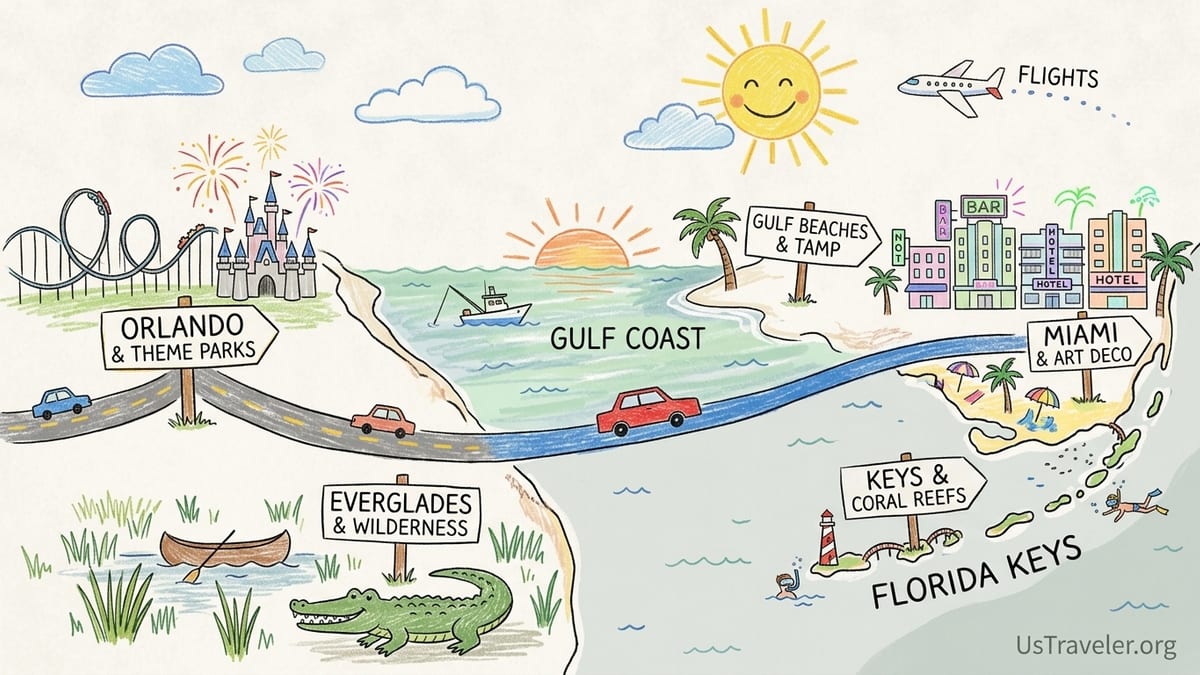
Florida is best understood as a set of travel “clusters” rather than a checklist of individual cities. For a first visit, most travelers pick one main base such as Orlando, Miami, Tampa Bay or the Panhandle, then add one or two neighboring regions as side trips. Driving distances can be longer than they appear on a map. Miami to Orlando, for example, is roughly a 3.5 to 4 hour drive in good traffic, and Miami to Key West is usually at least 3.5 hours without long stops. Trying to combine the Panhandle with Miami and the Keys in a single week will mean many hours on the road.
Florida’s coasts also feel very different. The Atlantic side, from Miami up to Jacksonville, tends to have more consistent surf and slightly cooler water in winter. The Gulf Coast, from the Keys and Everglades up through Naples, Sarasota and the Panhandle, is known for calmer emerald water and softer, often sugar-white sand. Inland, Orlando and Central Florida revolve around theme parks and family attractions, while the Everglades remains one of North America’s signature wilderness areas.
For a first-timer, a classic two-part trip might be Orlando plus the Gulf Coast, or Miami plus the Keys and Everglades. These combinations keep driving manageable, give you a contrast between city and nature, and still leave time to slow down on the beach. In the sections that follow, you will find realistic examples of how long to spend in each region, when to go, and how they connect.
Florida is also well served by major airports. Orlando International handles most theme-park visitors, Miami is the main South Florida hub, Tampa and Fort Lauderdale are strong alternatives, and smaller airports in Jacksonville, Fort Myers, Pensacola and Key West can dramatically cut driving time if you are focusing on one corner of the state.
Orlando & Central Florida: Theme Parks and Inland Lakes
Orlando and its surroundings form Florida’s busiest visitor region, anchored by Walt Disney World, Universal Orlando Resort and SeaWorld Orlando. A typical one-day base ticket for a major Orlando theme park often starts around 120 dollars per adult before tax, with higher prices on peak dates. Many visitors find that three to five days in the area allows time for two or three major parks plus a rest day by the hotel pool or at a water park. Popular areas to stay include Lake Buena Vista for easy Disney access, International Drive for a central, budget-friendly base and the Universal area for shorter commutes to those parks.
Outside the big-name parks, Central Florida offers spring-fed lakes, state parks and smaller attractions. You can kayak in crystal-clear water at places like Wekiwa Springs State Park, book an airboat ride on the headwaters of the Everglades near Kissimmee, or visit the Kennedy Space Center on the Atlantic side, about an hour’s drive from Orlando. These day trips give first-time visitors a break from crowds and a sense of Florida beyond roller coasters and fireworks.
Orlando works naturally with several nearby regions. Many families pair four or five nights near the parks with three or four nights on the Gulf Coast around Clearwater Beach or on the Atlantic Coast near Cocoa Beach or Daytona Beach. Driving from the Orlando resort area to Clearwater Beach usually takes around 2 hours, while Orlando to Cocoa Beach is closer to an hour. This makes it easy to build a weeklong itinerary that blends theme parks with a classic beach break without spending most of the trip in a car.
Orlando International Airport is the main gateway, served by a wide range of domestic and international flights. If you plan to visit only the theme parks, you may not need a rental car; many resort areas have shuttle buses, ride-hailing coverage and on-site transportation. However, if you want to reach state parks, suburban outlet malls or the coasts, renting a car will give you much more flexibility.
Miami & South Florida: Culture, Nightlife and Urban Beaches
Miami and neighboring South Florida cities such as Fort Lauderdale and West Palm Beach offer a very different experience from Central Florida. Here the focus is on beach life, nightlife, diverse neighborhoods and Latin American and Caribbean influences. South Beach is known for its pastel Art Deco architecture and energetic nightlife, while neighborhoods like Wynwood, Little Havana and the Design District attract visitors with murals, cafes, galleries and live music. First-time visitors often spend three or four nights in Miami to sample a bit of each area without feeling rushed.
Miami’s beaches are long and urban, framed by high-rise hotels and condos. The Atlantic surf is more pronounced here than on most Gulf Coast beaches, which appeals to swimmers and casual surfers, though conditions vary day to day. Compared with many other Florida destinations, Miami is typically more expensive. Midrange beachfront hotels can easily run several hundred dollars per night in high season, and valet parking, resort fees and restaurant prices add up quickly. Budget-conscious visitors often stay slightly inland near downtown or in neighborhoods along the Metrorail or Brightline rail corridors and rely on transit and ride-hailing to reach the beach.
Miami fits naturally with several surrounding regions: the Florida Keys, the Everglades and parts of the Atlantic Coast to the north. Many first-time visitors plan a loop that starts in Miami, continues to Key Largo and Islamorada for snorkeling and quiet beaches, and then returns to the mainland through Everglades National Park before flying home. Miami also pairs well with a cruise from PortMiami or Port Everglades in Fort Lauderdale, which is why many travelers schedule one or two hotel nights in the city before or after a cruise.
Miami International Airport is South Florida’s primary gateway, with Fort Lauderdale-Hollywood International about 30 to 40 minutes away by car depending on traffic. Within the city, visitors can use rideshare services, local buses, limited rail lines and bike or scooter rentals along the beach paths. That said, a rental car is helpful if you plan to visit the Keys, the Everglades or beaches in neighboring counties, since public transport becomes less practical outside the urban core.
Florida Keys & Everglades: Island Chain and Subtropical Wilderness
The Florida Keys stretch in a long arc southwest from the mainland, connected by the Overseas Highway. Key Largo, about 90 minutes from Miami in normal traffic, is the first major island and a popular base for snorkeling and diving in protected reefs. Further down the chain, Islamorada markets itself as the sport-fishing capital of the world, while Marathon and the Lower Keys draw families and nature lovers with quieter beaches, wildlife refuges and small marinas. Key West, roughly 3.5 to 4 hours by car from Miami, feels like a mix of Caribbean port town and quirky American outpost, with sunset celebrations, historic homes and live music along streets like Duval.
For a first visit, two or three nights somewhere in the Keys is enough to get a feel for the chain. Many travelers split that time between Key Largo or Islamorada for water activities and Key West for nightlife and history. Lodging ranges from small, independent inns and motels to full-service resorts with private docks. Because there is only one main road, travel times can increase sharply on weekends and holidays, so it is wise to build buffer time into your schedule and avoid booking back-to-back activities in distant parts of the chain.
Immediately west of Miami and south of Naples, the Everglades provide a striking counterpoint to the Keys. Rather than jagged mountains, this national park is a vast, slow-moving river of grass dotted with mangroves and sawgrass prairies. First-time visitors commonly experience the Everglades on a guided airboat tour or naturalist-led boat trip. Standard shared airboat rides often cost in the rough range of 40 to 70 dollars per person for around an hour on the water, with higher prices for smaller boats or private tours. Many operators include access to a small boardwalk, wildlife exhibit or short walking trail with the ticket, making it an easy half-day outing.
The Keys and Everglades belong in the same itinerary, and both fit naturally with Miami or Southwest Florida. A realistic one-week plan might include two nights in Miami, three in the Keys and two near Everglades City or Homestead to explore park entrances on both coasts. This structure keeps most drives under four hours and lets you experience coral reefs, mangrove tunnels and tropical city neighborhoods in a single trip without trying to add distant regions like the Panhandle or Orlando.
Gulf Coast & Tampa Bay: Calm Waters and Sunset Cities
Florida’s central Gulf Coast, including the Tampa Bay area, is known for warm, generally calmer water and wide beaches that face the sunset. Tampa itself is an inland bay city with a revitalized riverfront, historic Ybor City district and a sizable professional sports and concert scene. Across the bay, St. Petersburg and Clearwater are more beach-focused, with barrier island communities such as St. Pete Beach, Treasure Island and Clearwater Beach offering a mix of high-rise resorts, family-style hotels and vacation rentals.
For a first-time visitor, three or four nights on the central Gulf Coast provides time for beach days, a boat excursion and perhaps a visit to Busch Gardens Tampa Bay, an African-themed amusement park and zoo known for its roller coasters. Families often visit the Clearwater Marine Aquarium, take a dolphin-watching cruise from marinas around Clearwater or Madeira Beach, or book a half-day deep-sea fishing trip from a local pier. Prices for activities vary widely; as a ballpark example, a basic shared dolphin cruise often starts somewhere around 30 to 50 dollars per adult, while full-day fishing charters can run several hundred dollars for a small group.
The Tampa Bay region pairs seamlessly with Orlando and Central Florida, thanks to a straightforward two-hour drive along Interstate 4. Many visitors fly into Orlando for the theme parks, then drive to Clearwater or St. Pete Beach for a few nights on the Gulf before flying home from Tampa International Airport. The route also works in reverse. This combination is especially practical for families who want both roller coasters and sand castles in a single trip without long one-way drives.
North and south of Tampa Bay, the Gulf Coast continues with more relaxed destinations. To the north you will find quieter, more residential communities and spring-fed rivers popular for tubing and kayaking. To the south, areas like Sarasota, Anna Maria Island and Venice offer cultural attractions, including established art museums and performing arts venues, along with beaches that are less built up than parts of Clearwater or St. Pete. These destinations suit travelers who want a slower pace and are willing to rent a car and explore.
Atlantic Coast & Northeast Florida: Surf Towns and Historic St. Augustine
Florida’s Atlantic Coast runs from Miami all the way to the Georgia border, with a mix of resort cities, surf towns and wildlife refuges. Closest to Orlando is the Space Coast, anchored by Cocoa Beach and Cape Canaveral. This area makes a straightforward day trip or overnight from Orlando: visitors can watch rocket launches when schedules align, tour the Kennedy Space Center and relax on a classic Atlantic beach with a fishing pier and surf shops. Further north, Daytona Beach is famous for its racetrack and hard-packed sand where, in designated areas, cars can still drive on the beach for a fee.
As you continue toward Jacksonville, the coast becomes a patchwork of barrier islands, state parks and low-rise beach towns. Amelia Island, near the Georgia line, is known for its historic district and wide, generally quieter beaches. Inland, Jacksonville is a large, spread-out city with a growing food and craft beer scene, riverfront parks and access to multiple nearby beaches and natural areas. Most first-time visitors who are not traveling for business or family reasons, however, focus their limited time on either Central Florida or the far northeastern corner, not both.
One of the Atlantic Coast’s standout destinations for first-time visitors is St. Augustine in Northeast Florida. Established in the 16th century, it presents a compact historic district of stone and coquina buildings, narrow streets and a waterfront fort. Visitors typically spend one or two nights here, walking between sights, browsing small shops and taking evening ghost tours or narrated trolley rides. The Atlantic beaches of Anastasia Island sit just over the bridge, so it is easy to combine history and beach time without moving hotels.
Northeast Florida and St. Augustine fit best into itineraries that already involve Orlando or Jacksonville. The drive from Orlando to St. Augustine is roughly two hours, making it an appealing overnight sidetrip from a theme-park vacation. Travelers focusing on the northern part of the state or self-driving along the East Coast of the United States often use Jacksonville International Airport as their gateway, then explore down to St. Augustine and up toward Georgia’s barrier islands.
Southwest Florida & the Panhandle: Beaches at Two Ends of the State
Southwest Florida, stretching from roughly Naples up through Fort Myers, Cape Coral and Sarasota, offers many travelers their mental picture of a Florida vacation: palm-lined boulevards, long stretches of soft sand and calm Gulf water that glows at sunset. Popular beaches include Naples Pier, Fort Myers Beach and the barrier islands off Sarasota. Compared with Miami, this region tends to feel more laid-back and family-oriented, with early dinners on open-air patios and quieter evenings. Many visitors rent condos or vacation homes for a week or more, especially during the winter peak season.
Southwest Florida pairs naturally with the Everglades and, to a lesser extent, with the Keys. From Naples or Marco Island, it is a relatively short drive to Everglades City and the Gulf Coast entrance to Everglades National Park, where you can book boat tours through mangrove estuaries or hire a local guide for backcountry fishing. Fort Myers and Sarasota are a more practical match with Tampa Bay or Orlando, allowing an itinerary that moves gradually up or down the Gulf Coast rather than skipping across the peninsula.
At the far western end of the state, the Panhandle and Emerald Coast feel almost like a different region entirely. Beach towns such as Destin, Pensacola Beach and Panama City Beach sit closer to parts of Alabama and Georgia than to Miami. Their beaches are famed for powdery white sand and bright, often emerald-green water, especially on clear, calm days. The area is popular with families who drive in from neighboring states and rent condos, as well as groups of friends looking for an affordable beach break in late spring or summer.
Because of the distance, the Panhandle rarely fits smoothly into the same one-week itinerary as Orlando or Miami unless you are on a longer road trip. Driving from Orlando to Destin, for example, typically takes around six hours without major delays. For most first-time visitors, it is more sensible to treat the Panhandle as its own separate vacation centered on beaches, coastal state parks and small towns, accessing the area through airports such as Pensacola or Destin-Fort Walton Beach.
Practicalities: Airports, Driving, Tolls and Timing
Choosing the right airport can dramatically cut travel time. Orlando International and Miami International are the largest hubs, with Tampa, Fort Lauderdale, Jacksonville, Fort Myers, Pensacola and Key West providing strong regional options. If your main goal is a beach vacation on the Gulf Coast, for instance, flying into Tampa or Fort Myers often makes more sense than landing in Orlando and driving several extra hours. When comparing fares, factor in not only the ticket price but also rental car costs, tolls and parking, which can be significant in resort areas.
Florida is very car-oriented. While there are intercity trains and buses on some corridors and limited local rail in South Florida, most visitors rely on rental cars to move between regions and to reach beaches, state parks and outlying attractions. When budgeting, remember that Florida has extensive toll roads, especially around Orlando, Miami and Tampa. Many rental car companies offer toll packages that charge a per-day fee plus the tolls themselves. Travelers who expect to use toll roads frequently sometimes buy a prepaid transponder, or in the Orlando area obtain a temporary toll pass that hangs from the rearview mirror and automatically pays tolls at local rates rather than rental car markups.
Florida’s climate also shapes trip planning. Winters are generally mild to warm in most visitor regions, with South Florida and the Keys typically comfortable for swimming while northern beaches and the Panhandle can feel cool and breezy. Summer brings heat, humidity and frequent afternoon thunderstorms, especially inland around Orlando and in the Everglades. Hurricane season officially runs from June through November, with the highest likelihood of storms in late summer and early fall, so it is wise to purchase flexible airfare or travel insurance and keep an eye on forecasts if you are traveling during that window.
Approximate trip lengths for first-time visitors often fall into familiar patterns. A focused city-and-beach trip might involve three nights in Miami and four in the Keys, while a family vacation could include four or five nights in Orlando plus three nights on the Gulf Coast. Those with ten to fourteen days might string together Orlando, Tampa Bay and Southwest Florida, or design a road trip from Jacksonville and St. Augustine down the Atlantic Coast to Miami and the Keys. What tends not to work well in a single short trip is trying to include both the far north (like the Panhandle) and the far south (Miami and Key West), since you would spend much of your time on the highway.
The Takeaway
Florida rewards first-time visitors who treat it as a set of distinct but connected regions rather than a single theme-park-and-beach destination. Orlando delivers world-class attractions and family entertainment. Miami and South Florida offer urban beaches and nightlife. The Keys and Everglades reveal coral reefs and wetlands, while the Gulf Coast and Panhandle showcase some of the country’s most inviting soft-sand shores. Northeast Florida and St. Augustine add a historic dimension that many do not expect from a state known for modern resorts.
By grouping nearby regions into the same itinerary and leaving far-flung corners for a future visit, you can avoid spending days of your vacation behind the wheel. Pair Orlando with Tampa Bay and the central Gulf Coast, or link Miami with the Keys and Everglades. Use secondary airports when they make geographic sense, budget realistically for theme park tickets and excursions, and build in unscheduled time for strolling beach towns or lingering over a waterfront meal. With this approach, a first trip to Florida feels less like a rushed tour and more like the beginning of a long-term relationship with a state that offers far more variety than many travelers expect.
FAQ
Q1. How many days do I need for a first trip to Florida?
For a focused introduction, seven to ten days works well. That allows time for one main base such as Orlando or Miami plus one nearby region like the Gulf Coast, Keys or Everglades without rushing.
Q2. Which Florida regions make the most sense to combine in one vacation?
Common beginner combinations include Orlando and the Gulf Coast around Tampa Bay or Clearwater, Miami with the Florida Keys and Everglades, or Orlando with St. Augustine and the Atlantic Coast.
Q3. Is it realistic to visit Miami, Orlando and the Florida Keys in one week?
You can, but it will be rushed. Driving between those areas can take three to four hours per leg, so you would spend a significant portion of a short trip on the road. Most first-timers pick two of the three.
Q4. Do I need a rental car to get around Florida?
In most regions a rental car is highly useful, especially for reaching beaches, state parks and outlying attractions. In dense areas such as South Beach or downtown Miami you can rely more on ride-hailing and local transit, but a car still helps for day trips.
Q5. How expensive are theme park tickets in Orlando?
Prices vary by date and park, but a typical one-day base ticket for a major Orlando theme park often starts around 120 dollars per adult before tax, with higher prices during busy periods and discounts for multi-day passes.
Q6. When is the best time of year to visit Florida?
Many visitors favor late fall through early spring for milder temperatures and lower humidity. Winter is peak season for South Florida and the Keys, while northern beaches and the Panhandle are more popular in late spring and summer.
Q7. What should first-time visitors know about Florida toll roads?
Florida has many toll roads, especially around Orlando, Miami and Tampa. Rental car companies often sell toll packages, and in some areas visitors can use short-term toll passes or prepaid transponders to pay electronic tolls at local rates.
Q8. Which side of Florida has better beaches, the Atlantic or the Gulf Coast?
Both coasts are appealing but different. The Atlantic Coast tends to have more surf and slightly cooler winter water, while the Gulf Coast is known for calmer seas, gentle waves and very soft sand, especially along the central Gulf and Panhandle.
Q9. Is it safe to swim everywhere in Florida?
Swimming is popular, but conditions vary. Always heed local flags and lifeguard advice, pay attention to rip current warnings and be aware that wildlife such as jellyfish or stingrays may be present. In freshwater areas, follow posted guidance about alligators and other hazards.
Q10. How far in advance should I book hotels and activities?
For peak periods such as winter in South Florida, spring break or major holiday weeks, booking several months ahead is wise, especially for beachfront hotels and popular tours. In slower shoulder seasons you will usually find more last-minute availability and flexible pricing.