


Florida looks compact on the map, but on the road it quickly reveals its true scale. Miami to Orlando is roughly a four-hour drive, Miami to Key West can eat most of a day once you add traffic and photo stops, and crossing from the Atlantic to the Gulf can feel like a mini expedition. The smartest way to see the state is to think in regional road-trip loops rather than trying to “do Florida” in one go. This guide breaks the peninsula and Panhandle into realistic routes, explains rental-car and toll essentials, and points out which combinations work beautifully and which will leave you exhausted in highway traffic.
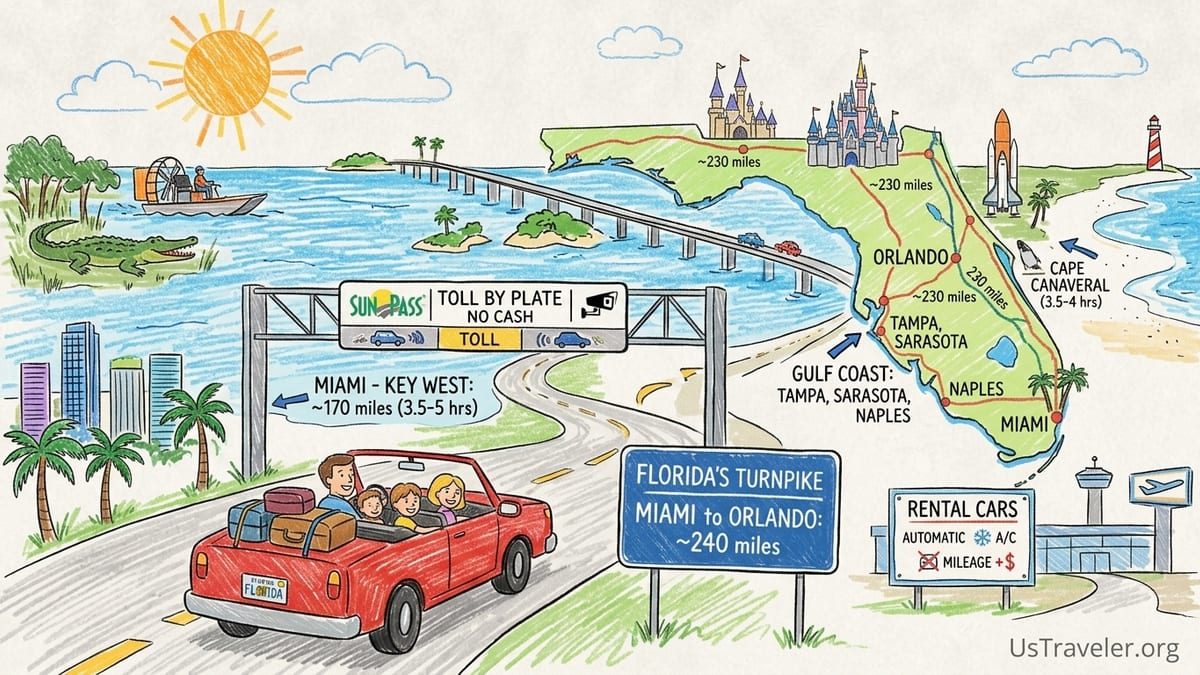
How Florida Really Drives: Distances, Tolls and Rental Basics
Florida is built for driving, but first-time visitors regularly underestimate both distances and how much of their vacation can disappear into the windshield. Miami to Key West is around 160 to 170 miles along the Overseas Highway, and with traffic, road work and scenic stops it often takes three and a half to five hours one way, not the two hours many mapping apps optimistically suggest. Miami to Orlando is roughly 230 to 240 miles; even using fast toll roads such as Florida’s Turnpike, it usually works out to about three and a half to four hours in real-world conditions.
Rental cars are straightforward to book at major gateways such as Miami International, Orlando International, Tampa, Fort Lauderdale and Jacksonville. The major brands typically include automatic transmission, air conditioning and unlimited mileage in base rates. Where the costs climb is in extras: SunPass or “toll package” fees, additional driver charges, one-way drop fees if you are not returning to the same location, and parking at city hotels or beach resorts. A compact automatic in high season might advertise at around 35 to 45 dollars per day, but it is common for taxes and fees to add 20 to 30 percent to that number, and toll programs can add several dollars per day on top.
Florida’s toll network catches many visitors out. Cash toll booths have largely disappeared from major facilities, especially around Miami, Orlando and on long-distance routes like Florida’s Turnpike. Instead, overhead gantries photograph license plates or read SunPass and compatible transponders. With a rental car, you normally have three options: accept the rental company’s toll program, bring or buy your own SunPass-compatible device and register the rental plate, or rely on toll-by-plate billing passed on by the rental company. The first option is convenient but expensive, with some companies charging around 6 dollars per rental day plus the actual tolls even if you pass only one gantry. The second requires a little admin but is often the cheapest for longer trips. The third sounds simple but can result in surprise administrative fees when charges are processed weeks later.
Parking is a quiet budget killer on Florida road trips. In Miami Beach, downtown Miami and parts of Orlando, nightly hotel parking commonly runs from 25 to 50 dollars for valet, with self-parking somewhat cheaper but still substantial. Beach towns along the Gulf Coast and in the Keys increasingly charge 3 to 5 dollars per hour at popular public lots. When planning road-trip routes, factor parking into hotel comparisons: a slightly more expensive room that includes parking can be better value than a cheaper rate plus high nightly parking charges.
Route 1: Miami – Everglades – Florida Keys
This classic route focuses on South Florida’s contrasts: skyscrapers and nightlife in Miami, alligators and endless sawgrass in the Everglades, and tropical islands linked by the Overseas Highway. It works well as a five to seven night itinerary, usually starting and ending at Miami International Airport with a standard round-trip car rental. The loop keeps driving legs manageable while still offering time to get out of the car and onto boats, boardwalks and beaches.
Many travelers begin with two or three nights in Miami or Miami Beach without using the car much at all. If your hotel in South Beach charges 45 dollars a night to park and you plan mostly to walk or use ride-shares, it can make sense to delay picking up the rental until the day you leave the city. From central Miami, it is roughly an hour to the main eastern Everglades access points around Shark Valley or Homestead. Booking a morning airboat ride or tram tour gives you a structured way to see wildlife without worrying about gravel side roads or navigation in a huge, flat landscape where everything looks similar.
From Homestead or Florida City, the road to the Keys starts as a standard multi-lane highway before narrowing to a two-lane road that hops from island to island. Key Largo, about 60 to 70 miles from downtown Miami, makes a practical first stop for snorkeling trips to the John Pennekamp reef. Islamorada, another 30 or so miles down the chain, is a comfortable base for fishing charters and low-key resorts. Many travelers split the drive, spending one night in Key Largo or Islamorada and then another two or three nights in Key West at the far end. With stops for lunch, photos on the Seven Mile Bridge and perhaps a swim at Bahia Honda State Park, Islamorada to Key West can easily take three hours or more even though the distance on the map looks short.
This route is ideal for travelers who want scenery over speed. The tradeoff is that backtracking is unavoidable: there is only one road in and out of the Keys. A popular solution is a one-way rental, picking up the car in Miami and dropping it in Key West or vice versa. That can save half a day of driving but typically adds a one-way fee that might be 100 dollars or more. When pricing your trip, compare total costs for a loop with free drop-off against a shorter one-way drive that might require a flight back to your starting city or an expensive ferry transfer. Either way, do not combine a full Miami–Everglades–Keys loop with a separate Orlando or Gulf Coast segment in one short trip. At a minimum, that combination requires an extra full day of highway driving each way.
Route 2: Orlando – Space Coast – St. Augustine
Central and Northeast Florida make a logical loop that emphasizes theme parks, space history and one of the oldest European-settled cities in North America. Orlando International Airport is the natural starting point, and a rental car is almost essential here because suburban resorts, outlet malls and theme parks are spread across a wide area laced with toll roads. Driving from the airport to the main Disney resort area typically involves two or three toll plazas, and even a short day of errands can rack up several small tolls.
Many visitors spend three to five nights based near Walt Disney World or Universal Orlando, using the car mainly for grocery runs, off-site dining and occasional day trips. For drivers nervous about toll costs, Orlando’s regional toll authority runs a visitor toll program that allows renters to pay tolls directly without the daily rental car surcharge. It requires picking up a tag at the airport and registering a payment method before driving through any toll gantries. Travelers who do not want to manage this can still rely on the toll transponder built into most rental windshields, but should ask clearly at the counter what the daily or per-use fees will be so that there are no surprises on the final bill.
From Orlando, the Space Coast is the natural next leg. Cape Canaveral and Cocoa Beach are roughly an hour’s drive east, mostly on multi-lane highways. This is close enough for a day trip, but spending a night or two on the coast lets you schedule a Kennedy Space Center visit, a morning walk on the beach and maybe a bioluminescent kayak tour without rushing. Parking at most midrange beach hotels is either free or much cheaper than in Miami, but cruise-port hotels around Port Canaveral may charge nightly fees similar to big-city properties, so it pays to read the small print when booking.
From the Space Coast, continue north along the Atlantic for roughly two hours to reach St. Augustine. The town’s colonial core is compact and walkable, which means once you are parked at your inn or hotel, you can leave the car and explore on foot or by trolley. Older buildings and narrow streets mean on-site parking is not guaranteed; some historic inns rely on nearby garages where daily rates are in the low- to mid-20-dollar range. After one or two nights, many travelers return directly to Orlando on the inland interstates, about two hours away, forming a simple loop that keeps individual driving days under three hours and avoids zigzagging across the state.
Route 3: Tampa – Clearwater – Sarasota – Naples on the Gulf Coast
The central and southwest Gulf Coast offers a chain of white-sand beaches and relaxed cities that work beautifully as a slow southbound or northbound road trip. Tampa International Airport is the main hub, with a dense cluster of rental desks and relatively easy highway access. From the airport, Clearwater Beach is about 40 to 50 minutes away in normal traffic, while downtown Tampa hotels are closer, often 15 to 20 minutes depending on the time of day.
Clearwater and nearby St. Pete Beach combine long beaches with family-friendly resorts, casual seafood restaurants and busy causeways. Parking can be tight on weekends and holidays; public beach lots often run around 3 dollars per hour, and many midrange hotels now charge a nightly parking fee. It is common for visitors to spend two or three nights here before moving slowly south. An alternative is to stay in downtown St. Petersburg and drive out to the beach for day visits, trading beachfront sunset views for easier parking and a more walkable arts and dining scene.
From Clearwater or St. Petersburg, Sarasota is roughly a one-hour drive south, mostly on Interstate 275 and Interstate 75, with local roads leading out to barrier islands such as Siesta Key and Longboat Key. Sarasota adds a more cultural flavor, with its museums and performing arts venues. Vacation rentals and hotels on Siesta Key typically include at least one parking space, but older low-rise buildings can have tight parking lots that feel crowded in peak season. Continuing further, Naples lies about two and a half hours south of Tampa along Interstate 75, known locally as Alligator Alley further east. The road between Sarasota and Naples can slow down at rush hour or during winter “snowbird” months, so allowing extra time for afternoon drives is wise.
A Tampa–Clearwater–Sarasota–Naples route works best as a one-way line rather than constant backtracking. Some travelers begin in Tampa, work their way down the coast and then drop the car in Fort Myers or Miami if they plan to connect onwards by air. Others build a loop by driving inland through the Everglades and back to Miami before flying home. One-way drop fees for Tampa to Naples or Fort Myers are often modest compared with cross-state or out-of-state drops, but they still need to be checked at booking. Crucially, this Gulf Coast itinerary should not be forced into the same week as a full Keys or Orlando segment. Each region rewards at least four or five nights; trying to string them all together in 7 to 10 days means you spend more time on Interstate 75 and Florida’s Turnpike than on the beach.
Route 4: Panhandle and Emerald Coast Beaches
The Florida Panhandle feels like a different state from South Florida, with low-rise beach towns, long bridges over sounds and bays, and a more Southern cultural flavor. Key hubs for a Panhandle road trip include Pensacola, Destin, Panama City Beach and the stretch of Highway 30A lined with master-planned beach communities. Distances between these towns are shorter than the huge gaps in the peninsula: Pensacola to Destin is under an hour in light traffic, and Destin to Panama City Beach is roughly an hour’s drive, yet because of seasonal congestion on the single coastal highway, these short distances can stretch in summer.
Pensacola makes a good starting point, especially for travelers flying in from other parts of the United States. The city’s compact historic core sits a short drive from Pensacola Beach, where mid- and high-rise hotels line a narrow barrier island with soft white sand. Continuing east, Navarre Beach, Fort Walton Beach and Okaloosa Island offer a slightly quieter feel than busy Destin. Many visitors choose to base in Destin or nearby Miramar Beach for three or four nights, taking day trips along the Emerald Coast for variety. Parking at public beach accesses here is often free or modestly priced compared with South Florida, but popular fishing harbors and boardwalks may charge for garage parking during peak times.
Further east, Highway 30A and Panama City Beach provide contrasting experiences. The master-planned resorts and town centers along 30A emphasize walkability, bike paths and stylish architecture, while Panama City Beach delivers more typical high-rise beach-strip energy with mini-golf, arcades and large condominium towers. The drive from Destin to Panama City Beach is under 50 miles, but frequent traffic lights and resort entrances can make it a 90-minute crawl on summer weekends. A common strategy is to choose one base for the entire Panhandle stay rather than moving hotels every night. For example, you might rent a condo in Miramar Beach for a week and visit Pensacola Beach one day and 30A another, accepting that each side trip will mean an hour-plus in the car.
The Panhandle is best paired with nearby Southern cities such as New Orleans, Mobile or Atlanta, or enjoyed as a stand-alone beach holiday. It is technically possible to combine the Panhandle with Orlando or Miami in one road trip, but this involves long cross-state drives of six to eight hours. For instance, Destin to Orlando is roughly 400 miles and can take seven hours or more. Most visitors will have a better time focusing on the Panhandle and perhaps adding a short inland detour to Tallahassee or one of the natural springs in North Florida rather than racing down the interstate to squeeze in theme parks as well.
Combining Regions Without Overdoing It
Because Florida appears narrow on a map, it is tempting to plan ambitious itineraries that crisscross the state. In practice, those lines are long driving days. Miami to Orlando is four hours in good conditions. Orlando to Tampa is about an hour and a half, but traffic on Interstate 4 can slow to a crawl at peak times. Miami to Naples via Alligator Alley is roughly two hours, but crossing from Naples to Orlando adds another three and a half to four hours. When you chain two or three of these segments together, you end up with entire days lost to the car, especially once you factor in fuel stops, lunch and hotel check-in.
For a trip of seven nights or fewer, it is usually wise to choose one primary region and one secondary side trip at most. A solid one-week plan might be three nights in Miami, one night near the Everglades, and three nights in the Middle Keys, or five nights in Orlando plus two nights on the Space Coast. Longer trips of 10 to 14 nights can reasonably combine two major regions, such as Orlando and the Gulf Coast or Miami and the Keys plus a short Orlando visit. What generally does not work is a single two-week vacation that tries to include Miami, the Keys, the Everglades, Orlando, the Space Coast, Tampa, the Gulf Coast beaches and the Panhandle all in one loop. The sheer distance between the Panhandle and South Florida alone makes that plan feel rushed.
One-way rentals are the main tool that make larger arcs realistic. For example, you might start in Miami, drive through the Everglades and Keys, then head up the Gulf Coast to finish in Tampa, dropping the car there and flying home. Or you could begin in Orlando, visit the Space Coast and St. Augustine, then wind down the Atlantic coast to Miami. Both plans avoid doubling back. However, one-way drop fees vary widely and are sometimes only visible late in the booking process, so compare scenarios carefully. It is not unusual for a cross-state one-way to add over 150 dollars to a week-long rental.
Hotel changes are another hidden cost. Each move involves check-out, driving, finding parking and check-in, which can consume half a day even if the distance is short. With that in mind, prioritize two- and three-night stays over one-night hops whenever possible. For example, instead of planned overnights in Clearwater, Sarasota, and Naples, pick one or two bases like St. Pete Beach and Naples and visit the third as a day trip. This approach simplifies parking logistics, keeps luggage in the room rather than constantly in the trunk, and makes the trip feel more like a vacation and less like a logistics exercise.
Practical Driving Tips: Tolls, Parking and Timing
Beyond route planning, a few practical habits can make Florida road trips smoother. First, decide how you will handle tolls before leaving the rental car lot. If you already use an interoperable transponder from another state, check whether it works with Florida’s SunPass network; many modern devices do. If not, weigh the cost of buying a SunPass mini tag at a supermarket or pharmacy and registering your rental plate versus accepting the rental car company’s convenience program. For short stays based mostly in one city, you may be able to avoid tolls by choosing alternate routes, but around Orlando and Miami some toll roads are hard to avoid without adding significant time.
Second, treat parking as a limited resource in crowded destinations. In Miami Beach, Key West, downtown Orlando and the busiest Gulf Coast beach towns, leave extra time in your schedule to find a space, navigate garage entrances and pay at machines that might have queues. Many hotel booking engines now let you filter by “on-site parking” or “free parking,” which is worth using if you plan a long stay. When comparing vacation rentals, ask the host explicitly how many parking spaces are included and whether large vehicles like minivans fit comfortably in the spot.
Third, time your drives. Florida’s climate encourages early starts. Leaving Miami or Orlando by 8 a.m. usually means cooler temperatures, lighter traffic and easier parking on arrival. Afternoon thunderstorms are common in warmer months and can dramatically slow highway traffic when visibility drops. On routes like the Overseas Highway, where passing opportunities are limited and much of the road is two lanes, getting stuck behind slow traffic after a storm can easily add an hour to a relatively short mileage. Similarly, Interstate 75 near Naples and Interstate 4 between Tampa and Orlando are notorious for rush-hour slowdowns; if possible, schedule these legs for late morning or early afternoon instead.
Finally, understand that “scenic” in Florida does not always mean fast. A direct interstate route from Miami to Orlando may lack charm but keeps average speeds high and offers frequent service plazas. The A1A coastal road between Jacksonville and Daytona offers ocean views but often has lower speed limits, drawbridges and lots of local access. When planning each segment, check not just the distance but the type of road and how many small towns you will pass through. If you choose the slower, prettier option, adjust your expectations and daily schedule accordingly so that you are not checking into each hotel after dark.
The Takeaway
Florida rewards travelers who think in segments. Rather than one giant loop, it makes more sense to plan a Miami–Everglades–Keys adventure, a focused Orlando and Space Coast vacation, a Gulf Coast beach route from Tampa to Naples, or a Panhandle escape along the Emerald Coast. Each region offers enough variety to fill a week on its own, and careful driving plans mean you will spend more time on beaches, in theme parks or on nature trails and less time in rental car queues and toll lanes.
The keys to a successful Florida road trip are realistic driving times, honest budgeting for tolls and parking, and restraint when combining regions. Use one-way rentals only when they meaningfully reduce backtracking, protect full days in your schedule from being eaten by long highway drives, and favor two- or three-night stays in well-chosen bases over nightly hotel hopping. With those principles in place, Florida’s scattered highlights become a network of satisfying regional journeys instead of one exhausting dash from coast to coast.
FAQ
Q1. How many days do I really need for a Miami, Everglades and Florida Keys road trip? For a relaxed pace, plan at least five to seven days: two or three nights in Miami, one night near the Everglades or Homestead, and two or three nights split between the Middle Keys and Key West. Trying to do the full loop in three or four days usually means you spend most of your time driving instead of exploring.
Q2. Is it worth renting a car in Miami if I mostly want to stay in Miami Beach? If your plans focus on South Beach or a compact part of Miami, a car can be more hassle than help because of high parking fees and traffic. Many visitors rely on ride-shares, local trolleys and walking while in the city, then pick up a rental car only on the day they leave for the Everglades or the Keys.
Q3. What is the best way to handle tolls in a Florida rental car? The easiest, though often priciest, option is to accept the rental company’s toll program, which adds convenience fees on top of tolls. Cheaper options include buying a SunPass tag at a local store and registering the rental plate or, in Orlando, using the regional visitor toll program. Whichever you choose, ask at the rental counter exactly how fees are calculated so you are not surprised later.
Q4. Can I combine Orlando theme parks with a Florida Keys road trip in one vacation? It is possible but works best with at least 10 to 14 days. Orlando to Miami is about a four-hour drive, and Miami to Key West can be another four or more with stops. If you have only a week, it is usually better to focus on either Orlando and the Space Coast or Miami and the Keys, not both.
Q5. Are one-way car rentals between Florida cities a good idea? One-way rentals can save time by avoiding backtracking, for example starting in Miami and ending in Tampa or Orlando. However, they often come with additional drop fees that can add more than 100 dollars to the rental. Compare quotes for both loop and one-way itineraries and include those fees in your total trip budget.
Q6. How bad is traffic in the Florida Keys and on the Overseas Highway? The Overseas Highway is mostly two lanes and can become congested on weekends, holidays and during special events in Key West. It is common for a drive that looks like three hours on a map to stretch closer to four or five with slow-moving traffic. Starting early in the day and avoiding Friday afternoon or Sunday return times helps a lot.
Q7. What is a realistic driving day between Gulf Coast towns like Tampa, Sarasota and Naples? Distances are modest, but congestion can slow you down. Tampa to Sarasota is roughly an hour in light traffic and Tampa to Naples about two and a half hours, but winter weekends or rush hours can add significant time. Planning no more than three hours of driving on moving days leaves room for beach stops and avoids arriving tired.
Q8. Is it practical to drive from the Florida Panhandle to South Florida on one trip? It is physically possible, but the distances are long. Destin to Orlando is around seven hours, and Destin to Miami can take eight or more. Unless you enjoy very long driving days, it is usually better to treat the Panhandle as a separate trip or combine it with closer Southern cities rather than forcing it into a South Florida itinerary.
Q9. How many hotel bases should I plan for a 10-day Florida road trip? For 10 days, three or at most four bases is usually comfortable. For example, you might spend four nights in Orlando, three on the Gulf Coast near Sarasota or Naples, and three in Miami or the Keys. This keeps packing and unpacking to a minimum while still giving you variety.
Q10. Do I need a four-wheel-drive or special vehicle for Florida road trips? In most cases, no. Florida’s major attractions are connected by paved highways and urban streets, and a standard compact or midsize car is sufficient. Exceptions might include specialized trips to remote state forest roads or deep sand beach launches, but these are not part of typical visitor itineraries and usually involve guided tours rather than self-driving.