


Renting a car in Florida can feel straightforward until you start comparing airports, toll programs, parking costs and one-way drop fees between cities like Orlando, Miami, Fort Lauderdale and Tampa. This guide brings those moving parts together so you can choose the right car, the right pickup point and the right toll strategy for your specific trip, whether you are heading to theme parks, the Florida Keys, the Gulf Coast or on a multi-city vacation.
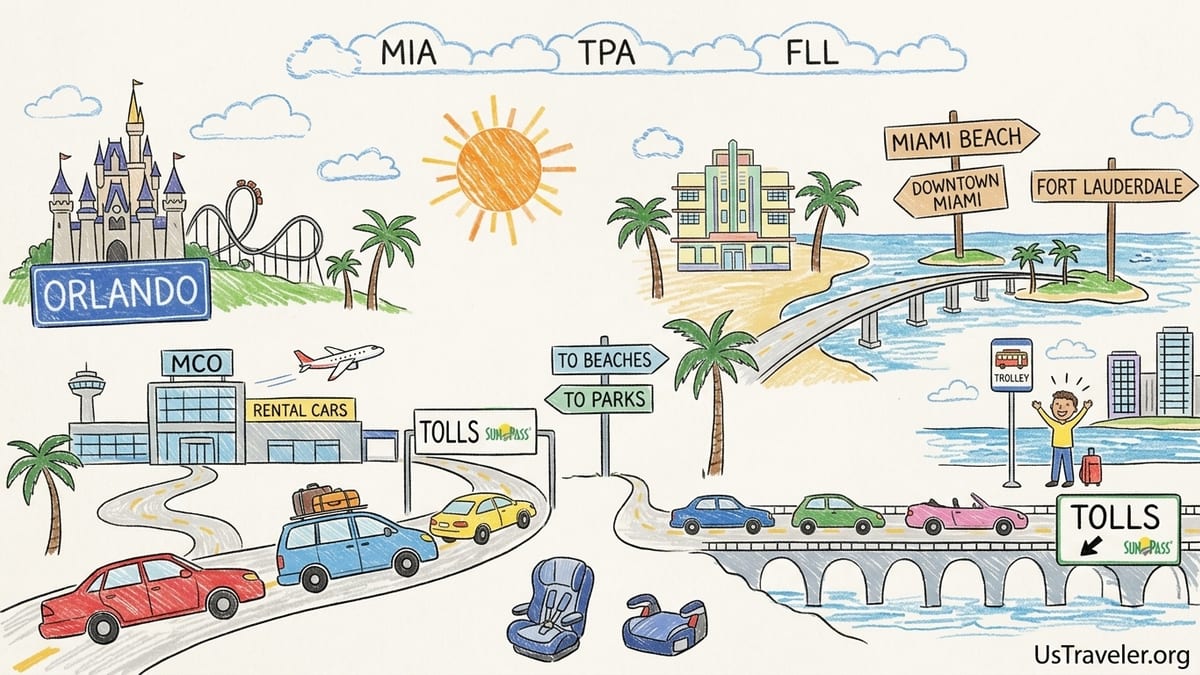
Where to Pick Up: Orlando vs Miami vs Fort Lauderdale vs Tampa
Most visitors fly into one of four major Florida gateways: Orlando International Airport, Miami International Airport, Fort Lauderdale-Hollywood International Airport and Tampa International Airport. All four have large on-site rental car centers, with brands such as Alamo, Avis, Budget, Dollar, Enterprise, Hertz, National, Sixt and Thrifty typically represented. At Orlando and Tampa, rental counters are inside or directly connected to the main terminal. At Miami and Fort Lauderdale, you usually ride a short airport people mover or shuttle to the consolidated rental center.
Airport pickup is almost always the most convenient option if you plan to drive immediately to a resort or another city. For example, landing at Orlando International in the evening and driving directly to a Disney-area hotel is far simpler if you collect your car at the airport rather than arranging a rideshare to an off-airport neighborhood office that might close at 5 or 6 p.m. Similarly, if your Miami flight arrives late and you are continuing to Key Largo the same night, collecting your vehicle at Miami International avoids an extra transfer.
Neighborhood locations around these cities, however, can be noticeably cheaper, especially for multi-day rentals. In Orlando, an off-airport location along International Drive or near Lake Buena Vista can sometimes price 10 to 30 percent lower than Orlando International’s on-airport rates. In Miami and Fort Lauderdale, small locations in Doral, Coral Gables, Hollywood or downtown Fort Lauderdale may be less expensive than the airport center, and they often serve locals with lower demand on weekdays.
The trade-off is logistics. To use a neighborhood location, you may need to take a rideshare or hotel shuttle from the airport, and you must match your arrival time to the office’s opening hours. This works well if you plan to spend a car-free day or two in Miami Beach or downtown Orlando and only need a car later for a day trip. It is less ideal if you are landing with luggage, kids and a long drive ahead.
Understanding Florida Tolls, SunPass and Rental Toll Programs
Florida runs one of the most extensive toll-road networks in the United States, especially around Orlando, Tampa and South Florida. Key routes such as Florida’s Turnpike, the Beachline Expressway near Orlando, the Selmon Expressway in Tampa and the Dolphin and Airport expressways in Miami use electronic tolling. Many plazas no longer accept cash and rely on transponders such as SunPass and other compatible devices, plus a camera-based toll-by-plate system for vehicles without a transponder.
SunPass is the state’s prepaid toll program and is widely accepted on toll roads and some airport parking facilities. Drivers using SunPass or compatible passes generally pay the lowest toll rate. If a car without a transponder uses an electronic toll lane, cameras capture the license plate and the toll converts to toll-by-plate, where a bill is sent to the vehicle’s registered owner. In the case of rental cars, that means the rental company receives the bill, then passes the charges to you with added administrative fees.
Most major rental agencies in Florida sell their own toll packages. A common structure is a per-day convenience fee plus the actual tolls, such as roughly 10 to 15 dollars per day of toll usage with a weekly cap, though amounts vary by company and can change frequently. For a week spent driving daily between Orlando theme parks and the Space Coast, this convenience can easily add 70 dollars or more in fees on top of the underlying tolls.
Visitors who want to control costs increasingly bring or buy their own toll transponder. SunPass Pro and other compatible passes can be purchased at retailers such as supermarkets and pharmacies, then linked to the rental’s license plate in the account, usually by selecting a specific rental-car option and end date. In Orlando, a free program called Visitor Toll Pass is available to renters picking up cars at Orlando International; it lets visitors pay tolls at local transponder rates without daily rental-company fees, making it attractive for week-long Orlando road trips. Whichever option you choose, decide before you hit the first highway ramp out of the airport, since one unplanned toll can trigger a day of rental-company fees.
Comparing Airport and City Parking in Orlando, Miami, Fort Lauderdale and Tampa
Parking costs can significantly affect the value of renting a car, especially in urban cores and at resorts. In downtown Orlando, city-operated garages typically charge around 2 dollars per hour with a maximum in the mid-teens per day, and surface lots often advertise flat event rates. Tampa’s municipal garages and lots tend to be in a similar ballpark, with several locations used by visitors heading to the Riverwalk, Channelside area or Ybor City. These prices can be modest compared with parking in many major U.S. downtowns, which makes self-driving attractive for families staying in central hotels or day-tripping into the city.
Miami and Fort Lauderdale tell a different story. In downtown Miami and popular neighborhoods like Brickell or Miami Beach, hourly street parking often starts around 3 dollars, and hotel overnight valet or self-parking commonly runs between 30 and 50 dollars per night at midrange and upscale properties. Fort Lauderdale’s beachfront resorts also lean on daily parking charges, although they can be slightly lower than Miami Beach’s top-end rates. If you plan to spend most of your time walking, Ubering or using trolleys in these dense districts, a parked rental car can quickly turn into an expensive liability.
Airport parking intersects with tolls as well. Several Florida airports, including Orlando, Tampa, Miami and Fort Lauderdale, allow compatible toll transponders such as SunPass to pay for parking directly at airport garages. This is mostly relevant to Florida residents using rental cars occasionally, but it also illustrates how deeply integrated toll technology is with everyday driving in the state. For visitors, the bigger financial decision is often whether to park at all. In Miami, it can be cheaper to return your car before a multi-night stay on Miami Beach, then rent again later for a drive to the Keys or Everglades.
For coastal towns like Clearwater, St. Pete Beach or Cocoa Beach, parking pressure varies by season. In winter high season and on spring-break weekends, municipal lots near popular beaches can fill early and often charge flat daily rates. Planning your arrival before mid-morning and budgeting for a daily beach parking fee of around 10 to 30 dollars, depending on locality and season, helps avoid surprises.
Insurance, Child Seats and Choosing the Right Vehicle Class
At the rental counter, the most expensive choices often come not from the base rate but from add-ons such as insurance and child seats. In Florida, collision damage waiver and liability coverage are commonly offered at the counter. Many U.S. visitors rely on their personal auto policies for liability and on credit-card benefits for collision coverage, but travelers from abroad often do not have equivalent coverage and may need to buy one of the agency’s protection bundles. If you are flying in from overseas, it is worth pricing packages that include basic insurance upfront rather than adding coverage ad hoc at the counter.
Florida law requires appropriate child restraints for young passengers. Children up to age three must ride in a separate child seat or an integrated manufacturer child seat, while older children must use a booster or other approved device until they meet state age and size thresholds. Rental companies will happily provide infant, child and booster seats for a daily fee, which can add up quickly on a long vacation. For a family spending 10 days visiting Orlando and the Gulf Coast, renting two child seats at a typical rate of around 10 to 15 dollars per seat per day can easily cost 200 to 300 dollars, which often exceeds the cost of buying basic seats on arrival at a big-box store.
Vehicle choice should match your route and season. For an Orlando-only vacation where you mainly shuttle between theme parks, a midsize or full-size sedan is usually sufficient and often cheaper on fuel and base rate. For a multi-family Gulf Coast road trip, a minivan or three-row SUV provides more luggage space and comfort, especially if you are carrying strollers and beach gear. Along Florida’s coasts, convertibles are popular, particularly for Miami to Key West drives, but they typically come with higher rental prices and smaller trunks. If you are traveling with more than two people and large suitcases, a standard SUV may be more practical than a soft-top, even for a classic Keys road trip.
Season also matters. In the peak of Florida summer, with humidity, thunderstorms and strong sun, the appeal of a convertible can fade after an hour on Interstate 95 or the Turnpike. In contrast, during drier winter months, a convertible between Miami Beach and Key West or along A1A near Fort Lauderdale can be a memorable splurge. When pricing options, compare actual numbers. A convertible might be 20 to 50 dollars more per day than a midsize sedan, turning a long weekend into a noticeable budget bump, while a standard SUV can add 10 to 25 dollars per day over a compact car.
One-Way Rentals and Multi-City Florida Itineraries
Florida is particularly well-suited to one-way road trips. Common routes include flying into Miami and out of Orlando, or arriving in Tampa and departing from Fort Lauderdale after a loop up and down the Gulf and Atlantic coasts. Most major rental brands allow one-way rentals within Florida, but they often apply a drop fee, which can range from modest to significant depending on demand, distance and season. For example, it is not unusual to see a one-day Miami to Key West rental with a modest surcharge, while a longer multi-week one-way involving a busy airport at spring break can add a large fee.
Travelers frequently drive the Overseas Highway from Miami or Fort Lauderdale to Key West and then either return the car there and fly out, or drive back to the mainland. One traveler might find a deal around 50 to 100 dollars for a one-day one-way from Miami to Key West outside peak periods, while another in high winter season could see a drop charge almost matching the base rate. The most reliable strategy is to price several permutations: Miami pickup with Key West drop; Miami pickup with Miami drop after a round trip; and a split involving pickup in Miami and return in Fort Lauderdale or West Palm Beach.
Between Orlando and Miami, one-way rentals are common for visitors combining theme parks with South Beach or cruise departures. For instance, a family might arrive in Orlando, spend five days at Disney and Universal with a rental car, then drive to Miami to catch a Caribbean cruise, dropping the car at Miami International and flying home afterward. Within Florida, one-way fees on this corridor can sometimes be low during shoulder seasons because agencies need cars in both markets, but pricing can tighten during school holidays. Checking several brands and adjusting pickup or drop-off times by a few hours can change the fee structure.
Multi-city itineraries along the Gulf Coast also benefit from flexible rentals. A couple might fly into Tampa, drive south through Sarasota, Venice and Fort Myers, then return north via inland lakes and Orlando, returning the car there. Others might reverse the direction. Since Florida’s major airports are within a day’s drive of one another, rental companies are accustomed to these patterns, but it is always wise to confirm that your chosen rate explicitly allows one-way travel and to note any mileage limits, which are often unlimited within the state but may be restricted for certain vehicle classes.
When a Rental Car Is Essential: Keys, Gulf Coast, Everglades and Beyond
There are parts of Florida where a rental car is not just convenient but practically essential. The classic example is a Florida Keys road trip. The Overseas Highway between Key Largo and Key West is largely car-dependent, with limited public transportation and rideshare coverage that can be inconsistent outside the larger keys. Having your own car allows you to stop at John Pennekamp Coral Reef State Park near Key Largo, take detours into Islamorada for a late lunch, or linger at Bahia Honda State Park for sunset before continuing into Key West.
On the Gulf Coast, a rental car unlocks small beach communities and barrier islands that are not well served by rail or extensive bus systems. From Tampa, you can hop down to Clearwater Beach, St. Pete Beach, Anna Maria Island and Sarasota in a flexible loop, adjusting plans for weather and crowds. While some of these areas have local trolleys and limited bus routes, they rarely replace the flexibility of having your own vehicle, especially if you are carrying beach umbrellas, coolers and children.
The Everglades and Big Cypress regions also strongly favor self-drive. Airboat tours and boardwalks near Shark Valley, Everglades City and along the Tamiami Trail are spread out over long stretches of highway on the southern Florida peninsula. Organized day tours do exist from Miami and Fort Lauderdale, but they usually follow fixed itineraries and can be more expensive for families than simply renting a car for a day or two. With your own vehicle, you can visit multiple visitor centers, continue to the Gulf Coast at Naples or Marco Island, or divert back to Miami via different scenic routes.
For multi-city vacations that string together Orlando, the Space Coast, the Gulf Coast and South Florida, a rental car often becomes the backbone of the itinerary. You might land in Orlando, visit theme parks, then drive to Cocoa Beach and Kennedy Space Center, continue across the state on the Beachline and Turnpike to Fort Lauderdale, and finish with a couple of days in Miami Beach. In such cases, the flexibility, time savings and access to less touristy beaches and state parks typically outweigh the combined costs of rental, fuel, tolls and parking.
When You Can Skip the Rental: Urban Cores, Theme Park Bubbles and Cruises
Equally important is knowing when you do not need a car. In Miami Beach, especially South Beach, many visitors get by comfortably without driving. Hotels are clustered, the area is relatively walkable, and rideshares, taxis and local trolleys are widely available. Parking is expensive, and traffic can be frustrating on weekends and during events. If your plans center on the Art Deco district, beach time and dining along Collins Avenue or Ocean Drive, skipping the rental entirely for that segment can save hundreds of dollars in fees and stress.
Orlando’s theme park “bubble” can also be surprisingly car-optional. Larger resort complexes such as Walt Disney World and Universal Orlando run extensive internal transportation networks of buses, boats and monorails, and many off-site hotels provide shuttles to the main gates. Visitors who plan to spend most days within these resorts, especially those staying at on-property hotels, often find that a car sits unused in the parking lot. In this scenario, arranging airport transfers and then renting a car only for specific off-property excursions, such as a day at Kennedy Space Center or an outlet-shopping run, can make more sense.
In Tampa and Fort Lauderdale, cruise passengers frequently arrive the night before departure and stay in downtown or port-adjacent hotels. Both cities offer port shuttles, taxis and rideshares that make it possible to reach the ship without renting a car at all. For example, a traveler flying into Fort Lauderdale for a Caribbean cruise may find that an airport-to-hotel rideshare, a short ride to the port the next morning and a return trip at the end are cheaper and easier than renting a car they will barely use.
Even in car-oriented regions, short stays focused on a single neighborhood can be handled with rideshares, especially if parking at your hotel would cost more than your projected Uber or Lyft trips. As a rule of thumb, it is worth sketching out your likely local transport costs before booking. If you expect to make only one or two short trips per day within a compact area, rideshares or hotel shuttles may beat the combined expense of rental fees, insurance and parking.
The Takeaway
Florida rewards travelers who plan their car rental strategy as carefully as their hotel and flight choices. Selecting the right pickup point among Orlando, Miami, Fort Lauderdale and Tampa can shave meaningful amounts off your bill, especially when you weigh airport convenience against sometimes cheaper neighborhood locations. Once on the road, understanding how Florida tolls, SunPass and rental-company toll programs work can prevent a handful of expressway trips from quietly inflating your final invoice.
Matching your vehicle type to your itinerary, managing the real costs of parking, and deciding in advance when a car is essential and when it is optional all contribute to a smoother trip. A family driving between Orlando’s theme parks, the Gulf Coast and the Everglades will likely benefit from the freedom of a rental car. A couple enjoying four days in South Beach or a cruise passenger overnighting near the Port of Tampa may be better off relying on rideshares.
In the end, the best Florida car rental plan is the one aligned with your actual movements: rent the car for the days and places where it substantially improves your reach and comfort, arrange alternatives where it does not, and go into tolls, parking and one-way options with your eyes open. With that groundwork, the state’s highways, bridges and coastal byways become less of a logistical puzzle and more of an open invitation to explore.
FAQ
Q1. Is it cheaper to rent a car at Florida airports or from neighborhood locations?
Neighborhood locations around Orlando, Miami, Fort Lauderdale and Tampa are often cheaper, but airport rentals win for late arrivals and immediate long drives.
Q2. Do I really need a car in Miami Beach?
If you are staying mainly in South Beach and nearby, you can usually rely on walking, rideshares and local trolleys, since parking is costly and traffic heavy.
Q3. What is the best way to handle tolls on a Florida rental car?
Decide before you drive off. Either accept the rental-company toll program, bring or buy a compatible transponder like SunPass Pro, or use a local visitor pass where available.
Q4. Are one-way rentals between Miami and Orlando expensive?
They can be reasonable in shoulder seasons but may carry noticeable drop fees at peak times, so it is worth comparing several rental brands and travel dates.
Q5. Is a convertible worth it for a Florida Keys road trip?
A convertible is fun in cooler, drier months on the Overseas Highway, but it costs more and has limited trunk space, so larger groups may prefer an SUV.
Q6. Can I avoid renting a car for an Orlando theme park vacation?
Yes, if you stay at on-site resorts or hotels with park shuttles and plan few off-site activities, resort transportation and rideshares can replace a rental car.
Q7. How expensive is parking in downtown Orlando and Tampa compared with Miami?
Orlando and Tampa public garages are relatively moderate, while downtown Miami and Miami Beach hotels often charge much higher overnight parking rates.
Q8. What are my options for child seats in Florida rentals?
You can rent seats from the car company for a daily fee, bring your own if practical, or buy inexpensive seats locally for longer trips to save money.
Q9. Do Florida rental cars usually come with unlimited mileage?
Most standard rentals within Florida offer unlimited mileage, but specialty vehicles and certain promotional rates may have limits, so check your contract.
Q10. When is it better to rely on rideshares instead of renting a car?
For short stays focused on compact neighborhoods, cruises or high-parking-cost areas like South Beach, rideshares often cost less and require less hassle.