


Landing in Central Florida, many visitors assume renting a car is automatic. Orlando’s airports, toll roads and sprawling attractions can make driving incredibly convenient, but they also create plenty of opportunities to overspend on rental fees, toll programs and parking. This guide walks you through how to rent smart at Orlando International Airport, when to consider Sanford or off-airport pickups, what to do about tolls, where parking charges really bite, and when you can avoid a car altogether.
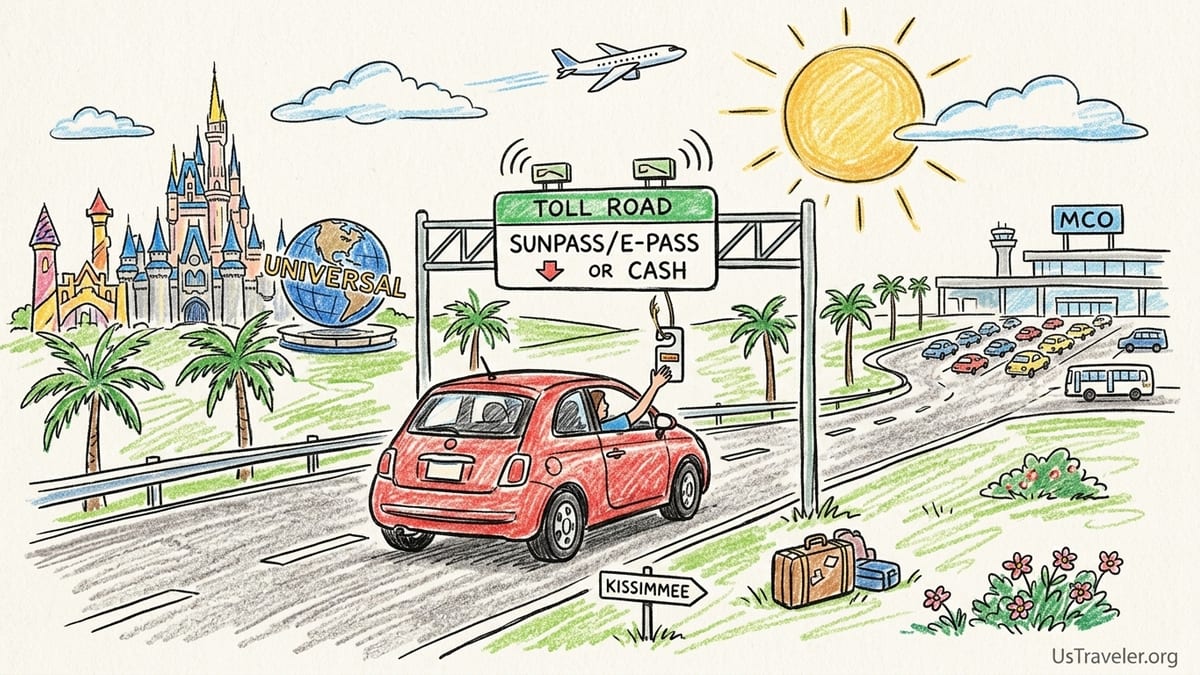
Understanding Orlando’s Car Rental Landscape
Orlando is built for drivers. Theme parks, outlet malls and vacation home communities sprawl across Orange, Osceola, Polk and Lake counties, and public transit is limited away from the core tourist zones. At the same time, Orlando International Airport (MCO) has one of the densest collections of rental counters in the United States, from the major brands to local outfits, plus off-airport agencies accessible by shuttle. That competition keeps base rental prices relatively low outside peak holidays, but the extras can quickly add up.
On a typical midweek in shoulder season, you might see compact cars from the major brands at MCO pricing in the range of 35 to 55 dollars per day before taxes and fees, with SUVs and minivans significantly higher. School holidays, Easter, summer and Christmas week can push prices far above that. Orlando Sanford International Airport (SFB), which serves many low-cost carriers, has on-site rentals too; daily rates there can be similar to MCO, but the smaller selection means less flexibility during busy periods.
Because Orlando is ringed with toll roads, including Florida’s Turnpike and expressways like SR 417 and SR 528, how you handle tolls may matter more to your total bill than whether you paid 5 dollars more per day for the car itself. Rental-company toll programs often add daily fees on top of each toll, while Orlando’s own Visitor Toll Pass at MCO lets you pay the same electronic rate locals pay without daily surcharges. Understanding these options before you step up to the counter is one of the most valuable money-saving moves you can make.
The other big variable is where you are staying. A family booked into a Disney resort with airport transfers included may barely use a car, while a group in a Kissimmee villa or Davenport townhouse will likely rely on one every day. Day trips to spots like Mount Dora, Winter Haven or Lakeland also become dramatically easier if you have your own wheels. The sections below break down what makes sense in each scenario.
Orlando International Airport: On-Airport vs Off-Airport Rentals
Orlando International Airport has a large consolidated rental center with counters for the major brands in Terminals A, B and C. For most travelers, picking up directly at MCO is the simplest option. After collecting your bags, you follow the signs to Rental Cars on the same side of the terminal and walk directly to the counter. The benefit is obvious: you avoid waiting for external shuttles with luggage and kids, and you can be on the road in 20 to 30 minutes if queues are reasonable.
However, the convenience is priced in. On-airport rentals often carry higher base rates and airport concession fees. Travelers who shop broadly sometimes find that an off-airport company advertising a similar car for 10 to 20 dollars less per day, plus a short shuttle ride from the terminal, comes out meaningfully cheaper, especially for longer stays. Orlando’s official airport site lists both on-airport brands and the off-airport companies that run free shuttles from MCO, so you can compare before you book.
When you pick up on-airport, expect a fairly standard process: you join the line, show your ID and credit card, confirm insurance choices, toll program options and any extras like child seats, then head to the garage level where vehicles are parked. Many big brands let loyalty-program members skip the counter and go straight to an assigned car row, which can save significant time at busy periods like Saturday mornings in summer.
With off-airport rentals, the procedure adds an extra step. After baggage claim, you follow signs to Ground Transportation and look for your agency’s shuttle pick-up point. Shuttles usually depart every 10 to 20 minutes and the ride to the lot can take 5 to 15 minutes depending on location. Once at the off-airport site, you complete paperwork and vehicle selection. Travelers who arrive late at night or with young children sometimes decide the savings are not worth the extra logistics, while budget-conscious visitors on longer trips often find an off-airport pickup makes sense.
Visitor Toll Pass, SunPass and Rental Toll Programs
For most Orlando visitors, tolls are unavoidable if they use major expressways between the airport, theme parks and surrounding cities. The crucial decision is how you pay. Rental companies typically offer their own electronic toll programs that activate a transponder hidden behind the rearview mirror or use automatic license plate billing. These programs charge the actual tolls plus a daily administrative fee which often runs in the 4 to 15 dollar range for each day you incur even one toll, often capped at a certain number of days per rental. Over a week, that can easily add 40 to 100 dollars to your bill in fees on top of the tolls themselves.
Orlando International Airport offers a powerful alternative: the Visitor Toll Pass. This is a free temporary toll transponder designed for rental-car drivers picking up and returning at MCO. You reserve it in advance through the dedicated app, then after landing you scan a QR code at vending machines located near the rental car counters on Level 1 in Terminals A and B or on the appropriate level in Terminal C. You hang the pass on your rearview mirror, register your rental’s license plate in the app and drive as normal.
With Visitor Toll Pass, your tolls are charged to your linked credit card at the same discounted electronic rate that local SunPass users pay, with no daily rental-program fee added. Travelers often report savings of 20 to 50 dollars or more over a week compared with their rental company’s toll package, particularly if they are using toll roads most days. The key limitation is that Visitor Toll Pass currently works only for round-trip rentals that begin and end at Orlando International; it is not available at Orlando Sanford or Tampa, and you must remember to drop the pass back into a designated return box at MCO before you fly out.
Another option is to bring or buy your own portable transponder, such as a SunPass or E-PASS unit. SunPass and E-PASS are widely accepted on Florida toll roads, and SunPass now offers tags compatible with E-ZPass roads in the northeastern United States. Visitors who drive in Florida regularly sometimes purchase a portable SunPass or E-PASS from local retailers like supermarkets or gas stations and link it to a prepaid account. You then add your rental car’s license plate for the exact dates of your rental. This method can work well, but it requires more setup, and you must ensure that the rental company’s toll device is not active, to avoid double billing.
Parking Realities at Disney, Universal and Beyond
Parking is one of the easiest Orlando costs to underestimate. At Walt Disney World’s four main theme parks, standard self-parking now costs around 35 dollars per day for cars and motorcycles, with preferred parking closer to the entrances priced higher. Guests staying at Disney-owned resorts currently receive complimentary standard parking at the parks, which significantly changes the math for those visitors. A family driving in from a Kissimmee vacation home for four park days, by contrast, might spend 140 dollars or more on parking alone, on top of fuel and tolls.
At Universal Orlando Resort, regular self-parking at the main garages serving the theme parks is similarly in the mid-30 dollar range per car in 2026. Universal offers free regular self-parking in the evenings after a certain time for guests visiting only CityWalk, which is useful if you are driving in for dinner and entertainment rather than a full park day. Overnight parking at Universal hotels and nearby partner properties generally incurs additional nightly fees, which can run in the 30 to 40 dollar range plus tax, so always factor that into your accommodation budget if you plan to have a car.
Other Central Florida attractions vary. Many off-site hotels in the International Drive and Lake Buena Vista areas charge nightly parking and resort fees, while some Kissimmee and Davenport vacation homes include driveway parking at no extra cost. Smaller attractions and shopping centers usually offer free parking, although some popular spots near International Drive or downtown Orlando may charge for garages or event parking on busy nights.
In practical terms, a family of four staying in a Disney resort might find that using Disney’s complimentary bus, monorail and Skyliner systems makes more sense than driving to the parks every day, especially if they would be paying daily parking anyway. By contrast, a group in a townhome south of US 192 often needs a car to get almost anywhere, so the added cost of parking becomes just one component of an already necessary vehicle.
Kissimmee, Davenport, Mount Dora, Winter Haven and Lakeland
Where you stay in Central Florida dramatically influences how useful a rental car will be. Visitors based in Kissimmee, particularly along US 192 and in the neighborhoods off Osceola Parkway, often rely heavily on rental cars. While some resorts run limited shuttles to Disney and Universal, they rarely cover grocery runs, restaurant nights along 192, or early-morning rope-drop arrivals at multiple parks. Many villas and townhomes in neighborhoods like Emerald Island, Windsor Hills or ChampionsGate are essentially car-dependent.
Davenport, farther south along US 27 and I-4, is even more car oriented. Large vacation home developments there attract budget-conscious families and long-stay guests, but ride-hailing waits can be long at peak times and fares surge after fireworks. A typical day might involve driving 25 to 40 minutes each way to the parks, using roads that may include toll segments depending on your route. For these travelers, a rental car is more or less essential, and choosing the right toll payment method can make a meaningful difference over a two-week stay.
Adding day trips to Mount Dora, Winter Haven or Lakeland further increases the value of having your own vehicle. Mount Dora, with its lakeside downtown, antique shops and festivals, lies northwest of Orlando and is awkward by public transit or ride-share, especially for families or couples who want flexibility to stop at small towns along the way. Winter Haven, home to Legoland Florida, and Lakeland, with its historic downtown and spring training baseball, sit along or near the I-4 corridor between Orlando and Tampa. While some organized tours reach Legoland, most visitors prefer the freedom of a rental car to time their arrival for opening and leave when kids tire out.
For example, a family staying in a Davenport vacation home and planning two days at Legoland plus an afternoon in Mount Dora would struggle to rely solely on ride-share. Individual rides to each destination could easily cost as much as or more than several days of a compact car rental when you factor in return journeys and potential surge pricing. In this scenario, picking up a car at MCO and using Visitor Toll Pass to handle tolls at local rates is usually the smartest choice.
Child Seats, One-Way Rentals and When You Can Skip the Car
Traveling with children introduces extra rental considerations, starting with car seats. Most major rental companies at MCO and SFB offer child safety seats and booster seats for an additional daily charge, commonly in the 10 to 15 dollar per day range with a per-rental cap. For a week-long stay, that can add 70 to 100 dollars per seat. Many parents therefore prefer to bring their own seats on the plane, both to save money and ensure familiar equipment. Airlines serving Orlando typically allow car seats to be checked free or brought on board if the child has a separate seat, but you should confirm current policies with your carrier.
If you do rent a child seat, inspect it carefully at pickup. Make sure the manufacture date is within the recommended lifespan, that there are no cracks or missing parts and that the harness adjusts smoothly. Do not hesitate to request a different seat if the first one seems worn or dirty. Installation can be more challenging in unfamiliar cars, so budget a few extra minutes at the rental garage before you drive away to install seats securely.
One-way rentals are another factor. Some visitors land in Orlando, drive to the coasts or down to South Florida, then fly home from a different airport. Major agencies often allow one-way rentals between popular Florida cities, but drop fees can be significant, especially if you are returning the car in another state or at a smaller location. For example, a one-way from Orlando to Miami might carry a moderate fee, while a drop in a smaller Gulf Coast town or out-of-state airport could cost substantially more. Always price out the full itinerary, including drop charges and tolls on long drives, before committing.
There are also situations where you can skip the car entirely. Guests staying at a Disney resort with included airport transfers or access to third-party shuttle services may find that Disney’s internal transport plus occasional ride-shares covers everything they need, especially for a short, park-focused trip. Similarly, visitors booked at a Universal Orlando hotel that includes shuttle or water taxi service to the parks can combine airport transfers, on-site transport and ride-share for off-property meals or shopping, avoiding rental fees, tolls and parking charges altogether.
Orlando Sanford Airport and Off-Airport Pickups
Orlando Sanford International Airport, north of the city, serves many charter and low-cost carriers. Its car rental center is smaller than MCO’s but still hosts several major brands with counters inside the terminal and cars in nearby lots. For travelers whose flights arrive at Sanford, renting directly there is usually the simplest option, since public transport options into Orlando’s tourist areas are limited and ride-share fares to Disney or Universal can be high compared with the cost of several days’ car rental.
At Sanford, the rental process mirrors that at MCO on a smaller scale. You collect your luggage, walk to the rental counters, complete paperwork and walk out to the lot to select or locate your car. Because Sanford serves many package holiday flights, queues can be heavy when multiple international arrivals land close together, so it pays to have your license, credit card and reservation ready and to decide in advance about insurance and toll options.
Off-airport rentals around Orlando’s tourist corridors can also make sense in some cases. For example, a couple spending their first three days at a Universal hotel might rely on hotel transport and ride-share, then pick up a car from an off-airport branch near International Drive for a later road trip to the Gulf Coast. Neighborhood rental locations sometimes price lower than the airport due to reduced concession fees, although selection may be limited to smaller cars. In practice, this approach works best for longer stays where you can neatly divide your trip into a “no-car” segment and a “road-trip” segment.
One important detail: the MCO-only Visitor Toll Pass is tied to rentals that begin and end at Orlando International, so if you are collecting a car elsewhere, you will either use the rental company’s toll program or bring your own transponder option such as SunPass or E-PASS. Build that into your calculations when weighing an off-airport pickup against the simplicity of stepping into a car directly at MCO.
Real-World Trip Scenarios and Cost Comparisons
To understand how these pieces fit together, it helps to look at concrete examples. Consider a five-night trip for a family of four staying at a Disney resort, planning four park days and little else. If they rent a car at MCO, they will pay the daily rental rate, fuel, and potentially tolls on the drive between airport and resort, but they will not pay for parking at the Disney parks. If they instead use a shuttle or ride-share from the airport and rely on Disney buses and monorails, they might only call ride-shares for a grocery run or an off-site dinner. In this very park-focused scenario, the convenience of a car might not justify the cost, especially if rental prices are high for their dates.
Compare that with a two-week stay in a Davenport vacation home, where the family plans multiple days at Disney and Universal, a day at Legoland in Winter Haven, an outlet shopping trip and a side visit to Mount Dora. Renting a car at MCO with Visitor Toll Pass, they will pay the rental rate, fuel, Disney and Universal parking and tolls at local electronic rates with no extra daily fee. Attempting the same itinerary on ride-share alone would likely see individual trips to and from Davenport regularly topping typical daily car rental costs, with the added inconvenience of securing child seats and waiting for drivers at late hours.
A third scenario might involve a couple visiting primarily Universal Orlando and International Drive for four nights, then heading to the Gulf Coast for another four nights. They could take a ride-share from MCO to their Universal hotel, rely on Universal’s transport and walking paths for four days, then pick up a midweek rental from an off-airport branch near I-Drive to drive to the coast and eventually back to MCO. In this case, paying for a car only for the road-trip half of the vacation can trim hundreds of dollars in rental fees and parking charges at Universal.
Finally, a traveler flying into Sanford for a long stay in a Kissimmee villa has different considerations. With fewer airport transfer options and a base deep in vacation-home territory, they are almost certain to need a car. Here, the best strategy is often to rent directly at Sanford, decline high-fee toll programs if possible, and either avoid toll roads altogether or bring a personal transponder solution if allowed by the rental company. Although Visitor Toll Pass is not available at Sanford, understanding the fee structure of the agency’s toll plan and planning routes in advance can still prevent bill shock at the end of the trip.
The Takeaway
Navigating Central Florida by car is not difficult, but doing it cost-effectively requires planning around three key areas: where you rent, how you pay tolls and where you park. Orlando International Airport offers the broadest rental choice and a major advantage in the form of Visitor Toll Pass, which allows on-airport renters to pay the same electronic toll rates as locals without daily rental-company fees. Sanford and off-airport locations can also work well when tied to your specific flight and accommodation plans.
Think carefully about your base. Travelers staying in car-dependent areas like Kissimmee, Davenport or along US 27, or those adding Mount Dora, Winter Haven or Lakeland to their itineraries, almost always benefit from a rental car. Guests staying at Disney or Universal resorts for short, park-centric visits may find they can skip the car altogether and rely on included transport and occasional ride-shares. Add up rental rates, toll handling, and parking at Disney and Universal before you book, and you will be in a strong position to choose the option that fits both your budget and your style of travel.
FAQ
Q1. Do I really need a rental car if I am staying at a Disney resort?
If your trip is mostly Disney parks and Disney Springs, you can often skip a rental. Disney’s internal transport network covers the parks and many hotels, and you can use ride-share for occasional off-site meals or shopping. A car becomes more useful if you plan frequent off-property excursions or day trips to places like Legoland, Mount Dora or the coasts.
Q2. How does Visitor Toll Pass at Orlando International Airport work in practice?
You reserve Visitor Toll Pass through its app before your trip, then after landing at MCO you scan a code at a dedicated machine near the rental counters to collect the hangtag. You attach it to your rental car’s mirror, update the plate number in the app and drive as normal. All tolls you incur are billed to your card at the standard electronic rate, with no daily rental-program fee, and you return the pass in a drop box at the airport when you depart.
Q3. Can I use Visitor Toll Pass if I am flying into Orlando Sanford or Tampa?
No. Visitor Toll Pass is currently limited to round-trip rentals that both start and end at Orlando International Airport. If you are using Sanford, Tampa or another Florida airport, you will need to rely on your rental company’s toll program, avoid toll roads or bring your own compatible transponder such as SunPass or E-PASS where allowed.
Q4. Are rental company toll programs ever worth it?
They can be worth it for short trips with heavy toll usage, such as a weekend involving multiple daily drives on Florida’s Turnpike or expressways, especially if you prefer maximum simplicity. However, because these programs add daily fees on top of the actual tolls, they often become expensive on longer stays. At MCO, Visitor Toll Pass usually provides better value, while frequent Florida visitors may prefer a personal SunPass or E-PASS transponder.
Q5. How much should I budget for parking at Disney and Universal?
For 2026, expect standard parking at Disney’s main theme parks and Universal’s garages to cost roughly mid-30 dollars per day for a car, with higher rates for preferred spaces and oversized vehicles. If you visit for several park days, these fees can add up quickly. Guests staying at Disney hotels receive complimentary theme park parking, while Universal hotel guests still pay nightly parking charges at most properties.
Q6. Is it better to rent a car at the airport or from an off-airport location?
Renting at the airport is most convenient because you avoid shuttles and can be on the road quickly. Off-airport locations sometimes offer lower base rates and avoid some airport concession fees, which may save money, especially for long rentals. The trade-off is extra time and logistics for shuttle rides or ride-shares to the off-airport office, and potentially reduced vehicle selection.
Q7. What should families know about renting child seats in Orlando?
Most agencies rent child seats and boosters for an extra daily fee that adds up over a week or more. Many families choose to bring their own seats on the plane to save money and ensure a model they trust. If you do rent, check the seat’s condition and age label at pickup and take a few minutes at the garage to install it securely before leaving the airport.
Q8. Are one-way rentals between Orlando and other Florida cities straightforward?
Major rental brands typically allow one-way rentals between popular Florida destinations such as Orlando, Miami, Tampa and Fort Lauderdale, but they often add a drop fee to the base rate. This fee can be modest for moves between big-city airports and higher for smaller or out-of-state locations. Always obtain a full price quote, including drop charges and taxes, before deciding on a one-way itinerary.
Q9. When is it cheaper to use ride-share instead of renting a car?
Ride-share can be cheaper for short, concentrated stays where you mostly stay on one resort property and make only a few off-site trips. For instance, a three-night Universal hotel stay with just airport transfers and one outlet mall outing might cost less in ride-share than several days of rental, tolls and parking. Once you start making daily off-site journeys or staying in villa communities like Kissimmee and Davenport, a rental car usually becomes more economical.
Q10. What are the main toll roads around Orlando I should be aware of?
Common toll routes include Florida’s Turnpike, SR 417 (Central Florida GreeneWay), SR 528 (Beachline Expressway), SR 429 (Western Beltway) and Osceola Parkway. Many visitors use these roads traveling between MCO, Disney, Universal, International Drive, Kissimmee and Davenport. Planning your toll payment method in advance, whether Visitor Toll Pass, personal transponder or a rental program, helps you use these expressways without unpleasant billing surprises.